Author: Nebula Walker Date: 01SEP2026 MYTHOGEN ENGINE (mythogenengine.com)
📌 Seven days of writing, from the 'no sympathy' years of corporate consulting, a farm under the Milky Way, a blank check from the Akashic Records, to a year of quiet standstill and the readjustment of presbyopic eyes. A candid introspection piercing the veneer of spirituality to confront an unorganized inner space.
Seven-Day Book | Body, Mind, and Spirit | Day 1 | No Sympathy
Seven-Day Book | Body, Mind, and Spirit — Day 1: Write about something you thought you had long let go of, but which still secretly aches.
I thought I had long put that sentence behind me.
It was spoken many years ago by a senior mentor who trained me in management consulting. Back then, I had just transitioned from the front lines into corporate strategy — journeying from R&D, field applications, and technical marketing all the way to walking the factory floor and watching how acquisitions were executed on the ground.
He taught me how to construct the numbers. How to scrub a company's balance sheet clean: collect every penny of accounts receivable, compress payables to the absolute floor, prune away redundant liabilities, make the financial metrics gleam, and position it to command a handsome price. Because if many of these companies were simply liquidated on the spot, the losses would cut right to the bone. The greatest value a consultant offers is making an ending appear dignified.
Yet he taught me something else at the same time.
He said: "The people down below — no matter how heartbreaking their stories sound, don't listen, don't pay attention, and don't sympathize. They are just numbers. The moment you sympathize with them, you can't get your job done. And then you will become one of them. Once you become one of them, there is no turning back."
I was young then. I believed this was what professionalism looked like.
I have always been a deeply inquisitive person, obsessed with how the world truly functions.
As a child, I wandered in and out of our family business, watching how my father and older brother managed affairs. Business was the eternal centerpiece of the dinner table. It was traditional Chinese family-style management — not the antiseptic diagrams in textbooks, but a living ecosystem of human favors, political maneuvering, and unwritten, tacit rules. I thought I was merely observing from the sidelines, catching fragmented glimpses, seeing individual trees rather than the forest.
Later, entering the workforce, my first job was as a researcher in Australia. What puzzled me was: why do things proven in R&D so rarely manage to transform into actual commercial products? Where is the fracture between theory and reality? Later, I pivoted to the front lines — FAE, AE, technical marketing, sales support. Each station offered me a look through another layer, yet every perspective remained an outside view looking inward.
I still had no idea what was really being orchestrated behind the curtain.
So I made a monumental choice: transition into strategic consulting, enter the manufacturing plants, and witness what actually transpired inside those facilities after an acquisition was signed.
Whether in Australia or the United States, when you look at these operations from the top down, all you see are numbers. You cannot see the cutthroat slaughter on the execution floor. You cannot see the genuine human faces behind the headcount.
My younger self ignored all of that completely. It simply wasn't my responsibility to care.
Until I sat squarely in that seat myself, and began looking directly into those faces.
After taking over an acquired firm, nobody issues an overt, sweeping layoff decree — that looks too crude, and the severance costs are far too high. What management needs is to achieve a targeted quota of "natural attrition" in a compressed window. It never needs to be written into company policy. The playbook can be ruthlessly simple: group three to six people into a team, pit them against one another to file complaints and monitor peers, reward the whistleblowers, punish the reported, and let them tear each other apart. The attrition quota is reached in no time. And that is only one trick among many.
Yet the most chilling phenomenon I witnessed was not people being coerced into leaving. It was people actively cooperating in the coercion.
They weren't devoid of conscience. They had simply learned how not to let their conscience flare up like an allergy. To pay their mortgages, to preserve their middle-class lifestyle, to secure their children's future — whether these were valid reasons or convenient excuses — they conformed to the company's choreography, fell in step with the restructuring tempo, and abetted the corporate gaslighting. The enterprise never explicitly commanded them to act like this. But the financial targets demanded results. Under relentless pressure, people spontaneously turned into their own executioners.
Every single company, every single acquisition, inexorably converged toward the exact same outcome.
I always wanted to maintain the vantage point of a detached observer.
Yet the reality was far more humiliating than mere observation. It wasn't that I was oblivious to the rot. I knew it intimately, but chose silence. Occasionally I raised my voice, to zero effect. Have you ever tried standing your ground and arguing the merits with a corporation in the middle of being dismantled and absorbed? You decipher its bottom line, exhaust your energy grappling with its bureaucracy, only to realize — you should have known from the beginning that the game was rigged. You wanted to believe its restructuring was more than just engineering two sets of numbers for an exit sale. Yet every single time, your trust was misplaced.
Over the past decade and more, there was one rare exception. For four or five years, I worked at an American racing components firm with a defense background. Its books were clean; there was no need to fabricate financial narratives. Those years showed me what a healthy, normal organization felt like. But precisely because I had seen what was normal, whenever I returned to the other corporate mandates, I could no longer pretend not to see what was broken.
Regrettably, that company eventually ceased operations as well. And for the rest of my career, I was thrown back into the same grinding cycle.
Not knowing the whole picture was never the real issue. The issue was that I knew more than enough, yet chose silence.
And if you deliberately look for it, you will find it every single month — two or three people whose descent into an inescapable corner you can trace step by step. The ones you never find out about vastly outnumber them. And then you realize: you dare not look any further. Out of sight, out of mind. Not just you, but the entire fabric of society operates this way. Those who haven't perished are perhaps simply trapped in chronic depression, stranded where no safety net can catch them; their suffering remains unseen, fading into quiet erasure. How do you grant yourself peace of mind? Don't dwell on it. Don't look for it. But because you refuse to think or look, does that mean it ceased to exist?
That phrase — "No sympathy" — I foolishly believed I had digested and dissolved long ago. I thought I had neutralized it with dozens of rigorous articles, meticulous analyses, and dispassionate systemic frameworks. How capital strips away enterprise value — I have written it. How macroeconomic cycles dictate who gets discarded — I have written it. How systems rationalize systemic erasure — I have documented that too. Every single essay sharp, every single sentence ice-cold.
Yet that very precision, that absolute chill — those were the exact techniques that phrase instilled in me.
It was never a piece of friendly advice. It was a tradecraft. And I mastered it brilliantly. So brilliantly that I convinced myself I had broken free. In truth, I had merely draped "No sympathy" in a more respectable, scholarly garment, christening it "structural analysis."
Only today did I finally hear the truth of what I have been doing: I was never merely analyzing the machinery. Through the very act of analysis, I was continuing to execute that phrase.
That is why it has never stopped aching. Because it was never laid to rest. It was simply co-opted.
Seven-Day Book | Body, Mind, and Spirit | Day 2 | The Milky Way
Seven-Day Book | Body, Mind, and Spirit — Day 2: Write about a moment you envied someone else, where that envy illuminated your inner longing or lack.
What I envy has never been a life of wealthy rural leisure. It is a rural life entirely freed from the anxiety of money.
These two ideas may sound interchangeable, but in reality they are worlds apart. You don't need opulent luxury. You merely need not to fear a failed harvest, nor dread that stormy seas will keep your fishing boat ashore. To be able to live ordinary countryside days with an unburdened mind — that is already more than enough.
While studying in Australia, I once traveled to a winery and farm. They kept bees, made wine, raised horses, and tended livestock. There were two teenagers on the property, around sixteen or seventeen years old. Their holiday routine consisted of riding horses and herding sheep. The horses were retired thoroughbreds; unable to race anymore, they ambled quietly along with riders on their backs.
At night on the farm, the stars shone with staggering brilliance — so bright that you could distinctly trace the sweep of the Milky Way. That kind of celestial canopy is something I have only ever witnessed in deep overseas countryside.
They didn't watch television. They listened to music and strummed guitars. They ate what they grew from the earth, and drank what they fermented from their own grapes. The estate was vast; though living in timber cabins, cooking and dining possessed a serene spaciousness. Just contemplating that kind of life fills the chest with ease.
Later, working in the United States, an old colleague of mine lived in a small rural pocket in Florida, near Daytona.
He recounted how land there had once been dirt cheap. Before developers arrived, locals bought up tracts and built their homes. He and his son each owned a spacious timber lodge, backing onto a lake so vast you could row a boat or cast a fishing line. Ducks waddled along the water's edge — not domesticated, but he fed them anyway, and occasionally caught one for dinner.
The entire village had perhaps a hundred residents. A single street, so short I reckon the whole hamlet was smaller than the Golden Computer Arcade in Sham Shui Po. There was only one local bar and one modest bookstore. If you wanted a drink, you went to that bar — because there were no other options. The bookstore primarily ordered titles upon request; you could purchase whatever the owner was currently reading, alongside secondhand paperbacks and basic sundries. A few small diners operated with storefronts below and residences above.
Does it sound desolate? Not in the slightest. A ten-minute drive delivered you to shopping malls, movie theaters, and a GameStop. Orlando was roughly an hour away. On weekdays you enjoyed deep tranquility; whenever you craved urban energy on weekends, you simply drove in. The distance struck a perfect balance.
I found that place utterly sublime. What made it so magnificent? Vast open space. Sparse crowds. Clean, uncluttered human relations.
To be fair, breathtaking skies are not exclusive to foreign shores. I witnessed similarly magnificent skies during a journey to Taitung, accompanied by an unforgettable sunrise. Escaping there for two or three days on vacation genuinely unwinds the nerves, allowing one to taste that rhythm of life in passing.
Yet savoring two or three days of relaxation is a world away from truly living that existence day in, day out.
Even if one's children grow up to establish their own homes, being able to retire into that unadorned pastoral rhythm would be a blessing. Not a lavish retirement by any means, just living plainly. But the reality is: you cannot retire yet, and you cannot reach that unhurried sanctuary.
Moreover, living in America adds another precarious layer. I am not an American citizen. If you lose your job and cannot secure another within three months, you are essentially forced to pack your bags and leave. Salaries may be high, but relocation expenses, tax burdens, visa vulnerabilities — those who have never worked in America cannot easily comprehend these pressures. You imagine you have settled down, when in fact you are merely a transient guest. The kind who could be compelled to depart at any given moment.
So that pastoral existence remains something I can behold from afar, yet never reach out and touch.
Writing down these reflections, I finally realize that what I envy is far more than orchards, lakes, or starry skies.
What I truly envy is a clean, direct relationship with the world: you eat what you cultivate, you drink what you ferment, you ride the horse you tend, and the ground beneath your feet belongs genuinely to you. Between your labor and your living, there are no middlemen, no accounting ledgers, no manufactured financial facades. You have no need to massage balance sheets to make a company look pristine for an M&A deal, no need to watch good people being steadily crushed by corporate machinery, and no need to school yourself in the cold art of "No sympathy."
All you need to do is feed the ducks, cast your fishing line, wait for dusk to fall, and watch the stars.
The inner deficit illuminated by that envy is perhaps not that I lack an acreage of farm. It is that I have ventured far too deep into the gears of the corporate machine to ever return to that primal simplicity. Even if I were one day to purchase a timber cabin and keep a flock of ducks — the numbers etched in my mind, the haunted faces, the systemic cruelties I deliberately trained myself to overlook, would not magically evaporate simply because the night sky is magnificent.
What I envy are those who were never burdened with knowing these things in the first place.
When they gaze up at the stars, their hearts remain utterly clean.
Seven-Day Book | Body, Mind, and Spirit | Day 3 | A Check with No Amount
Seven-Day Book | Body, Mind, and Spirit — Day 3: Describe a moment when you felt "held" or caught by a power greater than yourself.
Some call it an out-of-body experience. I am not certain whether the terminology is scientifically accurate, but I have found no vocabulary more precise.
The first time it occurred was in 2013. I underwent an intestinal surgery; the procedure itself was unremarkable, and once the anesthesia receded, I returned home. But upon arriving home, the exhaustion was overwhelming, and I sank into an exceptionally deep sleep. That single slumber, which spanned only twenty-four hours in waking time, felt subjectively as though an entire year had elapsed.
Under extreme physiological strain, the human brain is capable of compressing time — or perhaps constructing a potent temporal illusion, allowing you to traverse sprawling, epic dreamscapes within a narrow sliver of biological rest. The specific dream from that episode, I will leave aside for now.
What I want to recount took place in June 2025.
I had contracted COVID-19. By coincidence, I was recently unemployed. My wife and child had returned to Hong Kong to visit family, leaving me entirely alone in the house. I switched off every electronic device, surrendered myself to sleep, and collapsed into bed for three straight days.
During those three days, I lived through three full years inside a dream.
In the dream, my physical body remained motionless on the mattress, yet a distinct aspect of my consciousness drifted outward. It drifted to a realm beyond.
That place contained things I had recognized in waking life, alongside dimensions of reality I had never encountered. Later, when researching the experience, I discovered that esoteric traditions refer to such a space as the "Akashic Records." Is that name authentic? I cannot say. But that realm held vast troves of knowledge. Some insights, upon waking and empirical verification, proved astonishingly accurate; others I have still been unable to confirm.
And inside that realm, I encountered a person.
At first, I recognized him as James Wong (Wong Jim). His vocal cadence, his demeanor, the resonance in my memory — all bore an unmistakable likeness. Was he truly James Wong? I cannot make that claim. Yet in that dream, he imparted profound guidance to me — not on classical literature, nor on melodic composition, but on the foundational ethics of conducting oneself through life. What I retained upon waking was scarce, but one phrase remains indelibly etched into my memory:
The Great Way is of supreme simplicity; let nature take its course.
On one of those dream days, appearing in an aged, fragile form, he lay gravely ill upon a hospital bed and posed a question to me: "In your view, what does it mean to live without regret — to not have lived in vain?"
I pondered for a long time, speaking at length. I traversed philosophical territory from Descartes to Wai Ka-fai, contrasting the monumental masterpieces of history's giants against the quiet tribulations of ordinary souls. Having circled the globe in thought, I arrived at a realization: living without regret has nothing to do with whom you revere. It is not about idols, nor external ambitions, nor etching eternal classics into stone.
I believe living without regret simply means: A clear conscience, eating at ease, sleeping soundly, and possessing the tranquil freedom to pour your devotion into the things you genuinely care about.
It sounds deceptively elementary. Yet only after being battered by the machinery of the world do you discover that these four criteria constitute an extraordinarily steep threshold. Lack a fraction of moral clarity, and you will be jolted awake at midnight by regret and guilt; lack a sliver of autonomy, and every endeavor you undertake is merely running errands for someone else's agenda. To sit down to a meal with an untroubled conscience, to slumber in peace without haunting anxieties, and to freely channel your deepest passion into what matters to you — that spiritual fullness is the true definition of an unregretful life.
The ultimate ledger of a human journey is never balanced against other people's abacuses; it is reconciled against the quiet ledger inside your own chest.
Later, the final time I encountered him in the dream, his form transformed. In his middle-aged vigor, he manifested as the God of Wealth.
He extended a paper check toward me. On it, there was no dollar amount, and no signature.
He said: "Cash it on your own strength. Don't overthink it, and there's no need to stew in doubt! There are things you assume anyone can accomplish, thinking your turn will never come. But unless you attempt it yourself, you will never know — and if you don't step forward to do it, no one else ever will! Remember — The Great Way is of supreme simplicity; let nature take its course."
I thought of the legendary figures of Cantopop lyricism. Lin Xi, Wyman Wong, Andrew Lam, Richard Lam, Cheng Kwok-kong. Their artistic sensibilities diverged completely, each entirely irreplaceable — Andrew Lam could never write what Lin Man-chung penned, and Richard Lam could never be mistaken for Lin Xi. Uniqueness is simply uniqueness, and intrinsically worth pursuing. Yet being unique does not guarantee commercial triumph.
That blank check without an amount captured precisely that paradox.
Yet that dream did not merely bestow permission upon me. It also confronted me with terror.
Heaven remains silent; it reveals itself through portents.
As I plunged deeper into that dream, brushing against the raw strata of the spiritual core, my interior began to shake violently. I was shown visions of sweeping warfare and conflagration — overwhelming oceans of flame and billowing smoke, reminiscent of the 2025 Southern California wildfires, yet vastly wider, deeper, and stretching without end. It was not a prophecy of doom, for the ultimate resolution in the dream heralded victory. Yet those visuals carried such visceral weight that they felt entirely unlike arbitrary fiction.
I came to understand later what that inferno was communicating: this was not merely natural calamity, but the consequence of human malice. Within this world, immense darkness is veiled behind intricate, invisible pretenses. The vast majority have no inkling of what transpires, continuing to rejoice in blind contentment. Virtue is shrouded by an engineered glamour, while the multitude remains completely unaware. That ignorant euphoria will ultimately see people buried alive within the fire.
Thus, the sensation of being "held" is not purely tender warmth. It is simultaneously crushing in its gravity. That higher power hands you an open check, but it also compels you to gaze into the flames. To accept the check is to shoulder the terrifying weight of that ocean of fire.
Upon waking, I lay in bed for hours, sorting through my thoughts.
I am not a superstitious person, yet I refuse to feign that this experience never transpired. That blank check was not a binding contract, not a guaranteed fund, nor an oracle promising worldly triumph. It was, rather, a form of cosmic permission — granting you license to place faith in your own intuition, to commit to the work you deem worthy, and to courageously bear the consequences yourself.
The way it caught me was not by plucking me from midair and depositing me into a cushioned sanctuary. It simply reached out when I was on the precipice of surrender, handed me a clean sheet of paper, and commanded: Write.
And so I began to write. I wrote persistently for an entire year.
What was the outcome? Frankly speaking, far from illustrious. In three months, fewer than four hundred visitors trickled in; readership for most articles hovered in single digits. When I posted structural critiques on mainstream forums, my account was promptly blacklisted. Those capable of discovering my work were few and far into the margins.
Yet among the handful who found me, virtually all remained. The bounce rate on core long-form essays was under ten percent — meaning that those who began reading almost invariably finished. The bottleneck was never the quality of the content, but the mechanism of distribution. The voice was sent forth into the void, but the transmission channels allowed almost nobody to hear.
I cannot empirically prove that the check was real, cannot prove whether that presence was truly James Wong, nor verify whether the Akashic Records exist as an objective realm. But I can bear witness to one certainty: in the darkest depths of my disorientation, something caught me. It provided no ready-made answers, charted no roadmaps, but merely offered a blank page, leaving it entirely to me to determine what must be written upon it.
Perhaps being "held" was never meant to be a theatrical revelation. It is simply that quiet, decisive whisper when you are about to sink beneath the waves: You may still try.
That check remains in my possession to this day. There is still no amount written upon it, and no signature inscribed.
Yet my pen has already begun to move.
Seven-Day Book | Body, Mind, and Spirit | Day 4 | A Year of Blankness
Seven-Day Book | Body, Mind, and Spirit — Day 4: Share an experience of allowing yourself to "slack off" or come to a full stop. What did it feel like, and what new self-understanding did it bring?
After losing my job, I actually had clear avenues to walk back into the corporate fold.
My professional network, accumulated expertise, and execution capabilities remained entirely intact. Friends still offered introductions, yet I declined them.
I turned every single one of them down.
Not out of moral superiority, but because I had seen the underlying cards of those opportunities, and knew precisely where they would lead. More senseless involution, more predatory financialization, more human beings flattened into sterile metrics. I had already written that line on the first day: "No sympathy, or you will become one of them." I refused to rehearse that doctrine ever again.
Yet once you reject those avenues, what rushes in to greet you is an absolute blankness.
The modern slang "slacking off" sounds breezy, as if all you need to do is recline on a sofa. It is anything but. When you execute a genuine, screeching halt, what floods your consciousness first is not liberation, but unadulterated panic.
You no longer hold a business card. You have no title. No one answers your phone calls simply because you represent a corporate entity. All of your historical value — your analytical judgment, your hard-won experience, your network — was anchored entirely to a systemic machine you have consciously decided never to re-enter. Stripped of that machinery, who are you?
I spent an agonizingly long time before daring to confront that question.
And then, I began to write.
Remembering the third day's dream — the unsigned check, the counsel that The Great Way is of supreme simplicity; let nature take its course — I made a resolve upon waking: I would dedicate this entire year to writing. To articulate everything I had lived through, witnessed firsthand, and those systemic realities that so few individuals are ever willing to vocalize.
Not because I command the most eloquent prose, but because I realized that those situated to write these accounts are vanishingly scarce.
To describe how financial capital strips enterprise value, you must have walked inside factories and watched acquisitions executed in real time. To depict how human dignity is systematically ground to dust by corporate policies, you must have sat in those management chairs and looked into those terrified faces. To chronicle how an engineer evolves from lucid clarity to institutional compromise, you must have walked that path step by step yourself. Most who have endured these trials are either still trapped inside, unable to break free, or have escaped only to preserve a complicit silence.
I lived on both sides of the divide. And I chose to speak.
Yet for the first half of that year, I wasn't actually writing prose.
I was constructing an architecture.
This endeavor traced back to an earlier fixation. In the years preceding my resignation, I poured immense intellectual energy into a stubborn dilemma: how should enterprise data truly be structured and orchestrated? A modern enterprise runs on a dozen or two discordant software platforms; in theory data flows across them, but in practice nothing can discover anything else. Inter-departmental coordination relies on manual data transcription — an excruciating waste of talent and time. And in an AI-driven era, such fractured repositories are utterly unusable.
The steepest chasm lies between structured and unstructured data — establishing abstract semantic bridges between them is notoriously intractable. As early as 2023, I was already drafting theoretical frameworks addressing data integration and federated interoperability.
Yet that architectural blueprint could never gain entry into enterprise deployments.
Not because executive leadership failed to grasp its importance. On the contrary: precisely because they recognized its immense strategic gravity, they would never allow an external consultant to command it. If you prepare an exquisite feast and present it to their table, they may absorb every concept wholesale, or pull the plug on your initiative overnight. Back then, I often wrestled with doubt: was this unrecognized genius, or had I simply failed to communicate the problem with sufficient lucidity?
In retrospect, that exclusion was an immense blessing. Had it successfully integrated into an enterprise, it would have become their intellectual property. Precisely because it was shut out, it remained intact and became mine alone.
Thus, what I accomplished during that first half-year was not inventing a system from scratch. It was transmuting an enterprise-grade data architecture into a personal knowledge engine that an individual could operate. That conversion process alone holds enough material to fill an entire book.
Yet I have little appetite to write that book.
What the system looks like under the hood is irrelevant; how it was coded is equally secondary. What matters most is what it empowered me to achieve.
Once the engine was operational, the literary output began pouring forth. Six complete volumes.
Observing so many books produced in such a condensed timeframe, the immediate reflex of AI commentators was: This must be entirely AI-generated or heavily AI-assisted.
I understand the cynicism. Yet it completely overlooks reality: even without AI, I would have pursued the exact same labor — unearthing twenty years of accumulated journals, field notes, technical specs, memories, and personal experience, reassembling and restructuring them into coherent volumes. To me, AI functions as a logistical coordinator and indexing assistant, never the mind that thinks on my behalf.
Every volume represents the direct translation of my own cognition, not arbitrary algorithmic hallucination. The source materials are mine, the analytical judgments are mine, and the realities witnessed with my own eyes belong solely to me.
Moreover, six volumes barely scratch the surface. The subjects I genuinely yearn to articulate remain vast; grant me another six months, or even another year, and I could hardly exhaust them. Yet my desire to bring them all into the light remains unyielding.
A year has passed. Candor compels me to admit: the metrics look dismal.
Article reach is negligible. In three months, fewer than four hundred visitors trickled in, with readership for most pieces languishing in single digits. Complex structural analyses posted on mainstream platforms met with swift account bans. By any standard metric of "content entrepreneurship," this year's commercial score is practically zero.
Yet amid the dismal dashboard, one metric gleams with integrity: those who found my writing finished reading it. The bounce rate on core long-form essays sat below ten percent. The failure lay not in the substance, but in algorithmic distribution — the transmission radiated outward, but too few receptors were allowed to tune in.
Let me be entirely unambiguous: it is not as though I am blind to what algorithms reward. I know the playbook. I understand precisely how to inflate engagement metrics — buy traffic, peddle courses, pump speculative stocks to harvest retail investors; every one of these avenues is glaringly obvious to me. I deliberately ran in the exact opposite direction. No sponsored ads, no collusive syndicates, no unspoken mutual-promotion pacts, and no harvesting of vulnerable audiences. If the primary objective of writing were monetization, then every action I took this year was a deliberate war against making money.
There exists another, far gentler pathway: soften the critique, lavish praise, engage in mutual backscratching circles. That route is equally visible. Yet the moment one steps onto that path, structural critique vanishes into thin air — because rigorous critique is intrinsically offensive to vested interests.
And that dynamic is a mirror image of how corporate organizations operate.
360-degree performance reviews, peer appraisals, cultures of mandated harmony — ostensibly instituted to facilitate communication, their practical effect is ensuring no one ever dares push an issue to its logical conclusion. Expose a foundational flaw, and you offend colleagues; resolve a dysfunction thoroughly, and you obstruct someone's turf. Consequently, everyone masters the art of comfortable mediocrity: make no hard decisions, render no sharp judgments, pinpoint no one's incompetence, and award each other glowing marks during annual review cycles.
I walked away from that corporate mechanism, only to discover that the world of writing harbors the identical ecosystem, masquerading under different branding.
If someone were to interrogate what I accomplished over this past year, I could only reply: I built an architecture, authored six volumes, and almost nobody read them.
In the eyes of modern society, that is the very definition of "slacking off."
Yet coming to a complete stop bestowed an irreplaceable revelation.
Within the corporate machine, my self-worth was effortlessly quantifiable — how many geographic territories you managed, how many balance sheets you polished, how many millions in costs you slashed for the firm. Once you sever ties, those numbers plummet instantaneously to zero. You are forced to look in the mirror and ask: stripped of those operational metrics, what remains of you?
The realization was startlingly elemental: what remains of me is simply what I have witnessed with my own eyes, and my willingness to bear witness by writing it down.
Having brought my life to a standstill, I staked my existence on that check with no amount. To this day, I still cannot tell whether it was a divine oracle, or an elaborate mockery orchestrated by the devil.
Seven-Day Book | Body, Mind, and Spirit | Day 5 | Focusing
Seven-Day Book | Body, Mind, and Spirit — Day 5: Write a story about your relationship with a specific part of your body. How did it embody your sense of self, and how did you come to terms with it?
I possess no theatrical surgical scars or physical disabilities to dramatize. My limbs are intact, my features standard, my health generally decent. If forced to single out an anatomical peculiarity, it would be the onset of presbyopia.
It sounds mundane. Yet writing to this juncture, I realize it has quietly been articulating a truth about myself that I have long been reluctant to acknowledge.
In my youth, my vision was exceptional. I could discern microscopic mechanical components, decipher minuscule typography, and assemble hyper-intricate miniature scale models. Objects close at hand were rendered with razor-sharp fidelity.
Then, presbyopia crept in. It doesn't disrupt daily routines — reading menus at dinner poses no difficulty, and professional work proceeds unhindered. Only when inspecting minute details do objects directly before my eyes begin to blur. I require a magnifying lens, or must extend my arm to create distance, before clarity returns.
Distant vistas remain effortlessly sharp. Proximate details grow increasingly exhausting.
Reflecting on my life's trajectory, I recognize that my psychological orientation followed the precise optical path of my eyes.
Growing up in our family business, my father imparted an enduring principle: no matter how overwhelmed you are by daily operations, you must reserve at least forty percent of your bandwidth exclusively to observe and reflect. Observe shifts in the industry landscape; reflect on whether your own strategic execution harbors blind spots. For only relentless contemplation averts catastrophic blunders, and only deep research spares you the ruinous waste of time and capital that follows avoidable mistakes.
This was never taught by textbooks. It was familial conditioning, an ingrained habit passed down by an older generation of industrial entrepreneurs.
Most professionals cannot afford such a habit. Not because they lack intellect, but because their reality forbids it — pause to think for a month, and you might forfeit your livelihood. Yet I was fortunate; from my very first job, I carved out the space to step back and reflect across every career transition.
Consequently, I developed an acute aptitude for gazing into the distance. Parsing industrial trends, anticipating capital cycles, projecting where an enterprise would stand three years down the road. The further an object sat on the horizon, the more vividly I could perceive its trajectory.
Yet what about the things directly in front of me?
My own emotional currents, my personal exhaustion, the visceral aches I consciously elected to bypass — these elements closest to my skin have gone out of focus for years. It wasn't that they were invisible; they were blurred, exactly like presbyopic vision. The intimate details quietly slipped out of focus, and because the distant horizon remained crystal-clear, you assumed nothing was amiss.
These seven days of dedicated writing have functioned, in a profound sense, like a pair of reading glasses.
They have compelled me to reel my gaze back from the distant horizon and focus squarely on what is most immediate: that doctrine of "No sympathy," that quiet farm under the Milky Way, that check with no dollar amount, that year of silent blankness. Every one of these is a close-up portrait. Previously, I would have converted them into sterile raw material for systemic analysis, banishing them to a safe distance for detached observation. Now, I am attempting not to push them away, but simply to look at them as they are.
The viewing is slightly strenuous. Yet vision is restored.
I have always affirmed the philosophy of living in the present. But the present is not merely the superficial delight of sharing hotpot or enjoying sound sleep. The present is often deep reflection. And reflection, ultimately, prepares the ground for the long arc ahead. In that discipline, I have never paused.
The flaw was never that I invested too much time contemplating the horizon. The flaw was that within that forty percent of bandwidth reserved for contemplation, my thoughts were monopolized by industries, cycles, and macro trends — never once making room to include myself.
Presbyopia is not a pathology. It is merely the physical body reminding you through the simplest optical mechanics: your habit of focusing has been skewed for far too long.
Seven-Day Book | Body, Mind, and Spirit | Day 6 | This Is Good Enough
Seven-Day Book | Body, Mind, and Spirit — Day 6: Share a moment when you felt "this is more than enough."
I have often envisioned an image.
A village gathering where residents arrange an open-air banquet. Nobody tallies how much money each household contributed; nobody schemes how to extract extra advantage from the adjacent table. Those who cook, cook; those who carry tables, carry tables; children dart through the courtyards, and elders converse in the shade. When the feast concludes, everyone tidies the space together, then ambles back to their respective homes.
Much like a pastoral community out of a fairy tale. They have no need to secure survival through factional struggle and calculated leverage. By sustaining one another, they walk significantly further.
I recognize this tableau as an unvarnished utopia.
The original prototype of capitalism — market capitalism — did, in its infancy, aspire to principles of fairness, justice, and moral conscience. Yet that incarnation existed for a fleeting historical moment before being utterly superseded by predatory financialization. When will that vanished world return? I do not know. Perhaps it can never return.
Yet I do not require the entire world to journey back simultaneously.
What I am capable of doing is writing stroke by stroke, essay by essay. If a single reader finishes a piece, pauses, and reflects — even if only for three brief seconds — that is already more than enough.
The vast majority of people have never been told what capital financialization actually entails, how algorithmic feeds curate the reality they consume, nor how they are being conditioned by invisible, systemic rules. That is not their failing. But if I have seen these mechanisms firsthand, and yet remain silent, that becomes my moral failure.
How many people's conscience can I awaken? How many red lines of human integrity can I touch? I do not know.
Yet I have discovered that contentment possesses an even more intimate, accessible expression.
A reader once confided in me that having grown up in a rural village, her greatest childhood insecurity was information asymmetry — she didn't recognize prominent chain store brands, was the last to learn of trending topics, and suffered embarrassment as a result. Yet she declared with luminous pride: "The sunrise and sunset from my rooftop are the most stunning in the world; I am hopelessly in love with my rooftop."
I contemplated the distinction between those two realities for a long time.
Does information truly demand frantic pursuit? Computer Era transitioned from a monthly to a bimonthly publication, yet its editorial rigor led the entire industry. The Guardian's Long Read is far from a daily column. Publishing at a deliberate pace yields superior work. Truly essential knowledge can be retrieved instantly today via search and AI; real-time awareness is largely an illusion of necessity. As for what corporate brand just opened, or what trivial controversy dominates the chatter — that is not an information gap; it is merely a topical gap. Topics expire overnight; whether you learn of them three years late or never at all, the practical consequence is precisely zero.
The supreme anxiety of our era stems from being Pavlovian-trained to perpetually chase. Chase breaking news, chase viral trends, chase what everyone else supposedly knows. Chase to the bitter end, and what you catch is almost invariably pure anxiety.
Yet the sunset sits faithfully upon the horizon every single day. Whether you climbed to the rooftop to behold it — that is the only distinction that matters.
Rather than chasing shadows, cherish what stands directly before you, and experience it deeply. The things capable of enduring within you are never the fleeting trends you frantically chased down.
To have given one's best effort is enough. Wherever the writing reaches, let it rest there.
This is more than enough.
Yet I have also encountered a phenomenon that masquerades as this very picture — I recorded it in another essay: 〈Without Knowing Another's Suffering, Do Not Urge Them to Be Benevolent — Reflections Following Chapter 16 of Mirror Realm〉.
Seven-Day Book | Body, Mind, and Spirit | Day 7 | When All Forms Are Not Forms
Seven-Day Book | Body, Mind, and Spirit — Day 7: If your inner mind were a house, describe its current form and interior state. Having completed these seven days of writing, which corner do you wish to tidy first?
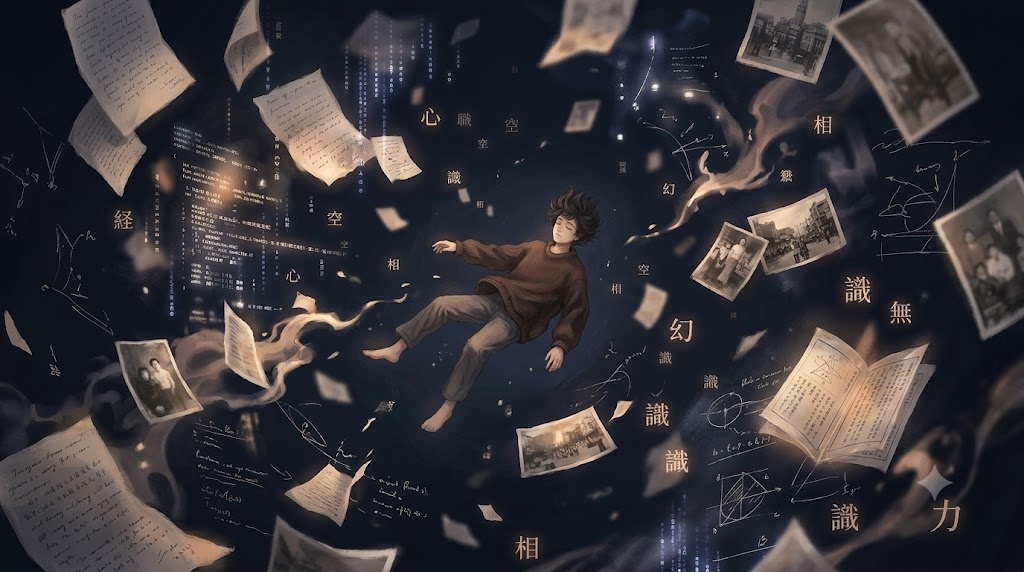
If you ask whether there is a house inside my mind, my answer is: there is none.
Not an empty house. Rather, it was never a house to begin with.
On the third day, I wrote of that dream — living through three years in the span of three days, drifting into a dimension that research later informed me some call the Akashic Records.
That realm is not partitioned into neat, bounded rooms; it is not even tethered to gravitational physics. You float within an extradimensional expanse where information envelops you from every direction — unimaginably rich, yet intricately entangled. The moment an intention forms in your mind to perceive something, the corresponding vision manifests immediately. You do not turn a doorknob. You simply intend.
If compelled to describe my inner psyche, it resembles that space far more than any architectural dwelling.
Within that expanse, right and wrong, black and white, truth and falsehood are extraordinarily difficult to demarcate.
Every article we encounter in this world arrives freighted with vested interests and the coded rhetoric of particular agendas. Every fragment of information represents merely one facet of a colossal iceberg — and almost invariably, the facet deliberately packaged and strategically showcased to conceal the rest. Social media algorithmic curation and corporate patent thickets operate fundamentally by withholding full disclosure, ensuring you can never grasp the whole picture.
Yet one classical verse has consistently guided my navigation through that shifting expanse:
"If one perceives that all forms are not forms, one beholds the Tathagata."
Every polished exterior, every grand narrative, every polarized stance — they are all lakshanas (forms/appearances). Pierce through them to witness the immutable reality underlying their surface; only that is authentic.
There is another couplet, inscribed at the Land of Illusion in Dream of the Red Chamber, which I heard throughout my youth, yet only truly absorbed in recent years:
"When falsehood is taken for truth, truth becomes fiction;
Where non-being is taken for being, being turns to naught."
Everything that unfolds across human history remains fundamentally unaltered in essence. What fluctuates are merely the manipulated historiographies, the rhetorical packaging, and the external manifestations orchestrated by human actors. Capital financialization is not novel; it merely operates under updated jargon. Institutional violence is not unprecedented; it simply dons a modern, legally sanctioned cloak.
Since the underlying essence is invariant, truth remains truth, and falsehood remains falsehood. Our imperative is to penetrate the glamour and perceive "all forms as non-forms," rather than placing gullible faith in the neatly packaged narrative presented before our eyes.
My inner mind is precisely such an expanse. Not an orderly library shelf, nor a sequence of compartmentalized chambers. It is a floating, continuously undulating suspension of intermingled truths, illusions, data, and memories.
These seven days of writing have prompted me to undertake an exercise I had never previously attempted: retrieving the artifacts from that floating space, one by one, to examine them in the light.
On the first day, what was retrieved was a sentence: "No sympathy." It had resided in that dark space for years, buried beneath strata of technical analyses and corporate white papers.
On the second day, a window was retrieved: farm pastures, starry skies, the sweep of the Milky Way. A reality I can behold, yet cannot cross over to inhabit.
On the third day, a paper check was retrieved: bearing no amount, and no signature. Accompanied by a sprawling sea of fire.
On the fourth day, a year of blankness was retrieved: six volumes, a proprietary knowledge architecture, and virtually no audience.
On the fifth day, a pair of reading glasses was retrieved: far vistas razor-sharp, proximate intimacy blurred.
On the sixth day, a quiet wish was retrieved: to have given one's best effort is enough.
On the seventh day, a revelation: the house that is not a house.
Seven artifacts. Each intelligible when inspected in isolation. Yet the living relationships among them — the countless interwoven filaments, the subterranean currents where mentioning one memory immediately tugs at another — resist comprehensive capture through linear prose.
Imposing pristine, linear order onto this magnificent chaos is extraordinarily difficult.
Human cognitive capacity for information is inherently fragmented and bounded. In an age of abbreviated attention spans, asking an audience to absorb a multi-hundred-thousand-word, deeply interconnected opus is nearly an impossibility. My individual essays routinely span thousands of words; nine or ten essays cohere into a volume, and multiple volumes converse with one another. How much can any reader genuinely assimilate? I cannot know.
What I can construct is designing every standalone piece as an independent gateway. Those drawn to dive deeper will naturally follow the subterranean threads; a newcomer stepping through any arbitrary essay will never find themselves disoriented.
Designing this architecture cost me an immense investment of time. It is not flawless — certain insights propagate far more effectively when severed into isolated snippets, while other truths reveal their majesty only when viewed across the entirety of a book. Yet at the very least, it provides the swirling, chaotic contents of that floating inner realm an outlet through which they may be encountered and read.
Having completed these seven days of writing, what I wish to tidy first is not any particular corner — for that space possesses no corners.
What I yearn to do is simply to continue bringing what resides inside out into the open.
Not everything at once. To empty the expanse entirely is neither feasible nor meaningful. Yet with every intention formed, every act of focusing, every instance where an ambiguous shadow is articulated with crystalline precision — that inner realm grows slightly more serene. Not because the artifacts have vanished, but because they have finally found their proper place.
Seven days, seven artifacts. With countless more waiting quietly in the deep.
Let nature take its course. Wherever the ink leads, let it rest there.
Seven-Day Book | Body, Mind, and Spirit | Postscript
Seven-Day Book | Body, Mind, and Spirit
In truth, when these seven days began, I had zero intention of writing on this theme.
The phrase "body, mind, and spirit" has long been degraded, hollowed out, and exploited to exhaustion by commercialized spirituality and pseudo-religious grifters. I avoided touching it because I knew intimately just how murky that pond has become.
Buddhist metaphysics has been twisted and commercialized beyond recognition by the "Law of Attraction" and assorted modern cults. It has degenerated to the point where monastics in temples are saddled with KPI quotas, managing religious institutions like corporate CEOs. The internal politicking and factional warfare within sacred cloisters can be vastly more cutthroat than secular corporate life.
Christian and Catholic institutions follow an identical trajectory. I was once an active believer. In earlier generations, while one could hardly claim every congregant was pure, many clergy genuinely harbored their original calling. Yet the moment predators discovered the staggering wealth accumulated within church coffers — donations ample enough to purchase prime real estate and erect cathedrals — opportunistic operators infiltrated in droves. Ultimately, you watch helplessly as sincere clergy and spiritual resources are partitioned and devoured by these actors.
This outcome is nearly inevitable. Clergy are seldom versed in political warfare. Divine wisdom may exist, but it operates as macroscopic cosmic guidance, not a tactical playbook for neutralizing malicious saboteurs. Historically, systems that preserved spiritual purity without the coercive armor of state power relied on the "separation of church and state"; once that institutional barrier crumbles, clerical corruption and institutional capture become an empirical certainty.
Much like the religious syndicate in Like a Dragon: Infinite Wealth (Yakuza 8) — the grandmaster was merely a mafioso who hijacked sacred resources following a hostile takeover. The video game's narrative was dramatized, but the structural mechanism was chillingly authentic.
Consequently, the vast majority of "spiritual chicken soup" flooding the marketplace is a toxic concoction of distorted religious dogmas blended with the prosperity gospel of the Law of Attraction. That was the primary reason I instinctively recoiled from engaging this topic.
If I were to address "body, mind, and spirit" rigorously, my natural inclination would be to systematically dismantle these manipulative grifts and psychological traps. Yet doing so makes bitter enemies — and while exposing cults guarantees viral engagement, investigative whistleblowing is not the crusade I wish to pursue. The domain of spirituality is far too sprawling, and not the primary terrain I intend to conquer at this stage of my life.
Nevertheless, observing everyone discussing this prompt brought to mind a narrative I have long intended to write: Quantum Bliss.
That novel conceptualizes how a pseudo-religious syndicate engineers a "quantum faith," executing psychological control over modern citizens and leveraging artificial intelligence for unprecedented cognitive indoctrination.
Yet the narrative architecture of that book is immensely intricate, and I have yet to officially commence the manuscript. To date, I have completed only Mirror Realm: The Mask System Murders; the volume dissecting spiritual manipulation and religious brainwashing must wait in the queue. Ordinary readers cannot easily digest such convoluted systems without extensive world-building and narrative scaffolding.
Thus, the seven days of writing that emerged diverged radically from the conventional understanding of "body, mind, and spirit."
I wrote no guides on mindfulness, no platitudes on emotional healing, and no motivational sermons on positive energy. What I set down was the lingering trauma of "No sympathy," a window through which I can gaze but never pass, a bank check bearing no amount, a silent year of unread obscurity, a pair of presbyopic eyes sharp on the horizon yet blurred up close, an unreachable pastoral village, and an interior room that is not a room.
If this qualifies as body, mind, and spirit, then spirituality is something entirely different from what I once imagined.
It induces a quiet headache to realize just how complex my cognitive framework has unconsciously grown over the decades.
Yet perhaps that is the ultimate lesson these seven days of writing imparted to me: complexity is never the problem. The unwillingness to bring that complexity out into the open to look it in the eye — that is where the problem lies.