Author: Nebula Walker Date: 27JUN2026 MYTHOGEN ENGINE (mythogenengine.com)
📌 If efficiency gains don't create new demand, they're just compression — and the AI education market is teaching compression at scale.
The Efficiency Trap: When Everyone Is Learning AI, Who Is Creating New Demand?



Three Days to Finish Four Months of Work
A post has been making the rounds in AI circles recently. A developer used ChatGPT paired with Claude Code and completed an entire internal system in twenty hours — the feature list came out to over two hundred modules. She said that when she'd previously asked engineers for a quote, the estimate was at least three to four months.
The article was long and packed with substance. Task decomposition, decision layering, session management, SOP design — all of it was hard-won, hands-on experience that you can only articulate if you've actually done the work. The comment section had hundreds of likes, hundreds of shares, and everyone was saying "I learned something."
I don't doubt she pulled it off. I don't even doubt that this method genuinely works for her.
But I want to ask the one question nobody in the entire article asked:
Three to four months of work was compressed into three days. So where did the people who would have filled those three to four months go?
A Very Pretty Picture
Every technological revolution, someone draws the same picture.
Automation will free up human labour. When people no longer have to do repetitive tasks, they can do more creative things. When R&D doesn't have to cover the production line, they have more energy for research. When engineers don't have to write boilerplate code, they can focus on design.
It's a very pretty picture. But it has one prerequisite: the time and labour saved must be channelled toward new demand, new creation, new possibilities.
What if that prerequisite doesn't hold?
Then efficiency gains aren't expansion. They're compression.
And compression, in Wall Street's language, has another name: margin improvement.
Sounds positive. What it actually means is: do the same work with fewer people, then turn the savings into profit.
Three Faces of Compression
The first kind: straight-up layoffs.
What used to take five people to do, one person plus AI can now handle. The other four are let go. This kind is the most visible — the news covers it, LinkedIn discusses it — which is exactly why it's not the most dangerous one. At least you know you've been laid off.
The second kind: they don't lay you off, but they steal your actual work.
This is the terrifying one.
Headcount stays the same. Job titles stay the same. But R&D no longer does R&D — they do quality checks on AI output. PMs no longer do product thinking — they do prompt management. Architects no longer design systems — they do code review on AI-generated code.
You're still sitting at the same desk, using the same computer, eating at the same company cafeteria. But the work you do is no longer the work you were hired to do. You've gone from being a thinker to being a supervisor. Nobody sends out an announcement about this. Your title still says Senior Engineer. It's just that your daily job has become cleaning up after AI.
The most ironic part? You're supposed to feel grateful. Because you weren't laid off.
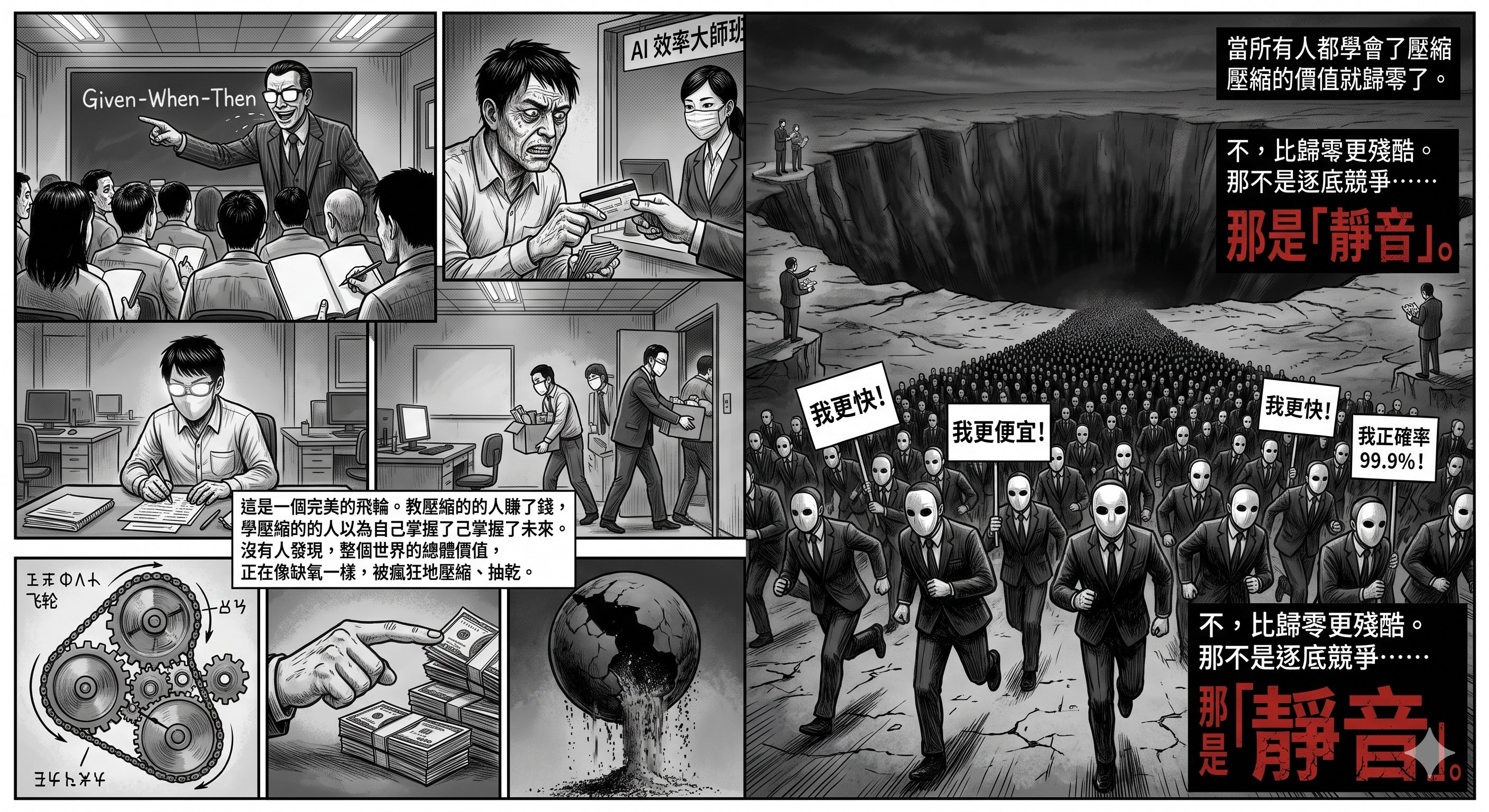
The third kind: once you've been compressed, you go out and teach compression.
This is the one I find most worth talking about.
Someone goes through the second kind of compression inside a company. They learn the art of "maximum output with minimum headcount." Then they leave, launch a course, and teach others the exact same thing.
What they're teaching isn't creation.
What they're teaching is compression.
Their students go back to their own companies and replicate the same cycle. The people being compressed, trying to keep their jobs, sign up for courses. The ones who take the course, if they're good enough, start teaching courses themselves.
A perfect flywheel. Every revolution, someone makes money — the course creators. Every revolution, someone feels like they learned something — the students.
But the net effect on the entire system is an acceleration of compression.
Ah Keung's Story
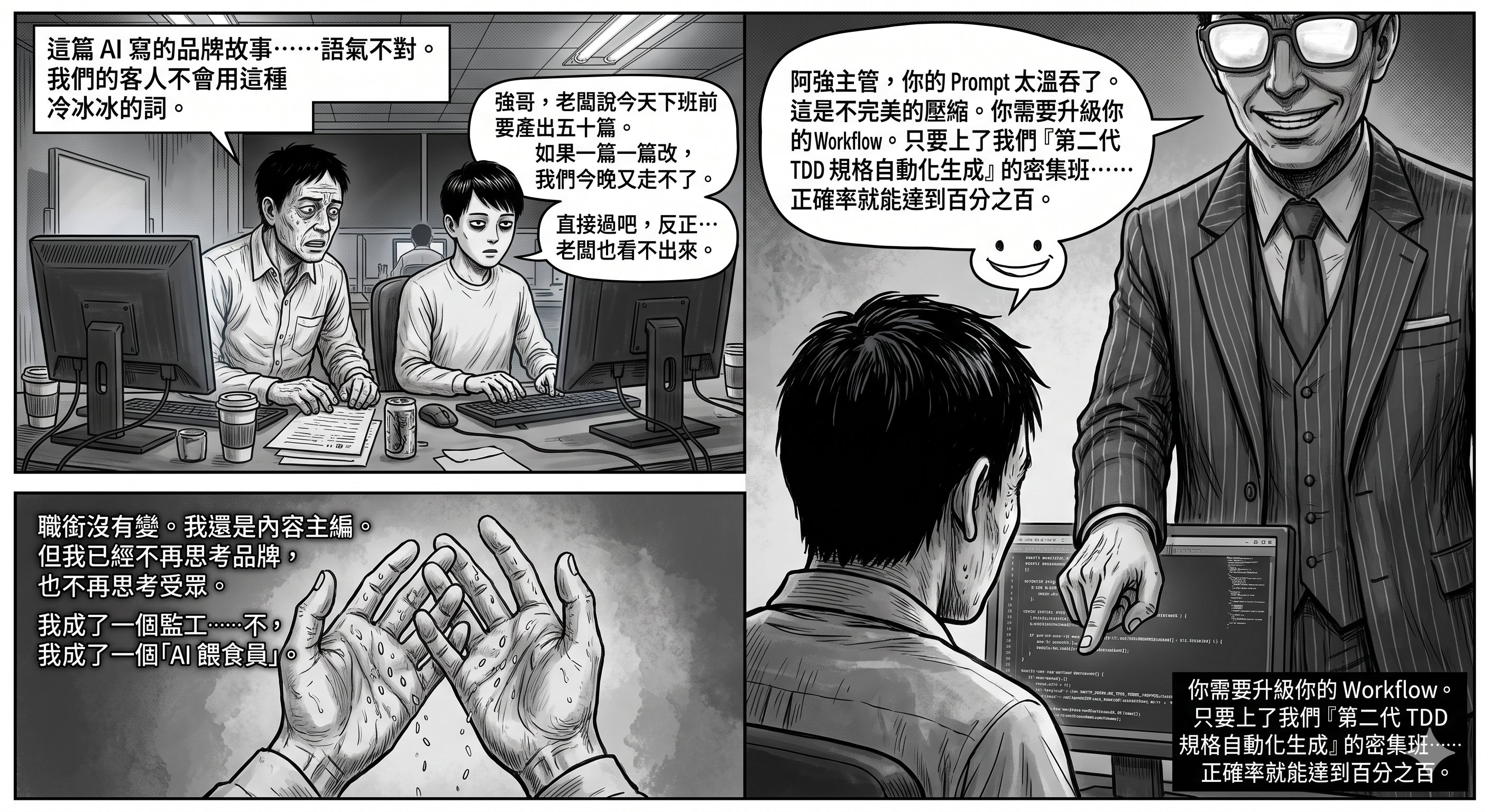
Ah Keung works as the content lead at a mid-sized e-commerce company. He manages a team of five: himself as the editor-in-chief, two copywriters, one designer, one community manager. They consistently put out thirty articles a month, supporting four marketing campaigns. Not blazing fast, but the quality is stable — because behind every piece of content is someone who understands the brand, understands the audience, and exercises judgement.
One day, his boss forwards him an article: "AI lets me do the work of a five-person team by myself."
With a single line attached: "Look into this."
Ah Keung's heart sinks a little. He knows exactly what "look into this" means.
Three months later, the team shrinks from five people to two. Output goes from thirty articles to a hundred. The boss is thrilled — costs halved, output tripled. Ah Keung gets a half-step promotion and a small pay bump, because he "successfully led the team's transformation."
But Ah Keung knows what actually happened.
Out of those hundred articles, seventy are cookie-cutter AI templates. Audience engagement drops by 40%. The brand voice starts getting fuzzy, because nobody is spending time asking "what are we actually trying to say to our customers?" His own daily work has become: feed the AI, edit the AI's output, upload, feed again, edit again, upload again.
He went from being an editor-in-chief to being an AI feeder.
Six months later, the boss decides the results aren't good enough and brings in an "AI content consultant" for training. The consultant takes one look at their prompts and says: "These are too simple. You need to upgrade your workflow."
Ah Keung holds his tongue. Because he knows: "upgrading the workflow" means he needs to learn a new feeding method. And the things he actually used to be good at — brand strategy, audience insight, editorial judgement — nobody needs those anymore.
After the consultant leaves, Ah Keung gets a message from the boss: "The consultant was very professional. Get the team to implement their recommendations."
Ah Keung stares at the screen, thinking: that consultant probably used to be a content person too.
What Do the Other Nine Do?
Every technological revolution in history has had to answer the same question: after efficiency gains, where do the people who were made redundant go?
Answer it well, and it's not just a technological revolution — it's a civilizational leap.
Cars displaced horse-drawn carriages. But cars weren't just "faster carriages." They gave rise to highway systems, suburban housing, long-haul logistics, road trips. Coachmen disappeared, but taxi drivers, truck drivers, mechanics, and traffic engineers emerged. New demand absorbed the freed-up labour.
The internet displaced travel agencies, newspaper classified ads, and brick-and-mortar record stores. But it simultaneously created e-commerce, social media, streaming platforms, digital marketing, and UX design. There was a painful adjustment period, but eventually new demand did appear.
What about AI?
Right now, the most common narrative is: "What used to take ten people, one person can now do."
Very few people ask the follow-up: "So what do the other nine do?"
Even fewer ask: "Has AI opened up any demand that didn't exist before?"
If the answer is no — if AI only makes existing work faster and cheaper without giving rise to new markets, new roles, new forms of consumption — then it isn't a technological revolution.
It's just a very powerful compression tool.
And compression doesn't create value. It just moves value from one place to another. Usually from the people doing the work to the people holding the capital.
Why the Market Naturally Teaches Compression
Have you noticed what the vast majority of AI courses are selling?
Use AI to write copy. Use AI to design. Use AI to code. Use AI to do analysis. Use AI to write reports.
Every single one is a variation of the same sentence: "You can do in less time what used to require more time."
Not a single one says: "You can do things that were previously impossible."
This isn't because the instructors have bad intentions. It's because compression is easy to teach, easy to learn, easy to demonstrate results, and easy to charge for. After you take the course, your output speeds up, and you can immediately feel you "got your money's worth."
But creation is hard to teach. The question "what problem should you be solving" has no standard answer, no before/after, no three-day intensive that can crack it.
So the market naturally gravitates toward teaching compression. It's not a conspiracy. It's economics.
The question is: when everyone has learned to compress, what happens?
Intuitively, you might think: once everyone compresses down to the same level, the value of compression drops to zero.
But reality is crueller than zero.
Not Zero — Silenced
You open a short-video platform and you see a certain style of video suddenly everywhere. Same rhythm, same transitions, same background music, same copywriting structure. AI has driven the cost of cloning a viral video to near zero, so within days of every hit, hundreds of imitations flood in.
What you see: this type of content seems to be blowing up.
What you don't see: how many of those hundreds of imitations died at zero views.
The same structure applies to formulaic writing. Some authors hit it big with precisely calibrated emotional pacing — you can't say they don't have a market, because they clearly do. But while they're hitting it big, how many people used the same template to write the same kind of thing, only to sink to the bottom of the platform, never even getting a chance to be seen?
AI hasn't brought everyone to zero. AI has made the distribution more extreme.
The top gets more top-heavy. The tail gets silenced.
A few people keep winning on first-mover advantage, platform bonuses, or some irreplicable personal quality. The masses at the bottom trample each other with the same compression tools. And the cruellest part of this distribution is: from the outside, you only see the ones that blew up. And then you think — this path works.
So you sign up for a course.
Then you learn compression.
Then you become yet another silenced person in that distribution.
This isn't a race to the bottom. A race to the bottom at least means everyone is still on the field.
This is a large number of people being silently removed from the game — and they don't even know it.
The Evolution of Compression Education
If you think compression education stops at "teaching you to write copy with AI," you're underestimating this market's learning ability.
Markets evolve too.
Recently, a new class of courses has started appearing. They no longer teach you which button to press or what prompt to write. They teach methodology — TDD, BDD, DDD. These are legitimate frameworks that have existed in software engineering for ten to twenty years. Test-Driven Development. Behaviour-Driven Development. Domain-Driven Design. Each one has historical depth, academic foundations, and industry practice.
Then they say: combine these methodologies with AI, and you can make AI generate 100% correct code.
The course landing page is beautifully designed. Accuracy rates start at 70%, climbing level by level — 80%, 90%, 99% — each level making you feel like "almost there." The final 100% reads: "Course secret — method not publicly disclosed."
You can't say this is a scam. Because TDD and BDD genuinely have value. Engineers who can write executable specifications are genuinely better than those who can't. Every individual piece of the course content, examined on its own, is real.
But if you look closely at the core promise, you'll notice something:
"AI makes mistakes when writing code because your specifications aren't good enough. Master your specifications, and AI won't make mistakes."
Let me translate that: the bottleneck in compression isn't the tool — it's your specifications. So you need to learn to write better specifications to make the compression more thorough.
It's still teaching compression. Just one level up.
From "use AI to write code" to "use AI to automatically generate correct code based on specifications." It sounds like progress — and it is, in a way. But it still doesn't ask the fundamental question: should this piece of code even exist? Is this system solving a real problem or a fake one? No matter how perfect the compression, if the direction is wrong, you're just marching toward the wrong destination more efficiently.
And hiding beneath this is a subtler contradiction.
The people who can truly write good specifications are people who've been steeped in extensive real-world practice. They can write precise boundary conditions not because they learned some framework, but because they've hit those boundaries, been bitten by them, and fixed the disasters they caused. A course can teach you Gherkin syntax, can teach you Given-When-Then structure. But the judgement of "where are the boundary conditions in this system?" — that's not something syntax can solve.
So in some ways, the evolution of this class of courses is even more dangerous. Because it has substance.
"Having substance" makes people lower their guard. You think: this isn't one of those vapid AI crash courses — this is a professional programme with real foundations. But "having substance" doesn't mean it answers the fundamental question. It just wraps compression to look more like creation.
The first generation of compression education said: "Follow my prompts, and you'll be faster."
The second generation says: "Follow my methodology, and you'll be more precise."
The next generation will probably say: "Follow my thinking model, and you'll go deeper."
Each generation has more substantial content. Each generation is harder to argue against. But the core promise of each generation is a variation of the same sentence:
"Follow the method, and you'll make it."
And every generation avoids the same truth: the tacit judgement you bring to the table is not part of the methodology.
The Most Troublesome Link
The most troublesome link in the entire cycle is that many instructors don't even realise they're teaching compression.
They genuinely believe their methods work. Because for them, they genuinely do.
A person with ten years of product experience uses AI to get results fast. They package their method into a course and teach it to students. But the reason their method works isn't because their prompts are well-written — it's because they know what to do, what not to do, when to stop, and when to push forward.
This judgement — they take it for granted, because they've been doing it for ten years. But they don't write it into the course. Not because they don't want to. Because they don't even recognise it as a skill.
It's like a chef with a naturally acute palate writing a recipe. Every step is laid out clearly: how many grams of salt, what temperature, how many minutes. Students follow it exactly. The flavour is off. The chef says: "Your heat control isn't good enough." Then they open an advanced class on heat control.
But the real issue might be: at step three, when adding salt, the chef took a sniff, felt it wasn't enough, and added an extra half teaspoon. They didn't even notice this action themselves. Because to them, it wasn't a decision. It was instinct.
You can't turn instinct into an SOP.
So students perpetually feel like they're almost there, perpetually feel like they need to learn just a bit more, perpetually come back for the advanced class. And the chef perpetually feels "I've taught them everything — they're just not trying hard enough."
This isn't fraud. It's a cognitive blind spot. But the outcome looks a lot like fraud.
What Is Truly Scarce
If you agree that efficiency gains only have value when paired with new demand, the next question becomes: in the AI era, what is the new demand?
I don't have the full answer. But I think the direction is becoming clearer.
When everyone can use AI to generate content, what's truly scarce isn't content — it's judgement: which content deserves to exist.
When everyone can use AI to write code, what's truly scarce isn't code — it's definition: what problem should this code solve.
When everyone can use AI to do analysis, what's truly scarce isn't analysis — it's the question: what should be analysed.
AI has compressed the cost of execution, but simultaneously amplified the value of judgement.
This is a good thing. But judgement has an embarrassing characteristic:
It cannot be standardised. It cannot be packaged. It cannot be forked.
It's not a Skills folder. Not a set of prompts. Not a workflow. It's something that grows within a person through prolonged experience, mistakes, and reflection.
Nobody teaches this. Not because nobody wants to learn. But because nobody knows how to sell it.
A three-day intensive can't teach it. The "follow the steps and you'll make it" model can't contain it. A before/after comparison can't demonstrate it.
So the market will keep teaching compression.
And judgement will remain scarce.
A Question You Can Ask Yourself
Next time you see an article saying "AI helped me finish XXX in XX hours," or a course promising "learn to boost your efficiency with AI," try asking yourself one question:
Is it teaching you to create new value, or to compress existing value?
If the answer is compression, ask one more:
When everyone has learned to compress, where do I stand?
This question has no standard answer.
But at least the person who asked this question has already done the one thing that almost nobody in the entire compression cycle does —
Stop.
📚 The Efficiency Trap and Cognitive Erosion Quintet
- Cognition and Judgment—The Last Thing AI Cannot Replace
- How Environments Make People Foolish—Cognition and Judgment (Postscript)
- The Efficiency Trap: When Everyone Is Learning to Compress, Who Is Creating New Demand?
- The Standard Operating Procedure for Killing Innovation
- The Efficiency Trap · Sequel: You Thought You Won