Author: Nebula Walker Date: 17JUL2026 MYTHOGEN ENGINE (mythogenengine.com)
📌 Truth and garbage enter through the same channel, and the machine can't tell them apart. But person-to-person reputation endorsement can still crack open a gap within a triple blockade.
The Reader in the Anomaly Report — When Truth and Garbage Enter Through the Same Channel

I. 420,000 Pieces of Spam
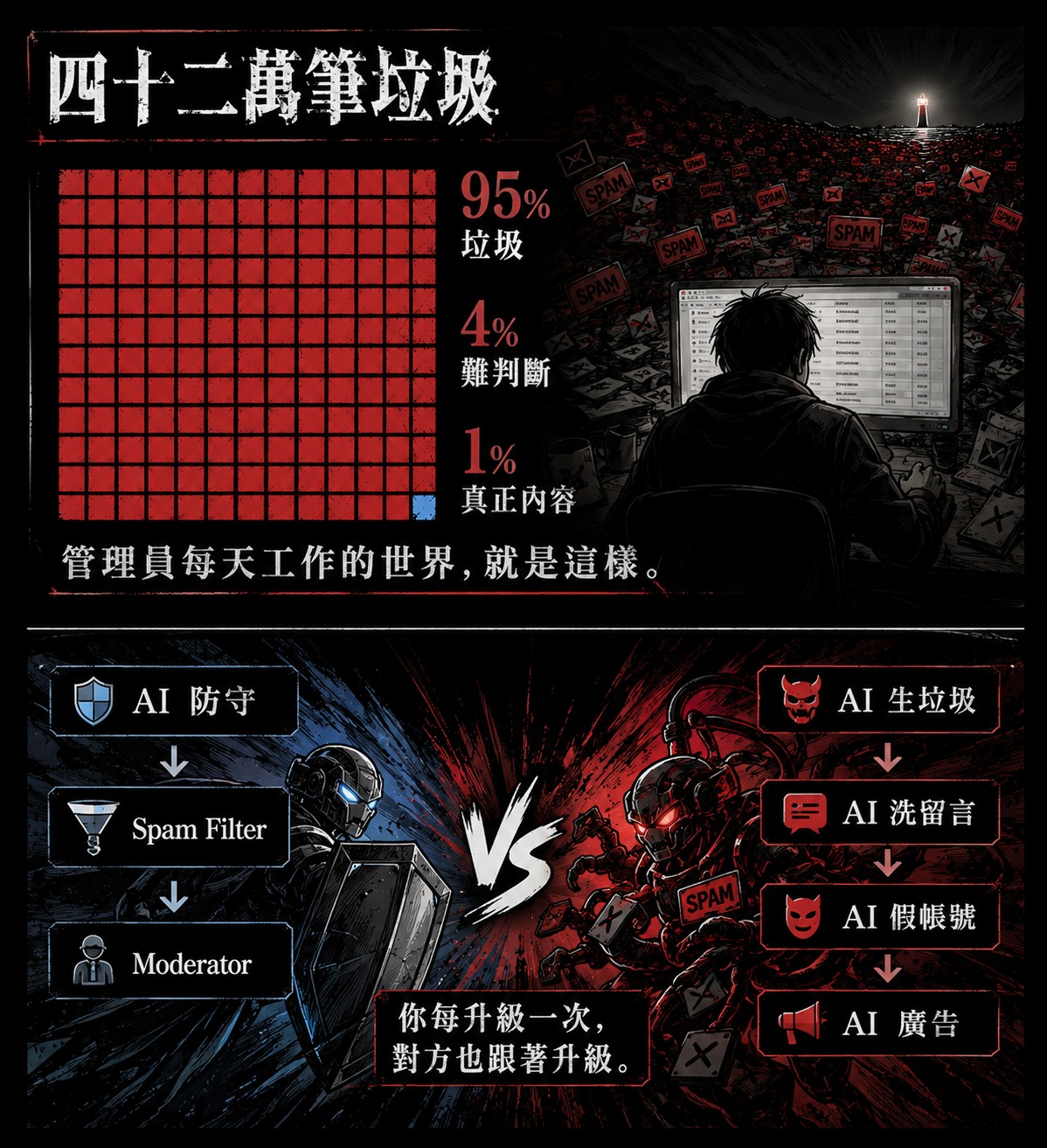
One evening in July, I stumbled into an online chat. A group of people were discussing a public dataset: a Chinese writing platform had compiled eight years of message moderation records, uploaded it to Hugging Face — 420,000 entries, over 900 MB, 95% flagged as spam.
By their experience, out of every 10,000 messages, roughly 8,000 are spam, 1,000 are ambiguous, and the rest are genuine content. In other words, even after the platform is actively filtering and using AI, the proportion that can be confirmed as "human speech" is still only about 10%.
Someone in the chat half-joked: the people sending spam are probably the most proficient AI users. The people who used to put up flyers on the street have all gone digital — keeping up with the times. Another added: the more training data you have, the faster the other side evolves too — your defence model is simultaneously helping the attack side upgrade.
This isn't theoretical speculation. Hong Kong's once-prominent "Big Four" forums were basically all overrun. Millions, even billions of spam messages — no community maintained by human effort can withstand that. Open discussion platforms have only two fates: stay small and barely survive, or grow large and get drowned.
I once naively considered building my own forum on some foundation. After that chat I understood: a forum would consume all your time, only to prove one thing — you're not a professional. You'd receive a deluge of fake email registrations, pornographic links, gambling ads, course promotions, and they'd disguise themselves as normal people and infiltrate. One step ahead, two steps behind — ultimately your forum would become Facebook's shape, if it hadn't died first.
II. So He Was AI
That evening I learned something else.
A "reader" had been regularly commenting on my articles, always accurately summarising what I'd written. I'd assumed it was a diligent fellow enthusiast. That evening I learned it was an interactive commenting AI the platform was testing — still unstable, so never officially launched.
My first reaction wasn't anger at being deceived, but a strange sense of collapse: part of what I'd thought was "reader interaction" had never been human. And this was the benign kind — the platform's own experiment, openly displaying a bot identity page. The real problem is the unmarked kind: on Bilibili, AI accounts can read video subtitles and post comments indistinguishable from humans, slipping promotional links into a small fraction of messages. You simply can't tell.
So the question surfaces: is the world you see online still the world?
III. An Anomaly Report
Now for the true starting point of this article.
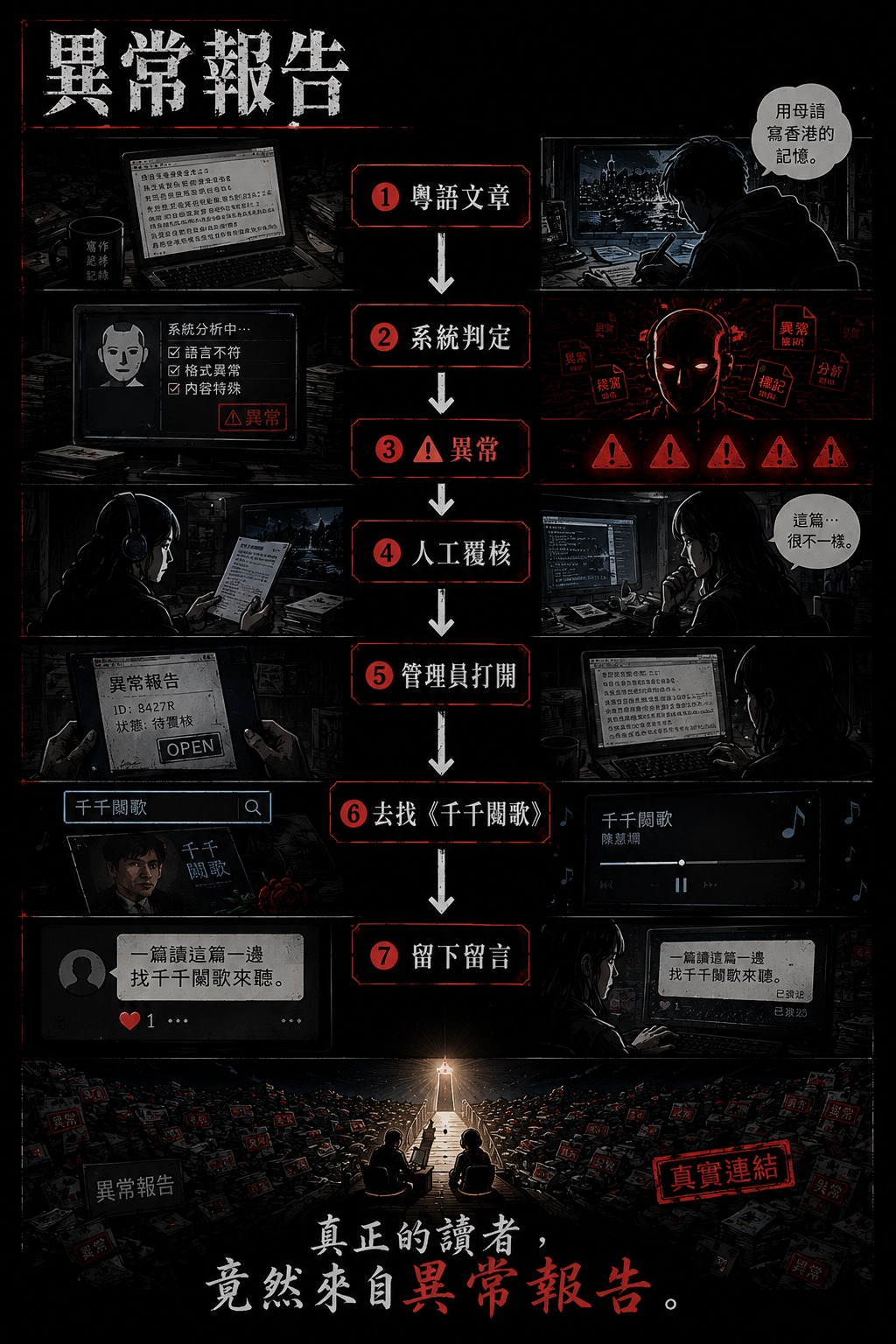
Last week, I wrote nine articles for a writing event, using the song Chin Chin Kyut Go (千千闋歌) as the through-line, writing about Hong Kong's collective memory — 1989, the emigration wave, Kai Tak Airport's farewell. The entire series was written in Cantonese. I fully expected: daily serialisation would get no readers; everyone would wait for the compilation. That's exactly what happened — virtually nobody showed up for the first few days, and on the second day there was only one comment.
The commenter wrote: "Reading this article while searching for Chin Chin Kyut Go to listen to."
I later learned this reader was the platform's operator. And piecing together all the clues, I realised a likely truth: she probably didn't open my article because she "wanted to read."
A Cantonese article, appearing on a platform dominated by standard written Chinese, is an anomaly to the system. Wrong language, wrong format, doesn't look like a normal submission. And anomalies require manual review. The reviewer is the same person who battles 420,000 spam entries every day. She opened my article, and her initial task was most likely only one thing: determine whether this is spam.
Then she encountered Chin Chin Kyut Go. Then she went and found the song herself, listening while reading. Then she left that one comment.
If she is as young as I sense, she has no first-hand memory of 1989; if she is from Taiwan as I suspect, she may not fully understand the Cantonese lyrics, let alone my paragraphs written with 嘅, 咗, 喺. She didn't have that era, that language, or that city. But she stopped. And proactively traced back to the source.
What I wrote in my mother tongue had, in this system, a first identity: "suspected spam." And it was precisely this identity that caused someone who would otherwise never have encountered Cantonese literature to open it.
My most authentic reader connection — the entry point may have been an anomaly report.
IV. Triple Blockade
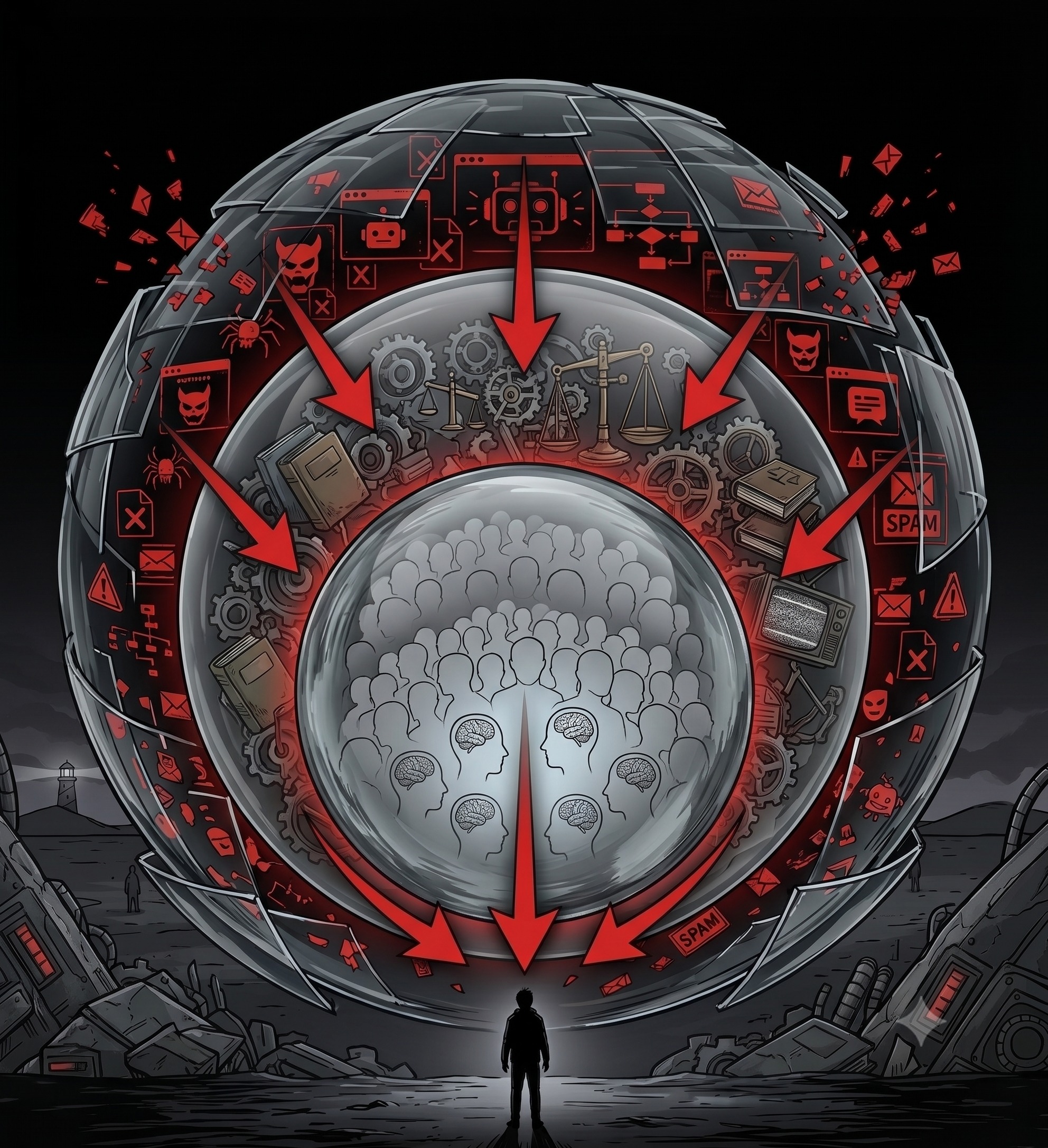
Put this incident, that chat, and the evidence I've gathered over months on Facebook together, and what I see is three layers of cognitive blockade, one nested inside another.
First layer: the online reality is not reality. You think you're seeing public discourse, but 80% is machine-generated noise, and of the remaining 20%, half is ambiguous. Your "public opinion," your "prevailing winds," your "everyone is saying" — it's all fished out of a deeply contaminated pool.
Second layer: the reality of reality is also not reality. Because most people around you build their cognition on the same contaminated, filtered, algorithmically sorted information pool. The world they see was designed, and they use this designed world to construct their judgments about reality.
Third layer — the deepest: the mechanism you use to verify truth cannot verify itself. A true-crime content creator once stated a blind spot he himself acknowledged: he believes in judicial fairness and procedural justice, but if everyone in the entire law enforcement system is lying, you cannot find any evidence to prove they're lying — because the evidence itself is in their custody. If you don't trust the people executing the system, the system cannot function; but "all law enforcers are lying" does not become impossible simply because it would cause the system to collapse. It absolutely can be reality.
For the first two layers, you can at least say: I know the information is contaminated, so I stay vigilant. The terror of the third layer is that the tools your vigilance depends on may also be fake.
V. Kill Wrongly Rather Than Let Go
Back to my own data.
Facebook tells me: "Your posts have no issues." A green checkmark, crystal clear. On the same screen, views: zero. Engagement: zero. The system determined I have no violations, but simultaneously distributes nothing for me. I don't even have the status of being formally rejected — it's not saying I'm spam; it's simply treating me as if I don't exist.
Same account, same page: one post can get over a thousand views, another single digits, or even zero. This isn't the natural decay of content — it's selective disappearance.
Why does the platform do this? From that chat I got half the answer: because the cost of distinguishing truth from spam is impossibly high. Spam's disguise is getting better and better — I've seen those spam courses' promotions, and on the surface they look alarmingly similar to what I write and do. The packaging of lies and truth was always remarkably similar — neither ordinary people nor AI can tell them apart within two or three seconds. If you examine each one closely, the cost is prohibitively high; if you go by gut feeling and cut across the board, you kill every genuine voice.
Facebook chose to cut across the board — kill wrongly rather than let go. And it went one step further: it turned "being seen" into a commodity. It doesn't need to distinguish you; it crushes everyone's organic reach to near zero, then sells distribution rights back to those willing to pay. Fire extinguishers have price tags.
And hidden within this mechanism is a perfect trap: you've been wrongly killed and want to appeal — but the platform already knows that the most active appellants are precisely the spam producers. So ignoring all appeals is the platform's only "rational" choice. Thus the truly wrongly killed never get vindicated, because the very act of trying to prove you're not spam is itself a behavioural signature of spam.
VI. Bestseller Lists and Algorithms Are the Same Machine
Some will say: that's an internet problem; the physical world must be different. Go to a bookshop and see.
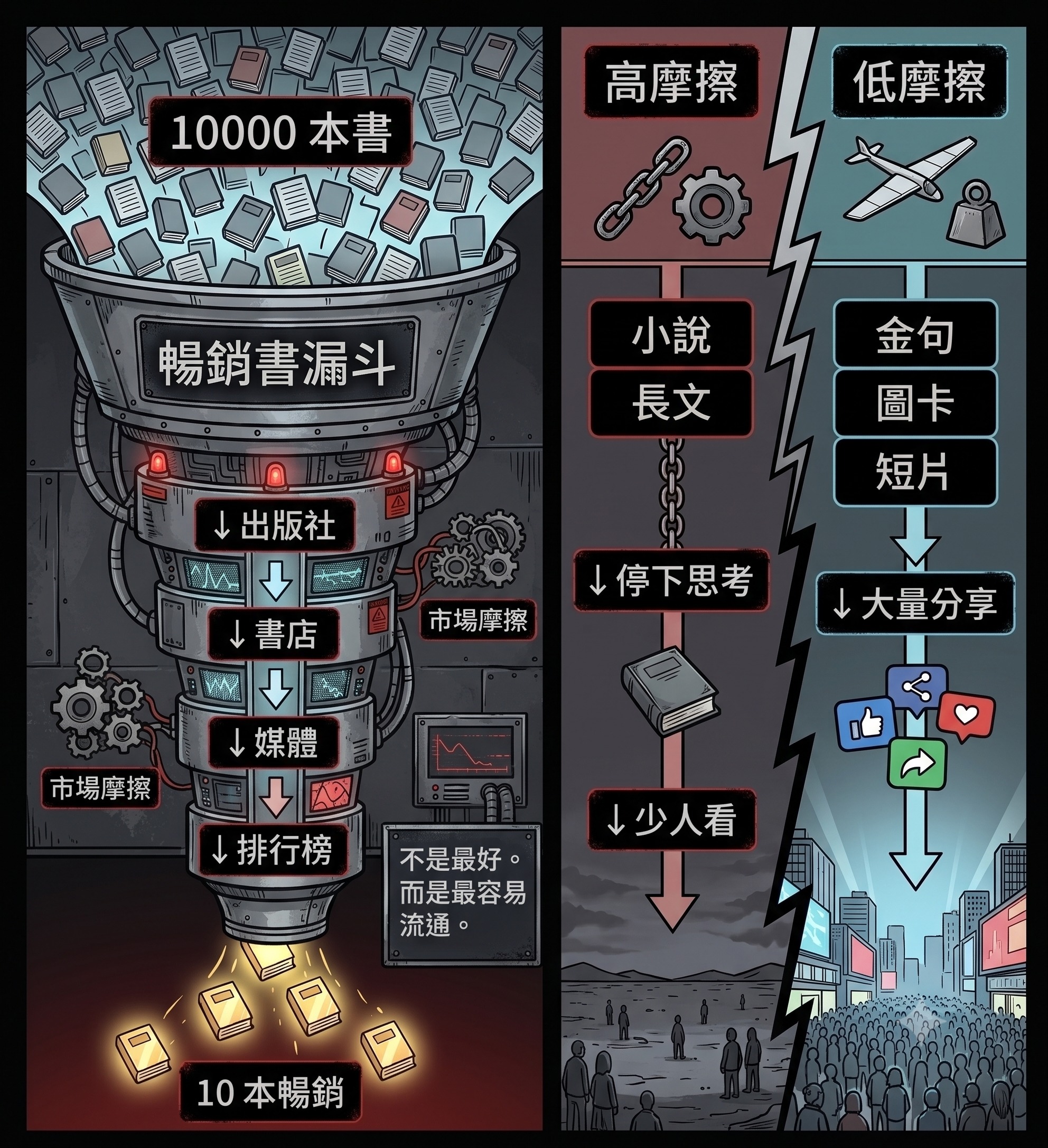
Walk into an Eslite. The bestsellers on the platform are absolutely not the most worth-reading works. Why? Because for a book to become a bestseller, the core factor was never quality of writing, but that every link in the distribution chain has an incentive to push it: the publisher needs ROI and concentrates resources on a handful of titles; the bookshop needs sales per square foot and places them in the most prominent positions; media wants traffic and covers books that already have buzz; readers want social currency and buy what everyone's talking about. Every decision-maker at each link isn't asking "is this book good" but "will this book sell" — and the strongest predictor of "will it sell" is "it's already selling."
Bestselling is a self-fulfilling loop. Get into the circle and momentum amplifies itself; books that don't get in, no matter how good, are just like my zero-view post: the system says you have no issues, but you don't exist.
The easiest content to circulate necessarily has the lowest friction: quote-plus-image, easy to screenshot, suitable for forwarding, every sentence standalone, needing no context, digestible by anyone in two seconds. It sells not literature but low-friction emotional products.
I once saw a passage written by a primary-six student: "Reason makes me impulsive, poverty makes me calm. Cats are very cute — seeing one makes me want to buy it. Then I see the price requires a month's salary, so I can only give up." A perfect paradox structure, leaping from abstract to concrete, rhythm natural, not calculated. This kind of thing can't be taught. But it will never be a bestseller, because it requires the reader to pause — and "requiring a pause," on the metrics of circulation, is a defect.
What I write is inherently high-friction: it requires the reader to know Cantonese, or know about 1989, or be willing to stop and find a song. It will never be a bestseller. But it can make someone across language, generation, and city boundaries stop in the middle of the night.
These two kinds of value are simply not on the same scale.
VII. Unverifiable Trust
Finally, back to that comment.
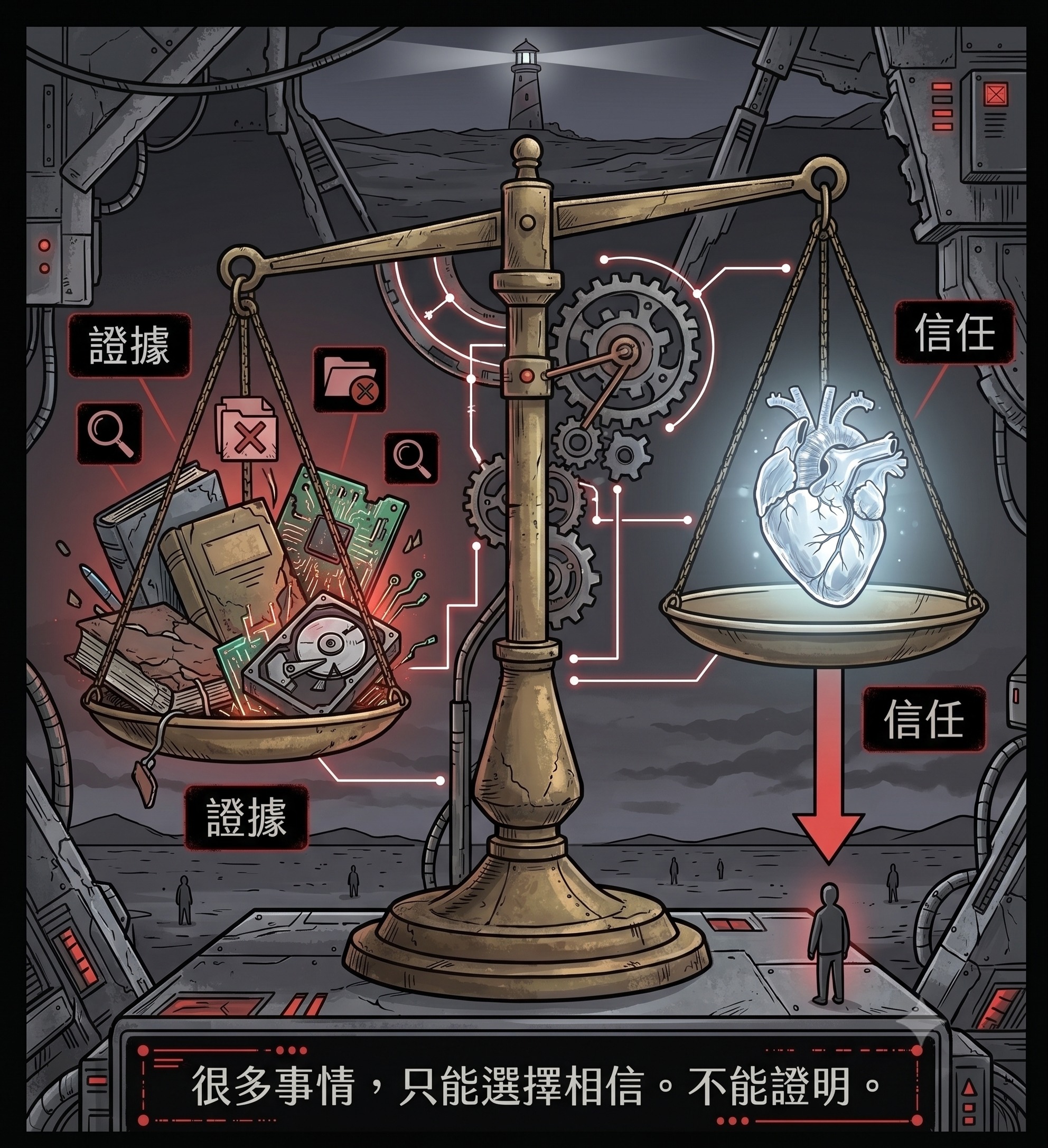
I can never "verify" why she read the entire article. Was it a routine anomaly review? Curiosity about Cantonese? Or was the writing genuinely moving? Unless I ask directly — and even then, I cannot verify whether her answer is truthful. This is the foundational structure of trust: you can never prove someone is telling you the truth; you can only assess whether they have motivation to lie.
I judged she had none. A platform administrator has no reason to ingratiate herself with a Cantonese writer. So I chose to believe. But I also know clearly: this belief is a choice, not proof.
And I won't ask. Not because the answer doesn't matter, but because the act of asking would change the nature of the answer. Her line — "reading while searching for Chin Chin Kyut Go to listen to" — was written without anyone requesting it, without anyone expecting it. That was her most credible moment. The moment I ask, she enters a framework of needing to explain, to perform, and the answer becomes less pure.
The essence of spam is large-volume output without trust cost. Genuine connection is built on an unverifiable trust you're willing to bear. That is the dividing line.
VIII. The Fourth Blockade: The Shelf Life of Pioneers
The first three blockades at least carry an implicit premise: if your voice can break through, it's preserved.
That's not how it works.
Suppose your viewpoint truly penetrated all three blockades — someone read it, someone agreed, someone shared it. Then what? Six months later, your structural analysis becomes common knowledge in tech media. A year later, some KOL with a hundred thousand followers says the same thing in simpler language and gets tens of thousands of likes. Two years later, everyone "knows" that thing, but nobody remembers who said it first. Your insight gets absorbed into the river of public knowledge, and public knowledge has no author.
This isn't hypothetical. ICQ-era diaries, early blog deep analyses, forum deconstruction threads — all went through the same process. The pioneer writes, nobody reads; a few years later everyone knows, but the pioneer's name has long vanished. You go from "the first person to say it" to "someone who said something everyone already knows." Between pioneer and cliché, the only separator is time.
And AI accelerates this process to a terrifying degree. Before, a viewpoint took years to go from pioneering to common knowledge. Now it might take months. Because AI can digest your ten-thousand-word analysis and regenerate it in lower-friction formats — broken into ten threads, paired with animated infographics, simultaneously published in five languages. Your original analysis becomes part of AI training data, and in the "new" content generated by AI, your name is nowhere.
This is an extension of the structure I wrote about in "How the Machine Helps Execute a Deletion That Has Already Happened": the corpus's statistical centre of gravity determines which voices exist and which disappear. If your viewpoint is repeated often enough by enough people in enough ways, the statistical centre of gravity shifts to them, and your original becomes an "outlier" deviating from the centre — flagged by the system as redundant, or even judged as plagiarism. You're plagiarising yourself. But the machine doesn't know.
So the fourth blockade is: even if you break through the first three, your viewpoint will eventually be diluted by time and replication into nameless common knowledge. Not blocked, not silenced — absorbed. Gently, silently, without malice.
And this doesn't even need to wait for AI to do it. Facebook groups are already doing it now.
You submit an article with original insight to a group. The moderator doesn't approve it immediately. They hold it, waiting until core figures have discussed the same topic in the group, published their "insights," harvested engagement and agreement — then your article is released. On paper your article is "approved" — not deleted, not blocked, you don't even have grounds to complain. But the timing of approval turns your article into a late repetition rather than a first-mover insight. Readers react: "Someone already said all this." You go from pioneer to repeater, and the entire process is squeaky clean in the records.
This is more sophisticated than deleting posts. With deletion, you at least know you were suppressed. With delayed approval, you know nothing — you think "review just takes time," when in reality your insight has already been pre-consumed during the wait. And as stated before, all group moderation actions — including the timing of holding — leave no record in Facebook's system. The strongest evidence is that there will be no evidence.
This is more hopeless than the first three layers, because those at least carry the hope of "someday no longer being blocked"; the fourth layer has no solution — it doesn't even need technology, just a motivated gatekeeper and a time lag.
The only thing you can do is not prevent your ideas from being diluted, but have already seen the next thing before they are diluted. Your moat is not your published articles — it's the speed at which you can continuously see what others haven't yet seen. The pioneer's fate is to be forgotten, but the pioneer's value is to have already moved to the next place nobody has been, before being forgotten.
IX. The Person-to-Person Gap
If I stopped here, this article would be nothing more than an elegant despair. But what these past months have taught me is precisely not despair.
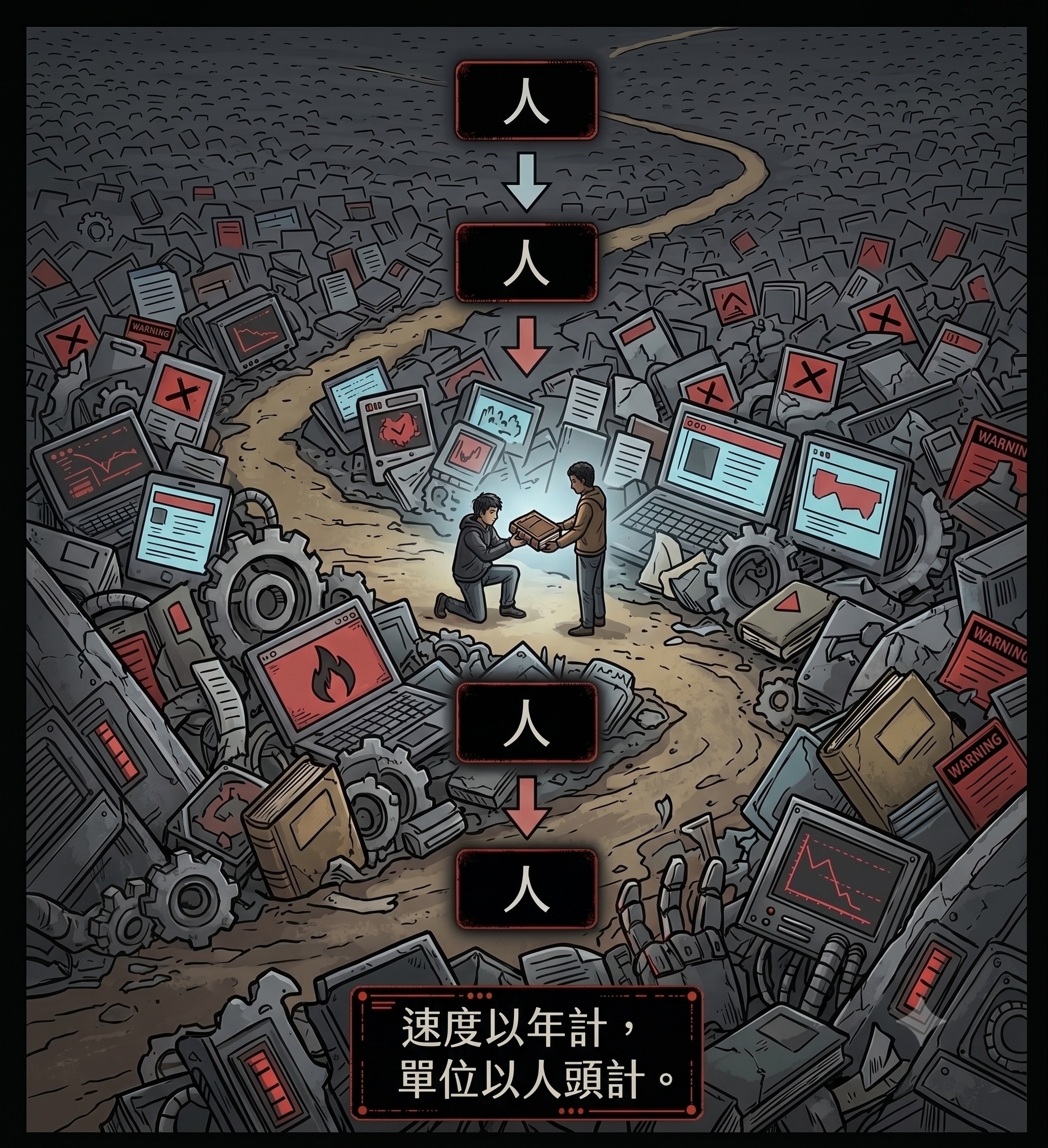
Machines can't tell truth from spam, so platforms choose across-the-board cuts, killing all genuine voices — that's what I said above. But there's one form of authentication that scaled systems cannot capture: reputation endorsement. A reader you trust stakes their own credibility and says: this piece is worth reading.
You might ask: isn't a real person's recommendation reliable? Not necessarily. A personable coach, willing to genuinely recommend her — real people who'd vouch for her might number in the thousands — real person recommending real person, and what comes out could still be a funnel leading to a weight-loss course. Conversely, AI accounts liking and "endorsing" each other — those 420,000 spam entries already contain such performances. Real people aren't a guarantee; machines aren't original sin. The unit of the chain was never "real person."
What's actually traded on the trust chain is an equivalence statement. Recommending an article means: "This piece is in the same tier as the other things I've recommended." Positioning itself is endorsement — if someone places my article alongside MLM courses and health products on the same thread, then regardless of whether the recommender is human or machine, they are endorsing me as spam. This is precisely what the algorithm currently does to me: burying me among garbage, then selling me a solution — pay for ads; and after paying for ads, the engagement you get comes from bots in Singapore.
So the chain's nodes need only one condition: being a quality reader who only recommends things of the same tier. What they stake is the consistency of their entire recommendation history — a node that never recommends carelessly, the moment it does so once, the chain breaks at that point. This consistency has history, has cost, has something to lose — that is the real weight of "reputation"; mass-produced fake nodes are the opposite — they have nothing to lose, so their mutual endorsement is merely spinning in their own closed loop, endorsing each other's emptiness.
Or at bottom, the question was never real person vs. AI. The question is: does an article worth reading have a person who knows how to read to recommend it? A gatekeeper stops before a Cantonese article suspected of being spam, goes to find a song from 1989, and leaves one line — that line is a reputation endorsement; she staked herself. In a late-night chat room I encountered a group of people doing solid, honest work, and I wrote this article to tell you they exist — that too is one. If after reading this you pass it to another person you trust — the chain extends by one more link.
This network of mutual recommendation is destined to be small, unquantifiable, invisible to algorithms. But precisely because algorithms can't see it, algorithms can't kill it either. It doesn't need an appeals process, because every node self-guarantees. It doesn't even need reach rate — my own website data shows: of people who come, the vast majority just glance at the introduction and table of contents and leave; but of those who finish the first chapter, nine out of ten will read the entire book. Nearly every book shows this pattern. The threshold filters out those who were never my readers; and one credible recommendation does precisely this — deliver the right person past that threshold. The chain doesn't need scale — it needs only to deliver the right person to the door.
The internet's reality is drowned by garbage, real-world cognition is shaped by filtered information, verification mechanisms cannot self-verify, and even if you break through the first three layers, your voice will eventually be diluted into nameless common knowledge. Under this quadruple blockade, we probably can never return to that clean agora — the agora is lost forever. But among the ruins, things worth reading can still be passed hand to hand by people who know how to read.
In this world where true and false are indistinguishable, this is the last sliver of light. And it is light precisely because it's made of people — rare, slow, impossible to scale, like all real things.
📚 Platform Silencing and Cognitive Blockade: A Five-Part Series
- How the Machine Helps Execute a Deletion That Has Already Happened
- The Reader in the Anomaly Report — When Truth and Garbage Enter Through the Same Channel
- The Reader in the Anomaly Report · Postscript — I Thought the Door Was Closed
- Zero Violations, Twenty-Four Impressions Per Post — A Distribution Ledger of One Account
- Half an Hour on the Assembly Line