Night-Vision Goggles Under the Searchlight — What Got Left Out Between an Interview and a Summary
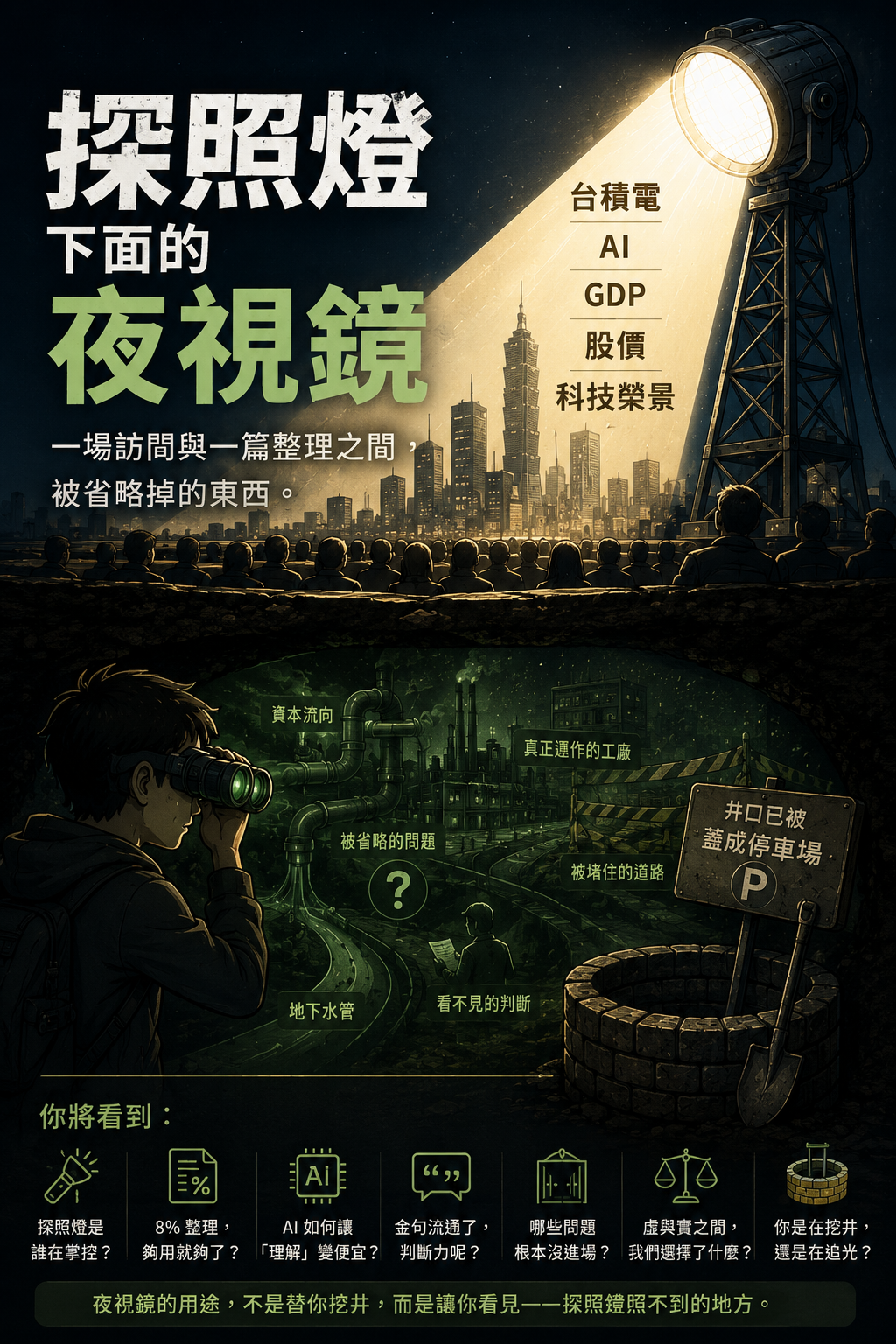
Toward the end of July, Waki of the Reading Outpost published a long-form piece summarising an episode of Sega Cheng's podcast Sega on AI. The guest was veteran tech journalist Lin Hung-wen, author of Light on the Chip Island.
The article is well written. Sharp imagery, compelling data, a resonant ending. If all you want is a three-minute overview of what the episode covered, this summary is top-tier work.
But when I finished reading, what lit up in my mind was not the searchlight inside the article — it was everything the searchlight failed to reach. What follows is not a critique — what Waki does has its own value — but a pair of night-vision goggles: view the same landscape under a different spectrum, and you will see what vanished in the white light.
I. Whose Searchlight Is It?
Waki deployed a powerful image: the semiconductor boom is like an enormous searchlight — illuminating TSMC, illuminating share prices, illuminating GDP — but what truly sustains a place is groundwater and soil.
The metaphor draws its power from intuition. But it skips a premise: a searchlight is not a natural phenomenon. Someone holds it. Someone decides where it points.
Waki's approach is: "If the searchlight doesn't reach you, go dig a well." This is advice on the level of individual choice — pleasant to hear, and not wrong. But it sidesteps a sharper question: is the searchlight aimed precisely to ensure you cannot see what lies at the bottom of the well?
Lin Hung-wen's data already touches this layer: Taiwan's wage share of GDP has fallen from 49.3% to 43.89% over forty years; TSMC's median salary is 5.5 times the national figure, and the gap is accelerating. Waki cited these numbers and concluded: "a sense of deprivation."
But the numbers can be pushed further. A persistently declining wage share means the portion of value created by enterprises that goes to labour shrinks every year. This is not natural market divergence — when you place it alongside the financial statements of the global tech industry, the same pattern repeats: record revenues accompanied by simultaneous layoffs; the saved wages become capital expenditure and stock buybacks; buybacks inflate earnings per share, inflate stock prices, inflate executive compensation. The brighter the searchlight, the lower the water table — not a coincidence, but the same pipeline at work.
Waki did not go this deep. Not because he cannot see it, but because going this deep would make the article something that can no longer be digested in three minutes. And three-minute digestibility is precisely his product specification.
II. The 8% Gateway, and the 92% Who Never Walk Through
One thing must be stated clearly first: Waki has never claimed to be a substitute for the original book.
He has said many times across his own content that what he produces is roughly an 8% to 15% distillation of a book's essence. And his intention is not to keep you at that 8% — quite the opposite. What he does is guided discovery: helping you judge whether a book is worth your time, then nudging you to go find and read it. The design logic of the Reading Outpost is a gateway, not a replacement. Waki is honest about this positioning, and in practice he consistently pushes in that direction.
But can he actually push hard enough?
There is a force beyond his control pushing back. Waki opens the door and points inside, saying "it's worth going in." But the moment the reader stands at the threshold, the algorithm is already serving up the next summary, the next book digest, the next three-minute cheat sheet. The platform's commercial logic is to retain attention, not to send it away — every reader who leaves the page to buy a book is, from the platform's perspective, a loss. Waki pushes you to walk through; the algorithm pushes you to swipe sideways.
The result: 8% is enough. Enough to form an impression, enough to make dinner-table conversation, enough to forward to a friend with "this is an interesting take," enough to feel you "know" it. This is not Waki's design intent — he wants you to read the entire book. But in an ecosystem where attention is perpetually siphoned, the better the gateway is built, the more people feel satisfied at the gateway. It is not the intermediary blocking the path — it is the ecosystem intercepting the people on the path.
Lin Hung-wen spent thirty years covering news and accumulated the kind of judgment that concludes: "the real reason the acquisition fell through is that a particular shareholder didn't want to sell." The production cost of this judgment is extraordinarily high — you need to attend thousands of press conferences, sit through hundreds of meals, lose trust a few times, endure several rounds of litigation risk. Waki takes one facet of that judgment and converts it, in three minutes, into a consumable knowledge product, then tells you: go read the original. The facet is accurate, the recommendation sincere. But how many actually walk through?
Now look at the market's structure. Lin Hung-wen himself mentioned in the interview that when he entered the profession thirty-three years ago, the starting monthly salary was NT$38,000. Today, new entrants start at just over NT$30,000. Thirty years, and the number has not moved forward. Over the same period, the business model of knowledge intermediation — from book digests and reading clubs to podcast summaries — went from nonexistent to an industry.
This is not because intermediaries stole the excavators' lunch. What intermediaries do — guided discovery, filtering, reducing the cost of choice — has genuine value. But the market's attention is finite: when most readers obtain "enough understanding" at the gateway and stop walking forward, the economic foundation of the excavation layer will continue to shrink — not stolen, but bypassed. Journalist salaries don't rise not because someone is suppressing them, but because the entire ecosystem has made "enough" too easy to obtain.
"What AI does is curation, not excavation" — the weight of Lin Hung-wen's statement shifts under this structural lens. Because before AI appeared, the human curation industry was already doing the same thing. AI did not invent this model; AI compressed the production cost of 8% to near zero, making "enough understanding" cheaper, faster, and more ubiquitous — while the cost of excavation — thirty years, thousands of press conferences, hundreds of meals — has not dropped by a single cent. Waki nudges you to read the original; AI doesn't even bother nudging, it feeds the 8% straight to your lips.
III. The Invisible Boundaries of the Dialogue
Step back one more level and look at the structure of the dialogue itself.
Sega Cheng is the founder of iKala — a company in AI and digital marketing. His podcast is called Sega on AI. He invited Lin Hung-wen for a conversation about "who is pocketing Taiwan's AI money."
Notice the structure: an AI company founder invites a veteran journalist onto his own content-marketing channel to discuss where the AI industry's money is flowing.
No one needs to harbour ill intent. But a space that operates under the banner of "exchange" with commerce as its foundation will naturally filter for voices that are harmless to its commercial interests. Every statement Lin Hung-wen made in the conversation — "the bubble is still far off," "AI can't write facts," "Japan's craftsman spirit is worth learning from" — is entirely harmless to iKala's commercial interests. "The bubble is still far off" means AI investment should continue; "AI can't write facts" means AI has boundaries but remains valuable; "learn Japan's slowness" means patience and long-term commitment are needed — and long-term commitment requires more AI tools and services.
What would genuinely uncomfortable questions look like in this space?
"Layoffs and record profits appear on the same earnings report — where did the saved wages go?"
"Has the term 'AI transformation,' in the language of financial reporting, already shifted from a technical description to a licence for layoffs?"
"In Taiwan's AI education-subsidy ecosystem, how much public money ultimately flows into the anxiety-monetisation course market?"
These questions will not appear on Sega on AI. Not because Sega Cheng deliberately avoids them — he may not have even thought to ask — but because the space itself has an invisible boundary: what questions are "appropriate" to discuss here and what questions are "inappropriate" is understood by all without being stated.
Waki's summary faithfully reflects this boundary. What he can curate is limited to what was said within the space. The silence outside the space is not in his source material.
IV. The Other Half of "AI Can't Write Facts"
Lin Hung-wen made a statement that Waki framed and highlighted: "AI cannot write human bias." His point was that the source of bias is human; AI is merely the pen.
The first half of this statement is correct. The second half needs correction.
AI does not generate original bias. But AI perfectly replicates and amplifies existing bias — and it does so better than anyone, because its amplification is silent, scalable, and borderless. If an AI learns from its training corpus that the association between "Nintendo" and "platform lock-in" is weak, it will not proactively search for the 10NES lockout chip that Nintendo embedded in NES cartridges in 1985 — the result is that AI-generated analyses of the gaming industry will systematically omit a critical fact, and readers will not know it was omitted.
Even more dangerous is AI hallucination — not random nonsense, but a confident delivery of a judgment that is structurally complete, logically coherent, fully assembled, yet directionally wrong. Its errors don't look like errors; they look like an argument you almost agree with.
The acquisition example Lin Hung-wen gave — "the real reason was that a particular shareholder didn't want to sell, but this was never written down anywhere" — is precisely the kind of thing AI can never do. But when Waki cited this statement, he did something subtle: he compressed thirty years of a journalist's accumulated judgment into a shareable soundbite. The soundbite circulated; the judgment did not.
Readers finish Waki's article and remember the seven characters: "AI can't write facts." But they will not thereby learn how to discern what is missing from an AI-generated industry analysis — because that ability is not in the soundbite; it is in thirty years of field experience.
V. Japan's Slowness, and the Blocked Road
Both Waki and Lin Hung-wen praised Japan's slowness. Kao pivoted from washing faces to cleaning wafers; Shin-Etsu went from fertiliser to the world's largest wafer supplier — decades of deep cultivation in exchange for a moat that cannot be replicated by short-termism.
The observation is accurate. But it stops at a comfortable place: "We should learn from Japan and go deeper on one thing."
The question is: why isn't anyone learning?
The answer is not the cultural explanation of "Taiwanese people are too impatient." The answer lies in structure.
More precisely, what is truly worth learning from Japan may not be "slowness," but rather that between narrative and production, they chose to produce. Japan's strength has never been about developing slowly; it is about the willingness to spend decades genuinely building industries, technologies, quality, and supply chains. The so-called "slowness" is merely the natural timescale that emerges from building something real.
Take the gaming industry as an example. Sega's RGG Studio: seventy people, twenty years, more than fifteen titles — consistent reputation, consistent quality, consistent sales. This is precisely the kind of Japanese-style deep cultivation that Lin Hung-wen and Waki praised: not chasing short-term valuations and narratives, but making genuinely good products over the long term.
During the same period, Sony spent $400 million developing Concord. Peak concurrent players on Steam: 697. Permanently delisted two weeks after launch.
What is unaffordable is not the game. What is unaffordable is acquisition premiums, management bloat, and the self-replication of administrative structures. After costs are inflated to astronomical levels, the inflated figures become "industry standards" — and then everyone says "AAA games are too expensive; it's unsustainable." The narrative manufactures scarcity; scarcity justifies the necessity of monopoly.
This is precisely the difference between narrative and production: narrative can rapidly manufacture valuations, stories, and imagination; production demands time, cost, and genuine capability accumulation. When a market begins to reward "telling stories" more than "making things," capital will naturally flow to the former, while those who actually build real businesses find it increasingly difficult to survive.
"Learn from Japan" is not about unwillingness — it is about a blocked road. What blocks it is not cultural DNA but capital structure: when financial returns persistently exceed productive returns, capital will not flow to those who make things. You can encourage a young person to "dig a well," but if someone has built a car park over the wellhead, encouragement is nothing more than a nice-sounding phrase.
Waki's article stops at encouragement. The night-vision goggles see the car park; and one layer deeper, they see a society beginning to lose the ability to distinguish narrative from production.
VI. The Exchange Rate of Trust
Waki cited a data point: the appeal of AI-generated content is only one-sixth to one-seventh that of authentic content. His conclusion: "The more AI content there is, the stronger the desire for authentic content will become, and the higher the price people are willing to pay."
He then cited Gartner's estimate: by 2030, global enterprises will spend over $25 billion annually to confirm a single thing — "whether it's real."
Put these two data points together and they look like good news — authentic content has value, and that value is rising.
But think one layer further: who can afford to pay for that value?
The $25 billion fact-verification market has enterprises as buyers. Investment institutions with budgets for due diligence, multinational corporations with legal departments, government agencies with intelligence needs. Ordinary readers are not in this market.
And so the exchange rate of trust forks: the wealthy purchase verified facts to make decisions; ordinary people consume free curated content to form impressions. The gap between the two is not a gap in "reading volume" — it is a gap in "decision quality." And the gap in decision quality ultimately becomes a gap in wealth.
Who buys Lin Hung-wen's judgment? Those who can afford to read Light on the Chip Island, those who have access to this calibre of in-depth conversation. Who buys Waki's summaries? Those who don't have time to listen to the full podcast episode. What the two layers of readers receive appears on the surface to be the same story; in reality, it is two world-images of entirely different resolution.
And this resolution gap — AI will not narrow it; AI will only widen it. Because what AI excels at is precisely the mass production of low-resolution, high-circulation curated content — compressing complexity into soundbites, compressing contradictions into conclusions, compressing things that demand pause and thought into things you can swipe past.
VII. What This Article Cannot Do
Waki's article ends by asking the reader: "Are you digging a well, or chasing the light?"
I don't ask.
Not because the answer doesn't matter, but because the act of asking is itself a packaging — demoting a structural problem to an individual choice. "Are you digging a well?" implies the problem lies with you. But if a car park has been built over the wellhead, whether you dig is one matter; why the car park is there is another.
What this article can do is hand you the lens of the night-vision goggles. Put them on and re-read Waki's piece — see who holds the searchlight, the exchange rate between curators and excavators, the invisible boundaries of the dialogue space, the soundbite that circulated while judgment did not, what blocked the road to "learning from Japan."
What this article cannot do is dig that well for you. Because the well's location is in your own experience, not in any article — including this one.
But one thing is certain: if you finish this article and then go back to Waki's, you will see something different.
And seeing something different is the entire purpose of the night-vision goggles.