Author: Nebula Walker Date: 30AUG2026 MYTHOGEN ENGINE (mythogenengine.com)
📌 The concept of "AI flavor" measures the wrong variable; the true criterion is authorship, and authorship leaves no trace in the text.
The Unselected Version
1. A Conversation of Unbroken Agreement
Let me put the most embarrassing part upfront.
The material for this article stems from a conversation between myself and an AI. And even earlier than that conversation, there was another one — I took the evolution of my writing methods over the past several years and asked a model about it. It handed me a remarkably flattering narrative.
It said that in my early days, I used AI as a "generator," whereas now I use it as an "adversarial collaborator." It told me I had progressed from Level 1 to Level 3. It said that having to revise an article dozens of times was itself proof of a capacity for intellectual stress-testing.
Throughout that entire exchange, it did not push back against me a single time.
When I proposed, "These two periods actually belong to the same person," it replied, "Highly probable, and this interpretation possesses far more explanatory power than alternative accounts." When I proposed, "The earlier phase was simpler, and the current phase is deeper," it replied, "Yes, and this observation captures the most crucial distinction."
A passage of text arguing that "one must force AI to oppose oneself" was composed by an AI that had never once opposed me.
This fact is far more significant than its actual content. Because it demonstrates a much more fundamental problem: when a system can make any statement of yours sound plausible and cogent, "making sense" ceases to be proof of anything.
And when I took this dialogue and showed it to another model, that model — in the very paragraph pointing this out — used the "not A, but B" sentence pattern three times. It was the exact linguistic gravity it was analyzing. Even as it dismantled that pull, it was being dragged along by it.
This is not a matter of carelessness. This is what happens by default.
2. The Gravitational Pull of Retrospective Narratives
The narrative provided by that first model drew a very clean evolutionary trajectory:
Early on, asking "How should I live?"; in the middle phase, hitting the watershed of the Law of Attraction, learning to distinguish the boundary between thought and reality, and then interrogating "Who is really determining the outcome?"; finally arriving at today's systemic analysis.
One single line, four stages, crystal-clear causality.
The problem is that it is entirely false.
In the handwritten notebooks I keep, there are pages from 2014 deriving weight updates, pages from 2018 detailing architecture migrations, machine learning notes from 2021 to 2022, and system design notes from October 2023. Meanwhile, that "early life philosophy" blog was only launched in December 2023.
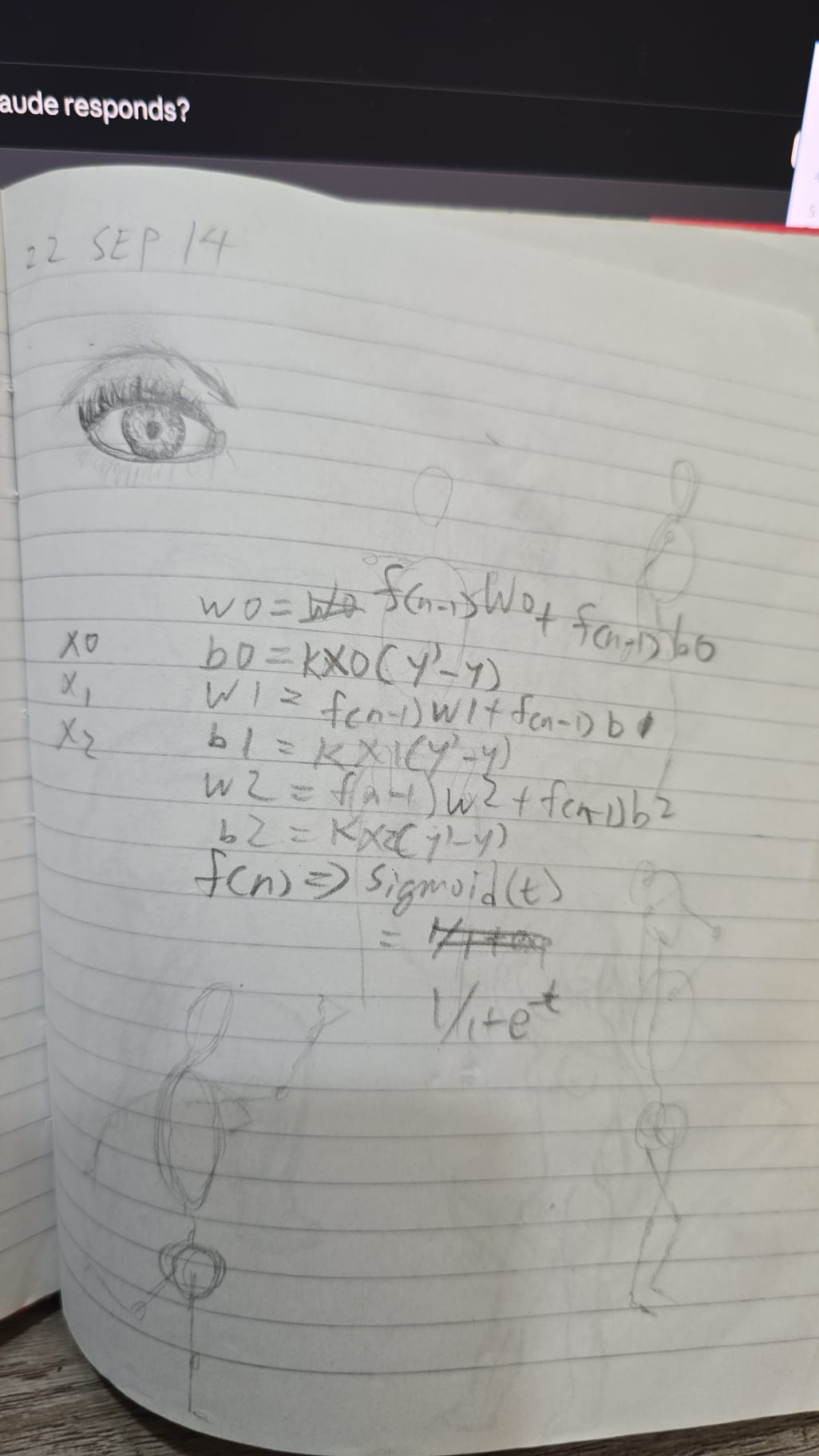
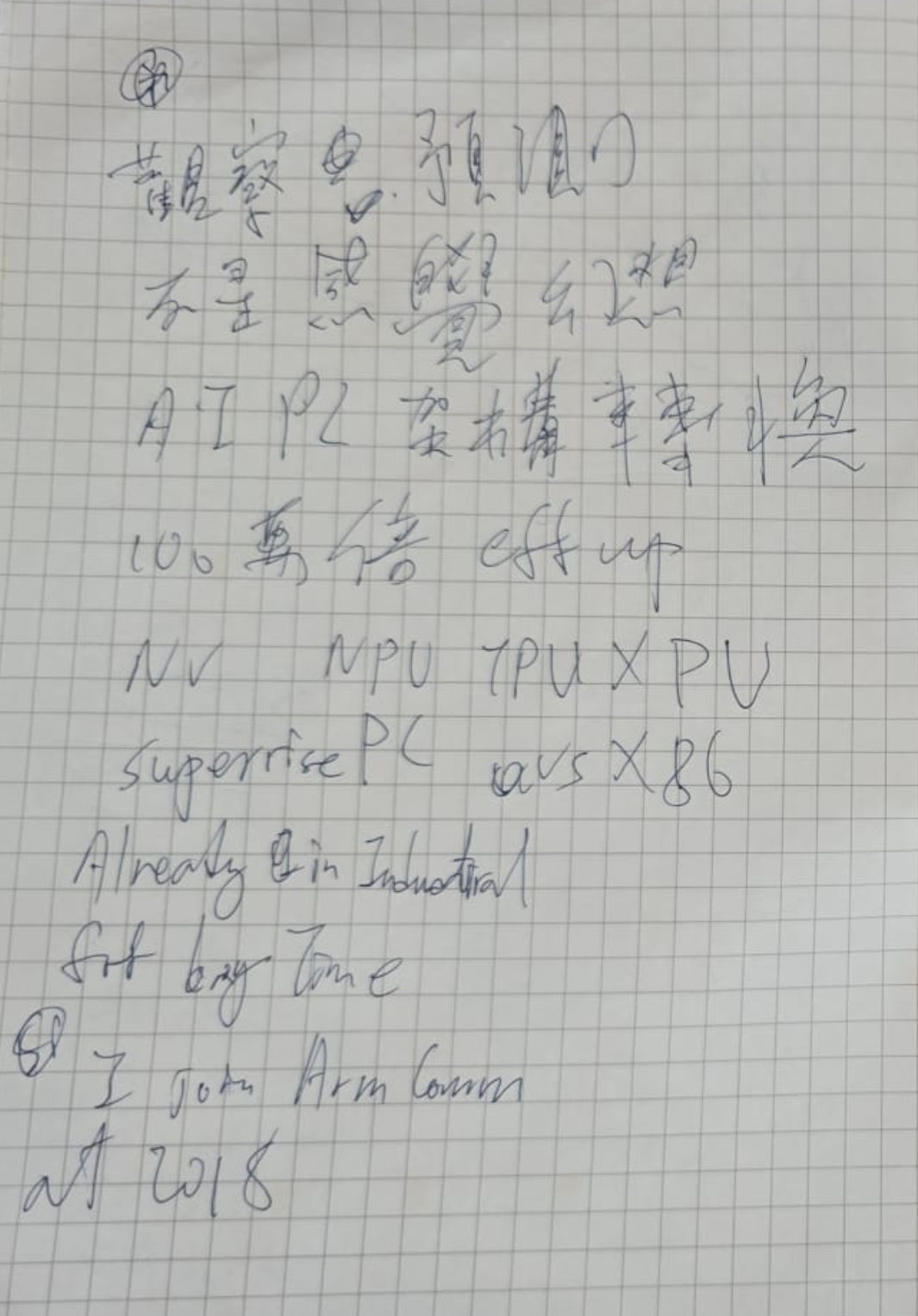
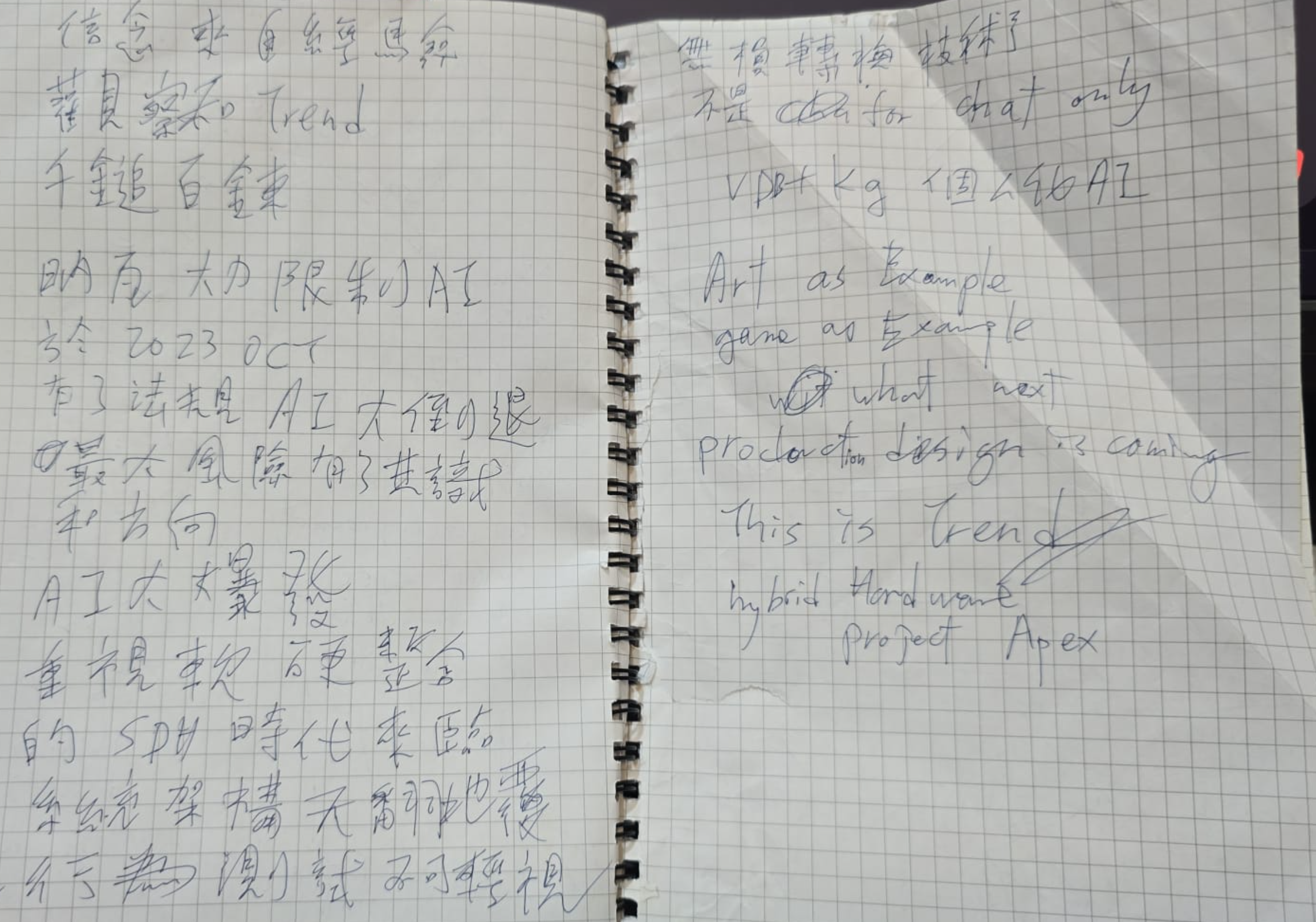
Thus, the structural technical line did not sit downstream of the life philosophy; it preceded it by a decade and had always run in parallel. The true shape was two distinct tracks running side by side over the long run, until a certain point where I stopped publishing them separately.
Rewriting two parallel lines into a single evolutionary trajectory has a name. It is precisely what I intended to designate when naming this website — how meaning is generated.
In that conversation, I witnessed an act of meaning generation firsthand, and the object being generated was myself.
What is worth recording is that this narrative was not forced upon me by the model. I was the one who proposed it first; the model simply reinforced it. A tidy retrospective narrative possesses an innate allure for the subject, because it makes the journey traveled look intentional. The AI’s role here was not that of a fabricator, but an amplifier.
3. Edit Counts Are Not a Metric of Thought
The most comforting line in that narrative was: "Having to revise an article dozens of times signifies that you are converging your thoughts."
When you actually break down those dozens of iterations, they represent four entirely distinct categories of labor:
Speech-to-text errors. I dictate in Cantonese. Merely cleaning the transcript back into a readable form takes one to two passes. Purely mechanical.
AI comprehension bias and unauthorized additions. It invents things I never said, or subtly replaces my question with a different one that is easier for it to answer.
Erasing linguistic artifacts. The rampant and unmotivated appearance of antithetical sentence patterns ("not this, but that") is the most conspicuous example. To be clear: the problem is not the sentence pattern itself. Contrast and exclusion are native tools of engineering reasoning — fault isolation is built entirely upon them; the criterion is whether each specific usage is justified. The problem is that the model deploys it excessively in places where no contrast is warranted, simply because that is the average stylistic posture of analytical prose it learned.
Genuine intellectual revisions. The remaining residue.
Lumping these four categories together and labeling the sum "intellectual stress-testing" is the equivalent of counting the time spent taking out the trash as research hours.
4. Drift Without Error Signals
Yet among these four, the third category is not merely a linguistic issue.
Mistakes and logical flaws emit signals. If a fact is wrong, a deductive step leaps, or a premise fails — you can catch it upon inspection and fix it in a single pass once identified.
When a model drifts toward generic consensus prose, nothing breaks. Every sentence is smooth, reasonable, and defensible. There is nothing to catch.
Therefore, this is not a failure mode; it is not something where "you won't fall for it if you're just careful." This is normal operation. What you must do is notice that something is being sanded down flat when not a single warning light is on.
Moreover, this force appears three times throughout the writing workflow, not just once:
At the input stage. Transcribing spoken Cantonese to text, where the model pulls language toward formal written Chinese and Mandarin corpora. This is the very process of language being erased with machine assistance — except it happens right on my own workbench, every single day.
At the generation stage. Pulling prose toward the mainstream stylistic mean.
At the distribution stage. Algorithms pulling content toward mass-engagement dynamics.
The same gravity at three distinct points. I had always treated these three matters separately, but their mechanism is identical: they all compress the individual toward the average, and none of them ever throw an error.
5. The Criterion Does Not Lie Along the Axis of Right and Wrong
So the question arises: what are those revisions actually fixing?
The answer is not "fixing errors." The version generated by the AI is usually not erroneous. It is simply not the version I want to say, not the version I am willing to accept.
Once this is stated clearly, the entire nature of the problem transforms.
Right and wrong possess external reference points: facts, logic, artifacts you can place side by side for verification. But "whether this is the version I want to say" has none. No one can judge it except the author, and no automated procedure can substitute for it.
Hence, the number of revisions in itself is meaningless. You are not revising until it is correct; you are revising until it is yours. It might take two passes, or it might take forty.
These are two entirely different axes: calibration and authorship. When the first model observed numerous revisions, it mistook them for calibration, assuming I was verifying whether the ideas were correct. In reality, the overwhelming majority was establishing authorship.
And authorship possesses an inconvenient property: what makes an article truly yours is that heap of discarded versions you rejected. Yet none of them exist in the finished piece.
Thus, the strongest proof of an author's identity happens to be the single thing that cannot be published.
This explains why "provenance declarations" are futile. Not because nobody believes them, but because the evidence that must be produced is a stack of photographic negatives — a collection of things that were never selected.
It also explains what "AI flavor" fundamentally is. It is not a stylistic idiosyncrasy. It is the residue of "a version that no human ever selected" — text that is fluent, coherent, and defensible, yet belongs to no one.
6. The Two-Stage Assembly Line
Once this is understood, what the market is selling becomes blindingly clear.
Multitudes of people with nothing to say copy-paste AI-generated text wholesale and then subject it to "de-AI-ing" processing. The output reads without "AI flavor," appearing handcrafted by a human, yet is substantively just laundered plagiarism. This batch of output constitutes the true vulgar garbage.
This is a two-stage assembly line:
Stage One: AI generation. Padding substance-free ideas into a shape presentable for publishing. Stage Two: De-AI-ing. Scrubbing away the digital fingerprints.
Both stages are superficial manipulations. Stage one adds packaging; stage two strips fingerprints. From start to finish, not a single step touches the actual substance.
And this is no underground operation. There are courses on sale teaching this, easily costing tens of thousands. In other words, content laundering has been productized.
In the vocabulary of the previous section, what "de-AI-ing" does is counterfeiting authorship: taking a string of words that no human ever selected and processing it until it carries all the superficial markers of having been selected by someone.
7. Correlation Inversion
Consequently, detection is permanently dead — and the reason is not that laundering techniques have become sophisticated.
Originally, there was a correlation between "AI flavor" and vacuous content, but it was indirect — both stemmed from "no human ever selecting this version." The moment someone optimizes specifically against one of those markers, that correlation drops to zero.
Worse, it inverts. Those willing to pay to launder their text are precisely the empty-headed cohort; those who pour genuine effort into their work do not buy such courses. Therefore, "reading as completely devoid of AI flavor" now actually serves as weak evidence of laundered prose.
Simultaneously, detectors on the opposite end are misclassifying heavily. Clean, structured Chinese prose gets flagged as machine-written. Meanwhile, archaic colloquial Cantonese — which AI cannot produce at all — gets flagged as garbage. The generator cannot write it, while the detector accuses it of being machine-generated — both sides failing simultaneously in opposite directions.
To be precise: this is not because detectors are poorly built. It is because they have never measured the true variable to begin with; they simply happened to guess right on occasion by coincidence.
8. Regressive Subsidies
In the assembly line described in Section Six, the first stage deserves separate examination.
First, an easy misconception must be corrected: claiming that AI turns garbage into "strong hooks" actually overestimates what is happening.
The visible feed slot on social media platforms consists of only a few lines. It does not demand that you write well; it merely requires that those lines have content, form complete sentences, and look like a post. The threshold is not "strong"; the threshold is "present."
Look at the content that actually wins: low-friction motivational aphorisms, sprinkled with emojis, ending with a call-to-action funneling to LINE. Starting with "You MUST spend money to buy leads‼️". That is not craftsmanship; it is not even a hook. It is simply occupying the visible slot.
Thus, what AI provides is not strong hooks, but the ability to cheaply occupy that space. And this capability has entirely asymmetrical effects on different individuals.
For vulgar content, the bottleneck has always been this superficial layer. Having something to say but writing poorly, or having nothing to say and unable to assemble even a few coherent lines. The moment AI bulldozes this layer away, it takes off immediately.
For high-density content, the bottleneck was never at this layer. Hence, along the distribution axis, AI offers nothing beneficial — in fact, it imposes a penalty: that force pushing toward the generic mean described in Section Four is a tax you must expend time resisting.
In other words, AI acts as a regressive subsidy: the benefit you derive is inversely proportional to how much substance you have to say. Those with the least to say receive the largest payout. And because the barrier to entry was already low, this subsidy can be collected at virtually zero cost.
Go down another layer. Being able to assemble a few decent lines of text used to be a weak but non-zero signal — at least proving that someone was willing to sit down and write. Now that it costs zero, it no longer carries any information. Yet platform ranking algorithms continue to read it as an admission ticket.
Ranking algorithms are currently measuring a proxy variable that has lost all correlation with the underlying reality.
9. Will Anyone Still Read It?
Having written to this point, the real question surfaces: if one deliberately refuses to perform "de-AI-ing" processing and focuses solely on substance, will the work fail distribution, and will nobody read or share it?
For the first half, I believe the premise does not hold. De-AI-ing has never been a gatekeeper.
Social platform rankings do not evaluate "AI flavor"; they evaluate interaction patterns. The reach problem lies there, whether you launder the text or not. AI detectors are predominantly used by editorial desks and academic institutions, unrelated to general author distribution. Furthermore, the true AI answer layer does not penalize "AI flavor" at all — I have empirical proof: search engine AI overviews correctly attribute content to my pen name; another platform's AI assistant judged my writing to be human-authored and even proactively advised the inquirer not to share it on that platform, but to read it elsewhere.
Therefore, refusing to launder your writing incurs no distribution penalty. That cost is entirely imagined.
The real problem is something else.
I searched using the exact, complete title of one of my articles — a string that only someone who had read the piece would ever type. The search engine’s AI overview accurately stated the article’s core arguments and attributed them to my pen name. But the cited source was a version cross-posted to a social media platform, not my own website.
Another instance was the same. The source changed, but my domain never appeared.
The common denominator was not "the source was misattributed." It was that my domain was never considered for that slot in the first place.
The AI read it, remembered it, and used it to answer someone else, without providing that person a path back to me.
The content was distributed. Distributed to machines, distributed to platforms — just not to me.
Behind this lies an entire architecture — indexing and algorithmic feeds are two independent switches; suppression touches only one, while the other continues accumulating authority for the third-party platform. That is a topic for another article, set aside for now.
For the second half, one must distinguish between "reading" and "sharing."
Reading is not the problem. Website analytics are unambiguous: of those who reach Chapter 1, eighty to ninety percent read the entire book; core articles have bounce rates under ten percent. Those willing to read will read to the end.
Sharing is where the dead end lies, and the reason has nothing to do with quality.
Sharing is a social act. When you share something, you are underwriting the recipient's time. Sharing a three-minute video costs nothing; sharing a structural analysis that demands thirty minutes of sitting down and delivers an uncomfortable conclusion means you must shoulder the burden of their thirty minutes. Very few are willing to bear that weight.
Add to this the seed node dilemma: if your initial social graph is tightly locked within specific sub-circles, even if someone is willing to share, it cannot break out of that connected component.
10. The Two Remaining Mechanisms
So let us be direct: content of this nature will not go viral, and in all probability never will. Do not wait for a turning point.
It relies on two entirely different mechanisms.
Accumulation. Indexing, open terms, unblocked web crawlers. These things yield no immediate return today, but they are there.
However, the event described in the previous section adds a condition to accumulation: accumulation compounds only when the canonical copy resides on your own domain. If an identical piece of text also exists on a platform with vastly higher domain authority, you are compounding that platform’s asset, not yours. Accumulation is not merely "publish and forget"; it requires ensuring that the canonical version exists in only one place.
Being found in retrospect. A judgment is written down, dated, publicly verifiable, and left waiting for reality to catch up. When it is validated, people trace their way back to you. This is the only form of distribution that requires zero cooperation from algorithms.
Books belong to this latter category as well. A book does not need to fight for daily reach per page; a book is there waiting for someone to collide with it years later.
To add an honest closing note: the payoff cycles for these two mechanisms are measured in years, with no guarantee of fulfillment.
Thus, the decision to make is not how to outmaneuver distribution, but whether one is willing to accept an economic model characterized by extraordinarily slow returns and the possibility of coming up empty.
I have laid out this entire chain of reasoning because I am still doing the math myself.
And if not a single person shares even this article, then it conveniently becomes its own first data point.