Author: Nebula Walker Date: 26AUG2026 MYTHOGEN ENGINE (mythogenengine.com)
📌 China's over-accumulation and America's financialization are not two distinct illnesses — they are two organs of a single system. For the past twenty years, both regimes have been postponing each other's day of reckoning.
Your Fixed Deposits Subsidized German Car Buyers
1. A Somewhat Comical Math Problem
Consider a set of numbers.
Worldwide, roughly 90 million motor vehicles are sold each year. According to Michael Froman's article "The Next Global Economic Crisis Could Be Made in China: How Overcapacity Ends," published in Foreign Affairs on August 13, 2026, China's domestic auto manufacturing capacity has reached 55 million vehicles per year, while domestic demand sits at around 12 million.
In other words: China has built enough capacity to produce over 60% of the world's cars, while its own consumers can absorb barely a fifth.
And yet — they keep building.
What makes this piece noteworthy is not standard China-bashing. Prophecies of imminent Chinese collapse have surfaced every year since the 2000s without materializing. The real significance lies in the author: Michael Froman, Obama-era US Trade Representative and current President of the Council on Foreign Relations. This man is a lifelong believer in free trade who spent the bulk of his career defending globalization. When someone who championed open markets for half a lifetime starts saying "the math doesn't work," it usually isn't a political stance — he genuinely ran the numbers.
Moreover: Froman himself did not predict a crash. He explicitly wrote that this crisis would not resemble the overnight collapse of a traditional financial institution, but would surface gradually — through declining industrial profits, mounting trade disputes, factory closures, weakening investment, and intensified government intervention. When Chinese-language commentary repackaged this article as the latest episode of "China collapse theory," that was a misreading, and one that discarded the most valuable part.
Incidentally, the article's most vulnerable point is the capacity figures themselves (nominal capacity can differ enormously from effective capacity). But the core symptom has independent corroboration: Dallas Fed research indicates that roughly 30% of China's industrial enterprises are loss-making, up from 20% pre-pandemic; by assets, loss-making firms' share in manufacturing rose from just over 4% in 2019 to nearly 11%.
His question ultimately boils down to one sentence:
If a single country seeks an ever-expanding market share across every tier of industry, who ultimately has the money to buy all of it?
2. The "Absolute Advantage" Label: Memorable but Inaccurate
Froman borrowed economist Yasheng Huang's term: China is running an "Absolute Advantage Economy." AI, EVs, semiconductors — while refusing to let go of garments and cheap sundries, competing with Germany in autos and Bangladesh in textiles simultaneously. This violates the logic of comparative advantage.
The label is catchy. But in economics it is loose, and its looseness misleads all subsequent reasoning.
A three-minute Ricardo refresher.
Suppose an attorney types twice as fast as their assistant and organizes files better too. The attorney holds "absolute advantage" in both tasks. Should they do their own typing?
Of course not. Every hour spent typing forfeits an hour of legal billing. The rational move is to allocate 100% of their time to high-value legal work and outsource typing — even to someone objectively less competent.
This is the entirety of comparative advantage: Specialization depends on relative opportunity cost, not absolute competence. Therefore "China excels at everything" is not a theoretical contradiction. A country superior in all industries should still exit low-return ones, because retaining them crowds out high-return capacity.
Why didn't China exit?
What broke is not the principle of comparative advantage but the mechanism that forces exit. Normally, three price signals automate this: rising exchange rates, rising wages, and declining returns on capital. When a textile mill stops making money, the owner withdraws capital to pursue other ventures. No committee convened to decide "we surrender textiles" — in Taiwan and South Korea, capital simply left of its own accord.
China's problem is: The money doesn't leave.
Why? Because for certain players, capital is kept artificially too cheap.
An immediate qualifier, or anyone who has done business in China will demolish the argument in one sentence: Cheap capital has never been universally available. Private SMEs face high, even exorbitant borrowing costs. Those who actually receive near-zero-cost capital are SOEs, local government financing vehicles, and designated strategic sectors — precisely the entities least accountable for commercial returns.
So the accurate mechanism is not "money is cheap" but "the price of money differs completely depending on who you are" — and those receiving the cheapest capital are exactly those least required to deliver returns. Capital so cheap that even a business with razor-thin margins or outright losses remains viable on paper.
The correct diagnosis, therefore, is not "wanting everything" but "price signals have been suppressed." This distinction has practical consequences: the former diagnosis prescribes asking China to voluntarily exit certain industries — an impossible recommendation; the latter points to the hard constraints of interest rates, exchange rates, and capital returns — terrain where there is actually something to discuss.
One commonly overlooked premise is also worth adding. The assertion "having climbed up, China should vacate the lower rungs" presupposes the upper tiers are actually profitable. But a large portion of China's high-end industries remain in the investment phase, not the harvest phase — wide-body jets aren't selling, chips survive on internal circulation, and the profitability of overseas infrastructure is questionable. If the upper level hasn't stabilized enough to sustain itself, then clinging to low-end manufacturing is not "refusing to let go" but lacking the qualification to let go: the bottom rung provides cash flow; the upper rung burns it.
3. The Truth About Subsidies: The Government Didn't Hand Money to Factories — It Drafted You
Whenever Chinese overcapacity comes up, the reflexive image is "government subsidies" — officials carrying suitcases of cash into factories.
Reality is vastly more elegant and more sophisticated.
Peking University economist Huang Yiping traced this mechanism's origins with no ambiguity. After reform and opening, the Chinese government's fiscal capacity actually shrank steadily: fiscal revenue as a share of GDP fell from 36% in 1978 to 11% in 1996. Many local governments could barely cover civil-servant payrolls — the phrase was "subsistence-level public finance" — let alone disburse direct subsidies to enterprises.
No money, yet SOEs had to be kept alive (because SOE collapse meant mass unemployment and social instability). What to do?
The answer: Bypass through the financial system.
Two specific measures. First, suppress deposit and lending rates in the formal banking sector to extremely low levels. Second, channel credit allocation with clear bias toward designated enterprises. SOEs thus obtained funding without paying market price — in Huang Yiping's own words, this was effectively a disguised subsidy.
What the fiscal budget could not do, depositors were drafted to do instead.
The most comprehensive long-term articulation of this thesis comes from Michael Pettis: his core argument, built over more than a decade, is that China's high investment and trade surplus are not the product of a savings virtue, but the result of income being systematically transferred from households to the production sector. Sections 3 and 7 of this essay are built fundamentally on his and Huang Yiping's work.
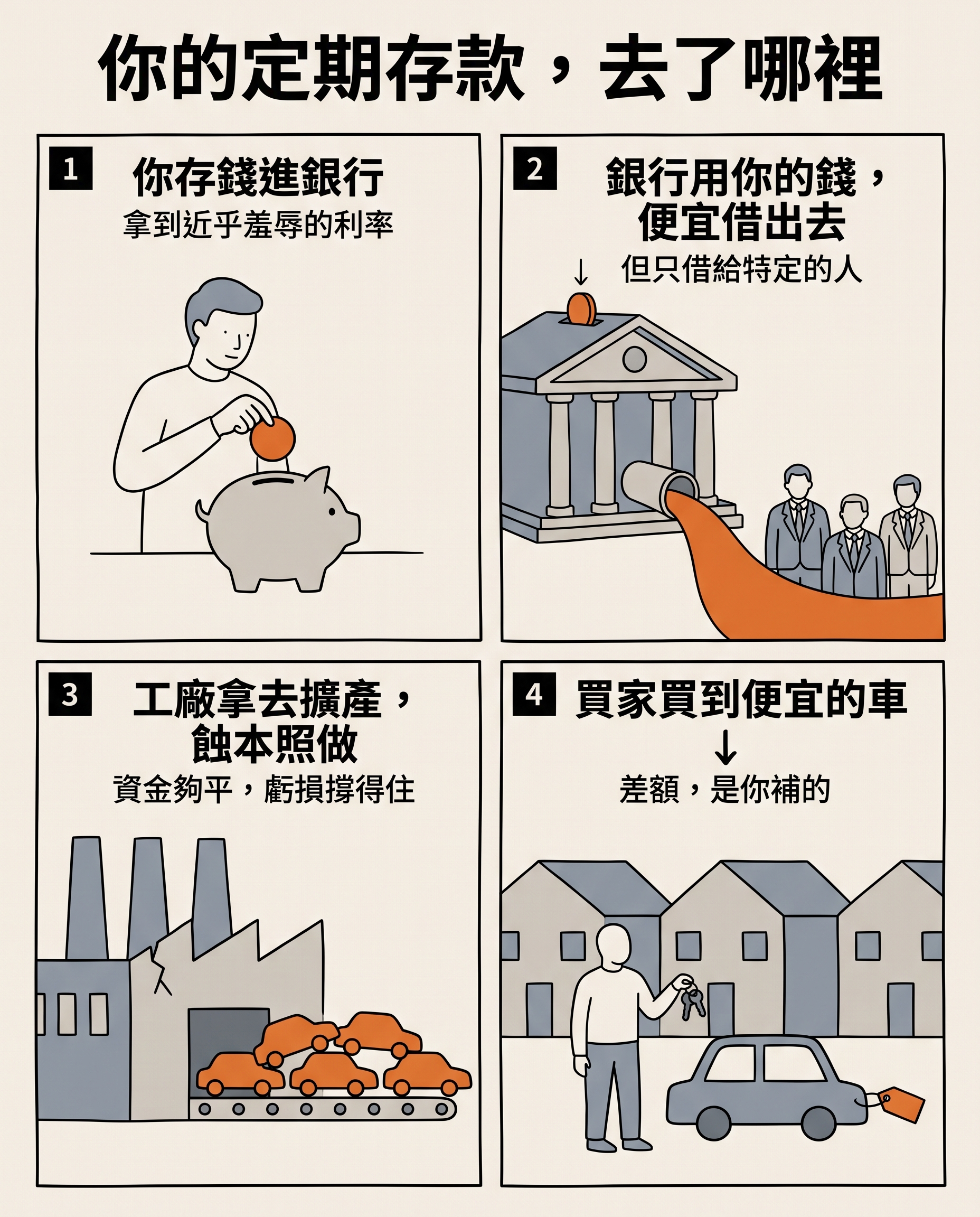
Trace the plumbing, and the picture becomes vividly concrete:
You deposit your life savings in a bank at a real interest rate so low it's nearly humiliating. The bank lends your money, at an equally suppressed rate, to a factory that hasn't turned a profit in years. The factory uses this cheap capital to expand production, then exports EVs, solar panels, and lithium batteries at prices no European manufacturer can conceivably match.
Your fixed deposits subsidized German consumers buying cars.
This is not rhetoric. It is a literal description of capital flows.
And the extraction operates through not one channel but two.
The first is savings: deposit rates are suppressed at or below inflation, quietly eroding your nest egg year by year. The second is wages: labor compensation chronically lags output value, keeping the labor share of national income depressed. The same people, in their dual roles as savers and workers, pay for that excess capacity twice — once when they deposit, and once before they are even paid.
So the word "subsidy" is too reductive. Costs never vanished; they merely changed address — residing in banks' non-performing loans, in local government debt, in household deposits whose returns never keep pace with inflation. This is a technique for driving costs off the income statement, onto the balance sheet, and then into time itself.
And its elegance lies in this: those being extracted can barely perceive that they are paying. Fiscal subsidies appear in budget documents and invite public scrutiny. Below-market deposit rates appear nowhere at all — just "this year's interest seems a bit less again."
4. Involution Is Not a Chess Game but Thirty Provinces Each Acting Rationally
-3c5947c4d59fc93a4f281b3c32468c13.jpg)
One sentence in Froman's article strikes me as its weakest: characterizing "involution" (neijuan) as a tool of Xi Jinping's political control.
This mistakes an emergent outcome for a designed intention.
The mechanism of involution has a very clear origin, one predating the current leader by far. After the 1994 tax-sharing reform, local fiscal revenues were largely siphoned to the central government, leaving industrial attraction and land sales as local governments' sole revenue lifeline; layered atop this was the GDP-and-investment-based cadre promotion tournament (classic analysis by economist Zhou Li-An). Every province thus had intense incentive to replicate the same industry on its own territory.
Not to make the nation wealthier, but for local accounting metrics and local employment.
Thirty provinces, each perfectly rational. Summed up: 55 million vehicles of capacity against 12 million of domestic demand.
This is coordination failure, not planning. A genuine planner would never allocate capacity this way — if someone were actually playing chess, the numbers wouldn't look like this.
And this is only half the push.
The other half comes from the household side, and it's an even harder constraint: People need jobs.
Tens of millions of graduates each year need somewhere to go, and that figure is non-negotiable. Society cannot supply that many positions, so people find their own way — wherever something still looks profitable, they crowd in, trying every industry. What they produce must be sold; if the quality can't compete, the only option is cheapness; to recoup costs quickly, the only path is dumping. Rock-bottom prices are grown this way — and local governments, seeing someone creating employment on their behalf, naturally support it.
So both ends meet at the same point: Government needs investment projects; people need jobs; the product of this transaction is another production line. One end pushes, the other pushes too, and there is no one in the middle stepping on the brake.
Someone in a discussion thread summed it up more bluntly: Nobody is playing chess — corrupt officials aren't that sharp.
"Unable to stop" is not a willpower problem; both ends are pushing simultaneously.
The most direct counter-evidence comes from Beijing itself. In the past two years, "opposing involution-style competition" has entered the highest tier of official language — price wars, automakers stretching supplier payment terms, photovoltaic overcapacity have all been called out by name. If involution were a tool of governance, the central government would have no reason to oppose its own tool. The more plausible reading is wanting to rein it in but being unable to: the cost of closing factories falls on local government finances and local employment, and those who bear the cost are not those who issue the orders.
Still, half-credit to Froman. The Xi era did add another layer: the logic for selecting industrial policy targets shifted from "whatever makes money" to "whatever plugs a vulnerability," with security overriding returns. So political intent is not zero — but it operates on directional choice (why semiconductors, EVs, AI) rather than on the involution mechanism itself (why every province must build its own copy).
Conflating the two yields the conclusion "this can be stopped by a single person" — an assessment that is both optimistic and naïve.
5. The Other Side of the Mirror: Over-Accumulation vs. Financialization
Now rotate the lens 180 degrees.
The pathology most fiercely criticized in the United States over the past three decades is called financialization: corporations ceasing to reinvest in operations, instead buying back shares, outsourcing production, cutting R&D, channeling resources toward asset prices.
On the surface, this appears to be a world apart from China's overcapacity — one invests too little, the other too much; one is the extreme of capitalism, the other looks like a residue of socialism.
But they operate the same lever, merely in opposite directions:
| Price of Capital | Corporate Response | Symptom | |
|---|---|---|---|
| USA | Inflated (asset-side returns too rich) | Profitable without investing | Hollowing out, loss of industrial capability |
| China | Suppressed (capital too cheap) | Continue investing despite losses | Overcapacity, deflationary competition |
The shared pathology in one sentence: Return on capital has decoupled from investment decisions. One decoupled upward; the other decoupled downward.
If each path needs a name: America's side is financialization; China's side is over-accumulation.
An honest caveat: in the original usage of Marx and David Harvey, over-accumulation is actually the shared premise for both sides — capital cannot find productive outlets and must seek alternatives; financialization is one such outlet, switching capital into a circulation of assets and claims. Strictly speaking, China's side should be called "over-accumulation in the physical production sector," America's side "over-accumulation in the financial sector." Same disease, two modes of outbreak.
One further asymmetry is worth noting, because it is the sharpest edge of this comparison. Marxian over-accumulation is caused by capitalists chasing profit: rising organic composition, falling profit rates, capital still compelled to accumulate. China's causation is precisely reversed — those allocating capital are not pursuing profit at all. Local governments allocate for employment and promotion; banks allocate along policy directives.
Identical symptoms, entirely opposite engines. Using Marx's vocabulary to describe a disease of a socialist-legacy system — the irony itself is the argument.
And more fundamentally, both sides are answering the same question — too much money, nowhere to go.
America turned surplus savings into asset prices; China turned surplus savings into steel, concrete, and production lines. In the end, both hold a pile of claims they cannot cash: one side has unsellable valuations, the other unsellable capacity.
6. So Is This Capitalism or a Planned Economy?
Intuition says: China's system is obviously a planned economy.
But there is a very hard counter-argument, from Hungarian economist Kornai János. He spent his career studying socialist systems and reached a core conclusion: The disease of planned economies is shortage, not surplus.
The reason is the soft budget constraint — enterprises that lose money do not die, those lacking resources do not go bankrupt, so they hoard raw materials and produce without accountability to demand. The result was the shared landscape of the Soviet Union, Eastern Europe, and Mao-era China: queues, rationing, everything scarce.
China's current symptoms are the polar opposite: falling prices, warehouse oversupply, insufficient capacity utilization, industry-wide losses.
The same component transplanted into a different environment produces an inverted symptom:
- Soft budget constraint + no competition, no prices → shortage
- Soft budget constraint + decentralized entry, brutal price wars → surplus
So this is not a continuation of planned economy but a single component of planned economy, transplanted into market competition, that has grown into something new.
Is it capitalism? Depends where you slice.
BYD, CATL, LONGi — private, publicly listed, with foreign institutional shareholders, covered by investment banks, issuing equity incentives, waging price wars to the bone. From ownership to product markets, this is capitalism through and through — and more ferocious than the American version. The only genuinely non-market element in the entire system is the price of capital.
So the true symmetry looks like this:
- China: Hyper-marketized product markets + non-marketized capital markets
- USA: Hyper-marketized capital markets + rent-seeking product markets (platform monopolies, regulatory capture, patent and network-effect rent extraction)
Both sides are excessive on one axis and dysfunctional on the other; they simply differ on which axis fails. This framing explains far better than "capitalism vs. planned economy" why two disease presentations look completely different yet share the same origin.
7. Not Two Systems, but Two Organs of a Single System
-d19b72332361219ca2caaab4af754880.jpg)
The previous two sections positioned the US and China as two sides of a single mirror. But stopping there misses a deeper layer: these two sides don't merely mirror each other — they feed each other.
Draw out the blood vessels, and it's a closed loop:
- China suppresses household income and consumption → savings surplus → trade surplus
- Surplus flows back into US dollar assets (Treasuries, agency bonds) → suppresses US long-term interest rates
- Cheap capital + cheap imported goods → US inflation stays subdued → the Fed can maintain low rates long-term → asset prices rise → financialization receives fuel
- US debt-fueled consumption → absorbs China's excess capacity → China need not rebalance
- Return to step one
This is not a new discovery; it's just that no one had previously written both sides' pathologies into a single sentence. Greenspan's 2005 "conundrum" — the Fed raised rates yet long-term yields didn't budge — described exactly step two; Bernanke that same year proposed the "global savings glut" to explain it. Some later called this arrangement Bretton Woods II; others, Chimerica.
And the mutual offset matters more than the mutual dependency.
Financialization pressed down the income share of American workers. In theory, this should have quickly detonated politically. But it didn't — because in the same period, capacity-ization pressed down the prices of goods.
Wages didn't rise, but things got cheaper, so the surface standard of living didn't immediately collapse.
This was a bilateral political subsidy: China used exports to absorb excess capacity that would otherwise have exploded domestically; the US used cheap imports to absorb a distributional contradiction that would otherwise have exploded domestically. Each regime parked its most dangerous bomb in the other's house.
But this offset had an expiry date, and that date has arrived.
Cheap goods can only offset the "buying things" portion of household costs. Over these twenty years, American household spending shifted steadily toward services, housing, healthcare, and education — precisely the things China cannot manufacture cheaply and that asset inflation makes ever more expensive.
Thus both ends of the same system backfired simultaneously: televisions and clothing got ever cheaper; rent, healthcare, and tuition got ever more expensive. The moment the offset ceased to work was the moment politics turned. Everything from 2016 onward can be read from this sentence.
A further uncomfortable inference. Since a significant portion of wages' purchasing power was propped up by suppressed goods prices, the real purchasing power of Western households over these twenty years was actually lower than it appeared — the gap was filled by the suppressed wages and deposit interest of people on the other side.
What was called "middle-class living standards were maintained" was partly not earned by the middle class itself, but subsidized by others.
And there is another question: who can absorb the surplus now.
The American absorption channel is closing, but the surplus won't vanish — it will merely reroute: the EU, ASEAN, Latin America, Africa. The problem is that every new recipient is smaller, less capable of absorption, and none holds reserve-currency status to recycle the surplus back into safe assets.
Previously, excess capacity was exchanged for dollar-denominated claims; now, it increasingly returns as accounts receivable, infrastructure debt, and political friction. The closed loop is degenerating into an open one.
One final trap to watch for. "The two systems coexist because they are complementary" slides easily into a functionalist fallacy — reading "appearing complementary after the fact" as "existing because of complementarity."
This is precisely the reasoning Section 4 rejected: emergent outcomes do not equal designed intentions. No one designed this loop; both sides made decisions for domestic reasons that happened to interlock for twenty years. The accurate description is happened to interlock, then mutually locked in — not "formed because they needed each other."
8. So Whose Pocket Did the Cheapness End Up In?
Up to this point, this essay has answered the supply-side question: why did such a torrent of cheap goods appear in the world?
One question remains unanswered, and it is actually closer to most people's daily lives: the dividend of suppressed goods prices — whose hands did it ultimately land in?
The answer does not, as one might imagine, land in consumers' hands. I examined Hong Kong, Shenzhen, inland China, and Taiwan side by side, and the conclusion is that no one in any of the four actually captured it — the cheapness was intercepted at the last mile by land rent.
That is the subject of another essay (〈Four Places Where No One Captured the Cheapness〉). This one only addresses how the cheapness was manufactured.
9. "When Will It Blow Up?" — The Question Itself Is Wrong
"Structural problem" and "imminent collapse" are two different things.
The Chinese system's special capability lies not in avoiding losses but in slicing losses thin and distributing them to those with no bargaining power: depositors receive below-market interest; suppliers eat extended payment terms; migrant workers eat wage arrears; local government finances eat rollovers. The Western logic is immediate clearing — if you can't pay, the court arrives. Here, the logic is delay: extend, restructure, impose capital controls, apply social control.
So asking "when will it blow up" has produced no answer for twenty years.
A more useful question: Who is left to absorb the losses? When is that list exhausted?
The advantage of this question is that it has observable proxy indicators, all publicly available:
- Actual payment terms from automakers to suppliers (how many days have accounts payable been stretched to)
- Default rates on commercial acceptance bills
- The share of LGFV bonds being rolled over and their refinancing costs
- The direction of household deposit migration (where are time deposits moving)
- Real deposit rates relative to inflation
- EU trade decisions — the US approach is already set; the EU's is not. How much Chinese capacity the world can still absorb is largely written in Brussels's forthcoming tariff and subsidy investigations
The weight of the last item is consistently underestimated. Germany has long been the most committed beneficiary and defender of trade with China, yet according to Rhodium Group figures, German goods exports to China in 2025 fell to a ten-year low — down 9.3% year-on-year, down 23% from the 2022 peak. When the largest stakeholder begins losing money, the wall inside the EU that had been holding back protectionism will start to crack.
And this isn't happening only in China.
"Loss-making enterprises surviving on renewed loans" has a universal name: zombie firms. OECD systematic research found that the higher the capital share held by zombie firms in an industry, the lower the investment and employment growth of healthy firms — low-productivity companies squatting at the exit threshold clog the market and slow resource reallocation.
Dallas Fed research provides the Chinese scale: zombie asset share among non-financial enterprises rose from 5% in 2018 to 16% in 2024, with real estate surging from 6% to 40% and manufacturing from 4% to 11%.
Europe has its own version: ECB data shows that the eurozone's zombie firm prevalence before the pandemic remained higher than pre-financial-crisis levels, and bank lending rates to these firms barely reflected their elevated default risk.
But before citing such figures, a trap must be addressed.
The most common zombie-firm definition is "interest coverage ratio below 1 for three consecutive years" — the denominator is interest expense. Rate hikes mechanically push a batch of companies onto the list, even if their operations haven't changed at all.
So recent record-high zombie-firm counts across countries partly reflect the arithmetic consequence of interest rate normalization, not new rot.
And once you think this through, it actually becomes more important: the real change is not that companies suddenly deteriorated, but that the era of cheap money ended. The system that ran for twenty years on suppressed capital costs now has the bill mailed back by interest rates.
Japan is currently the only major economy genuinely conducting liquidation — after ending negative rates, bankruptcy figures rose to their highest in over a decade, while zombie-firm counts saw their first multi-year decline. The cost is evident; so is the direction.
Watching these indicators is more reliable than watching any official statement.
10. The Ladder Was Never Lowered — It Was Toppled by Costs
This is the most important section of the entire discussion to take away — and the one I originally got wrong before readers dismantled it.
The popular narrative goes: over the past seventy years, industrializing nations followed a single path — start with shoes, garments, and toys; earn foreign exchange; cultivate a first generation of industrial workers; accumulate capital; then climb upward. Japan followed it, Taiwan and South Korea followed it, China itself climbed this way. Now China has reached the upper floors but refuses to lower the ladder.
It sounds morally weighty. The problem is: No one ever "lowered" the ladder.
Taiwan ceded garments, South Korea ceded footwear, Japan ceded textiles — none of these was generosity. Every case was wages rising until the business became unviable, forced out by costs. In all of history, no country has ever voluntarily exited an industry tier while it was still profitable. The so-called ladder was actually an unwilling, price-driven yielding of position.
What China disrupted, therefore, is not anyone's goodwill but the mechanism itself. When the cost of capital is suppressed to near zero, rising wages no longer constitute a reason to exit — losses can be sustained on even cheaper capital, held out until the competitor dies first. The ladder wasn't taken away by anyone — the law of physics holding the ladder up was switched off.
Framed this way, the argument actually becomes harder to refute: it need not appeal to morality, only point to the failure of price mechanisms — which is the very same thing this essay has been discussing since Section 2, making its second appearance.
And the ladder is being dismantled from the other end as well. Economist Dani Rodrik's concept of "premature deindustrialization" shows that developing nations are seeing manufacturing's share of employment decline at far lower per-capita income levels than Taiwan or South Korea achieved. The reason is automation — the same output requires ever fewer workers. Someone in a discussion thread captured it in one sentence: when the last person on earth costs more than a machine, everything switches to machines.
So the ultimate final competitor is not China but the machine. China is an accelerator and amplifier, not the sole cause.
And the same logic applies within China itself, though rarely stated: Using industry to absorb total employment is a dead end. Modern production technology's output per person has long exceeded per-person needs — under this premise, endlessly expanding capacity can only end in involution to death, because excess capacity finds no matching demand, and excess people find no matching positions.
Developed nations once used the tertiary sector to absorb these people. China did not take this path, for reasons tracing back to Section 3: for services to flourish, people must first have money to consume, and consumer spending power is precisely what was suppressed in exchange for capacity.
So the argument circles back to its origin — refusing to raise wages means domestic demand cannot be sustained; unsustainable domestic demand means continuing to rely on exports to absorb capacity.
This correction determines the prescription. If all responsibility is placed on China, the resulting prescription is tariffs, de-risking, supply-chain restructuring — but none of these can put the ladder back, because the ladder was never placed by anyone. The things that could genuinely substitute for it (capital transfer, technology transfer, market access for developing nations, and redistribution to address automation's impact) are currently the subject of virtually no serious discussion.
11. Where Is the Chinese Economy Headed?
First, rule out two extremes.
It will not be a crash-style clearing. The reasoning is the entire "when will it blow up" section: this system's core capability is distributing losses, not recognizing them. Froman's own assessment is also gradualist — declining profits, mounting disputes, factory closures, weakening investment, intensifying intervention. This is a downhill slope, not a cliff.
Nor is a smooth rebalancing likely. What needs to be done technically is actually widely known: return resources from the production sector to households — expand social security coverage, loosen the household registration system, replace land finance with property taxes, route SOE dividends into social insurance. The bottleneck is not knowledge but politics. Because that amounts to weakening the control over resources held by local governments and industrial departments — which is precisely the power base of this system. Asking a system to voluntarily dismantle its own distribution channels — the difficulty lies outside economics.
So the baseline scenario is the middle path: A Chinese version of balance-sheet recession.
The hallmark of Japan's 1990s was companies shifting from "profit maximization" to "debt minimization," rendering monetary easing powerless to stimulate credit. China's version differs in three ways, all three worse:
- It arrives earlier. Japan stagnated after becoming rich; China is hitting the wall at a per-capita income far below Japan's level at the time — getting old before getting rich.
- The external environment is hostile. Japan could at least rely on exports to absorb; now tariff walls are closing in from all sides.
- An additional layer of local government debt, tightly coupled to land prices. As property prices fall, local finances bleed in tandem.
But there are also two buffers Japan lacked: capital controls prevent money from fleeing, and the state-owned banking system precludes bank runs. These two features cannot purchase a solution, but they can purchase time — a great deal of time.
So the reasonable expectation: Nominal growth continues, but growth no longer generates profit. Output rises but revenue doesn't; export share keeps climbing until external doors close; deflationary pressure comes mainly from capacity rather than demand collapse; and the felt experience for residents will be "everything gets cheaper, but jobs get harder to find."
Along this main trajectory, three forks are worth watching:
- External acute shock: EU and US tariffs tighten simultaneously, narrowing the export valve, forcing surplus capacity back into the domestic market, intensifying deflation, compressing industrial profit and employment together. This is the fastest pathway, and its trigger point sits in Brussels and Washington, not Beijing. Note that per the closed-loop logic of Section 7, this pathway doesn't leave only China paying — the blood vessel is bidirectional; severing it means the US, too, faces real inflation without cheap goods and real funding costs without surplus recycling for the first time. Tariff walls were never a one-sided punishment tool.
- Internal chronic delay (baseline): Surviving year by year on household deposits, supplier payment terms, and debt rollovers. This path can run longer than anyone expects.
- Passive clearing: Not a policy pivot but losses accumulating until local government finances can no longer hold, with clearing forced by fiscal exhaustion. This is the most painful version, because no one chooses its timing.
A fair alternative reading should also be presented. Policy circles and some industry analysts believe that manufacturing upgrades will eventually support productivity and wages, with domestic demand following naturally — once EVs, batteries, and photovoltaics complete their shakeout and leave a few genuinely profitable giants, China will have walked the path that Japanese automakers and Korean semiconductors once walked. This version is not without basis: industry-wide losses followed by surviving winners is capitalism's standard script. The disagreement is over how many die in that shakeout, how many years it takes, and whether the external world is willing to continue being the buyer during that period.
My assessment: the form will resemble Japan's, the duration will be longer, the pain will be broader, and throughout the process, those compressed first will always be those with no bargaining power.
But this is judgment, not prophecy. The usefulness of the indicator list above is precisely that it lets you know what you are seeing when events unfold — rather than repeating "it'll blow up next year" every year.
12. Conclusion: Two Regimes Mutually Postponing Each Other's Day of Reckoning
Someone in a discussion thread wrote a very clean line: Surplus is not abundance. Abundance means you can use it all; surplus means you cannot. Abundance is wealth; surplus is waste.
This line applies equally to both sides. One turned surplus money into unaffordable houses and inflated valuations; the other turned surplus money into unsellable cars and batteries producing no electricity.
But more important than this comparison is what lies beneath it:
These are not two broken systems but two organs of a single system. One is responsible for producing more than the world can buy; the other for producing more claims than the world can repay. Both are connected by the same blood vessel.
So the true significance of tariff walls is not punishing China — it is severing that blood vessel. And what happens after the cut, more accurately described, is not hemorrhage but withdrawal.
For twenty years, the West relied on Chinese goods prices to suppress inflation — that was not an external supplement but something that had grown into the metabolism itself. Once withdrawn, prices return to where they belong — and people will experience that process as "inflation out of control," will search for culprits, yet will struggle to accept the real answer: their wages' purchasing power was never actually that high.
China's withdrawal will be equally painful: without external buyers, it must for the first time face alone the capacity it built.
The past twenty years were not two regimes competing. They were two regimes mutually postponing each other's day of reckoning.
Froman himself left an even colder line in his article: even if the next crisis is made in China, the cleanup work will most likely fall on the United States and the institutions it supports.
He probably didn't think that sentence through to its end. The bill was always co-signed — it's just that both sides believed the debt was owed by the other.
Notes: What This Essay Owes
The easiest mistake in writing commentary is presenting what you've read as your own discovery. So let's settle the accounts.
Not mine:
- China using suppressed interest rates and biased allocation to transfer household income to the production sector — Michael Pettis has argued this for over a decade; Huang Yiping provided the fiscal-capacity-decline causal thread
- The tax-sharing system and promotion tournaments as generators of redundant investment — Zhou Li-An
- Soft budget constraint, and why planned systems produce shortage — Kornai János
- The US-China savings–surplus–low-interest-rate closed loop — Bernanke's "global savings glut," Greenspan's long-rate conundrum, and subsequent Bretton Woods II and Chimerica formulations
- Premature deindustrialization — Dani Rodrik
- Why comparative advantage isn't invalidated by "excelling at everything" — Ricardo, 1817
- Employment as a hard constraint, "using industry to absorb total employment is a dead end," the "withdrawal" metaphor, and the first challenge to "kicking away the ladder" — from anonymous participants in a public discussion thread who reached the key points earlier than most credentialed commentators
Mine:
- Reading financialization and over-accumulation as two ends of a single lever, rather than as two opposing systems
- The ladder was never lowered — it was toppled by costs: replacing a moral narrative with a price-mechanism narrative
- And assembling all the above components into a single machine
Whether assembly itself counts as original is debatable. But if this essay has value, the value lies in the assembly, not the parts.
This is Part 1 of a trilogy. Part 1 addresses how cheap goods were engineered; Part 2, 〈Four Places Where No One Captured the Cheapness〉, addresses where that cheapness flowed; Part 3, 〈Capital Won't Leave, People Won't Leave〉, addresses why exit mechanisms failed. Series landing page: 《Exit Mechanism Trilogy: The Cost of Cheapness》.
Sources: Michael B. G. Froman, "The Next Global Economic Crisis Could Be Made in China: How Overcapacity Ends," Foreign Affairs, September/October 2026 issue (published online August 13); fiscal ratios and financial repression mechanisms from Huang Yiping's public lectures at the National School of Development, Peking University; German export data to China from Rhodium Group, as cited by Froman; "premature deindustrialization" from Dani Rodrik; soft budget constraint from Kornai János.