Author: Nebula Walker Date: 02JUL2026 MYTHOGEN ENGINE (mythogenengine.com)
📌 The same script—when capital learns how to kill innovation, every industry becomes the games industry.
The Standard Operating Procedure for Killing Innovation
The Same Script—When Capital Learns How to Kill Innovation, Every Industry Becomes the Games Industry
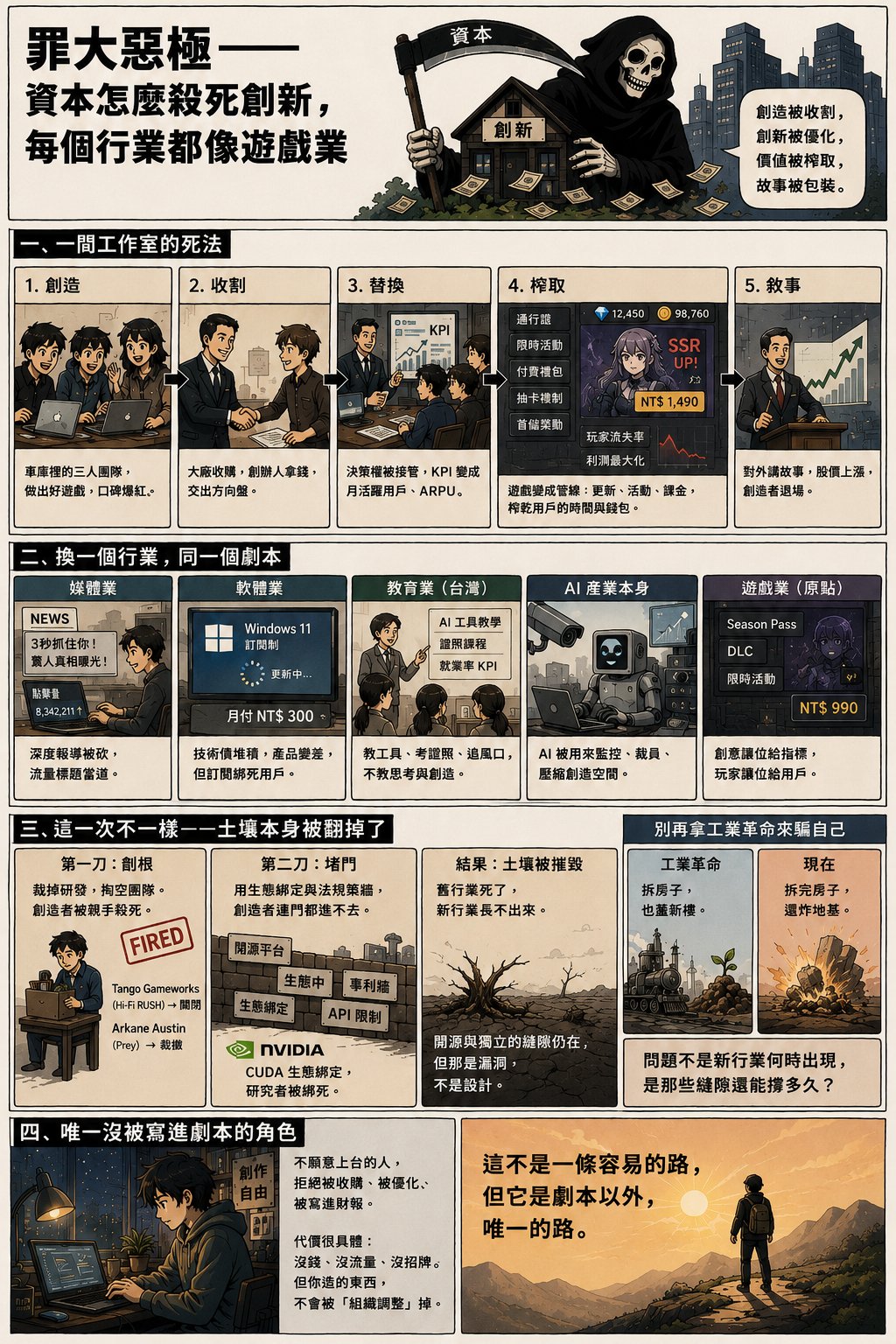
I. How a Studio Dies
The opening of the story is always moving.
Three people in a garage write a game, with no marketing budget and no publisher, climbing the Steam charts purely on player word-of-mouth. The media packages them with words like "dream" and "passion," and investors start knocking on the door.
Then the story enters the second act.
A major publisher acquires the studio. The press release headline reads "Joining Forces." The founder receives a life-changing sum of money in exchange for a three-year lock-in contract and a Vice President title. In the first year, he can still decide the direction of the game. In the second year, the higher-ups start sending people to "assist" with product decisions, and KPIs shift from "player experience" to "monthly active users" and "ARPU." In the third year, the contract expires, and he leaves.
Or perhaps he doesn't leave. He gets "restructured."
The studio doesn't close down. It remains, carrying the same brand name, but the people sitting inside are completely different. Designers are replaced by data analysts, programmers are replaced by platform integration engineers, and the producer is replaced by a "Director of Operations." Games keep coming out: sequels, DLCs, battle passes, and limited-time events. Every quarterly financial report looks beautiful.
But that thing that kept players glued to their screens at 3 AM, unable to bring themselves to shut it off—it's gone.
No one killed it. It was simply "optimized."
II. The Structure of the Script
If this were only the story of one studio, it would just be industry gossip. But the problem is, this script has been so successful that everyone is using it now.
Its structure is remarkably concise:
Act I: Creation. Someone uses their own time, energy, and expertise to build something new. This thing has value because it solves a real problem or opens up a space others didn't see.
Act II: Harvest. Capital enters the scene. Acquisition, investment, "strategic partnership"—the label doesn't matter; what matters is the transfer of control. The creators get a payout and hand over the steering wheel.
Act III: Replacement. The R&D staff are laid off; the monitoring staff are kept. "Innovation" becomes a column on a financial spreadsheet, to be filled in by the marketing department. Genuine engineering capability is outsourced, compressed, and standardized into interchangeable modules.
Act IV: Extraction. The product doesn't stop, but it stops growing. It becomes a pipeline: users flow in, data flows out, and money flows up. All "updates" are designed to maintain the flow of this pipeline, not to make the product better.
Act V: Narrative. Wall Street needs a story. So the company tells investors: we are using AI to boost efficiency, entering new markets, and positioning ourselves for the next decade. The stock price goes up. The CEO takes the stage to receive an award. Meanwhile, the three people from the garage have already updated their LinkedIn profiles to "Open to Work."
These five acts are not unique to the gaming industry.
III. Different Industry, Same Script
The Media Industry. Independent journalists and investigative reporting teams are laid off, replaced by SEO editors, traffic analysts, and automated content farm pipelines. Journalism isn't dead, but investigative reporting is. What survives are headlines that grab attention in three seconds, not journalists who spend three months chasing a lead.
The Software Industry. Microsoft's Windows has accumulated decades of technical debt—the entire system is a shit-mountain of code stacked on top of itself. Intel's process technology has been left behind by AMD. But none of this hurts their balance sheets—monopolistic positions let them keep harvesting through licensing, subscriptions, and ecosystem lock-in. The people who actually wrote the low-level engines are gone; what remains are people who can package "Copilot" as a revolution. The products haven't gotten better, but the subscription numbers have. Act IV of the script—Extraction—is executed here through the monthly subscription model: you don't need to make the software better; you just need to make sure the user can't leave.
The Education Industry. Taiwan's AI training ecosystem is the most naked version of this. Five thousand mentors teach you how to use tools, pass certification exams, and chase whatever's hot. No one teaches you how to define a problem worth solving. Education becomes a wholesale market for anxiety: certifications are the product, students are the users, and "employment rate" is the KPI written on the balance sheet. The kind of genuine mentorship that actually brings someone into the craft has been diluted to nothing by scale.
The AI Industry Itself. The most ironic part of this cycle: AI is being used to accelerate the execution of this very script. Enterprises use AI to cut R&D, monitor output, and compress the space for creation—then tell you this is "AI transformation." The original ideal of AI was never to perpetually optimize efficiency in order to replace people, but to free up space and create more possibilities. But when the people who hold AI only care about the efficiency numbers on a balance sheet, AI itself gets contaminated into a sharper, more precise sickle.
IV. This Time Is Different—Because the Soil Itself Has Been Turned Over
Whenever someone points out the cruelty of this script, the optimists trot out the same line: "New industries emerged after the Industrial Revolution, didn't they?"
The biggest problem with that statement isn't that it's wrong—it's that it treats two completely different things as the same.
The Industrial Revolution was destructive, but it simultaneously nurtured new spaces for creation. The power loom replaced hand weaving but opened the door to mechanical engineering. The steam engine phased out manual hauling but birthed railways, shipbuilding, and the entire modern logistics system. While old industries died, new ones truly grew from the soil—because technology was open, knowledge was fluid, and anyone willing to learn and build could construct something new from the ruins.
That is not the case today.
Capital isn't just harvesting the fruits of innovation—it is uprooting the whole plant, turning over the soil itself.
The first cut: laying off the people who do R&D. Independent studios are bought and then hollowed out; the people who build engines are replaced by people who track metrics. Tango Gameworks made Hi-Fi Rush and was shut down three months later. Arkane Austin made Prey and was cut in the same wave. The creators weren't weeded out by the market—they were killed by the very people who acquired them.
The second cut: using closed source, platform lock-in, and regulation to block future creators at the gate. NVIDIA's CUDA uses ecosystem lock-in to make sure all AI researchers can't leave its hardware—not because there are no alternatives, but because a decade's worth of toolchains, libraries, and teaching materials have all grown on CUDA; switching platforms means starting from zero. Patent walls and API lockdowns mean independent developers can't even reach the starting line. This isn't "market competition"—this is building a wall at the entrance.
When both cuts land together, the result is this: old industries die, and the soil from which new industries could grow is systematically compressed. It's not that there are zero cracks—the open-source community, the corners where indie developers work, things are still growing there—but those cracks are what slipped through the script's net, not part of its design. Within the territory this script covers, the space for creation is being methodically sealed shut.
Using the Industrial Revolution as an analogy for today is like treating an era that tore down houses while building new ones as the same thing as an era that tears down houses and then dynamites the foundations.
So the question isn't "When will new industries appear?" The question is: As this script's reach keeps expanding, how much longer can those cracks hold?
V. The Only Character Not Written into the Script
The reason this script can play out again and again is that it writes everyone into its own narrative: creators are "acquisition targets," engineers are "costs to be optimized," users are "quantifiable traffic," investors are "an audience that needs to be fed stories." Everyone has a role, and every role has its scripted way off the stage.
The only character not written in this script is the one who refuses to take the stage.
Not because they lack ability, but because they refuse to hand over their creations to be "optimized." They choose to build things at their own pace, in their own space—not to be acquired, not to boost financial reports, but because the thing itself deserves to exist.
This choice is not romantic. Its costs are concrete: no salary security, no platform traffic, no big-company name to stand behind. But its one advantage is real—what you build is yours, and it won't be "restructured" away one day.
It is not an easy path.
But it is the only path outside the script.
📚 The Efficiency Trap and Cognitive Erosion Quintet
- Cognition and Judgment—The Last Thing AI Cannot Replace
- How Environments Make People Foolish—Cognition and Judgment (Postscript)
- The Efficiency Trap: When Everyone Is Learning to Compress, Who Is Creating New Demand?
- The Standard Operating Procedure for Killing Innovation
- The Efficiency Trap · Sequel: You Thought You Won