Author: Nebula Walker Date: 31AUG2026 MYTHOGEN ENGINE (mythogenengine.com)
📌 The true health metric of an economy is not its growth rate, but its exit rate. Today, capital and labor have simultaneously lost the ability to leave.
Capital Won't Leave, People Won't Leave
1. A Peculiar Kind of Company
You have probably seen a place like this.
It isn't bankrupt, but it isn't really doing anything either. The R&D department stopped doing R&D long ago and now maintains a few legacy product lines. Every quarter brings a new strategy deck, every year brings a restructuring — and after each restructuring, fewer people do actual work while more people attend meetings.
Strangely, no one leaves. Everyone knows there is no future here, but everyone stays.
Even more strangely, it never dies. Year after year it loses money; year after year the bank renews its credit lines.
This species of company has been multiplying worldwide — so many that it has its own name. And it maintains the appearance of "still operating" because two things hold true simultaneously: Capital won't leave, and people won't leave.
What this essay argues is that these two things are, in fact, the same thing.
2. The True Health Metric of an Economy Is Not Growth Rate, but Exit Rate
The core promise of a market economy has never been "everyone will make money." Its promise is: Those who fail will exit, and resources will flow to those who succeed.
Schumpeter called this creative destruction. Destruction is not a side effect — it is the mechanism itself. Without destruction, creation has nowhere to stand.
Exit rates are therefore the immune system of this entire framework. They keep errors bounded and prevent resources from being locked in the wrong places forever.
Today, this immune function has failed simultaneously in two factor markets.
On one side, capital: companies that should exit haven't exited. On the other, labor: people who should move haven't moved.
The causes differ, but the outcomes interlock into a closed loop.
3. First Half: Why Capital Won't Leave
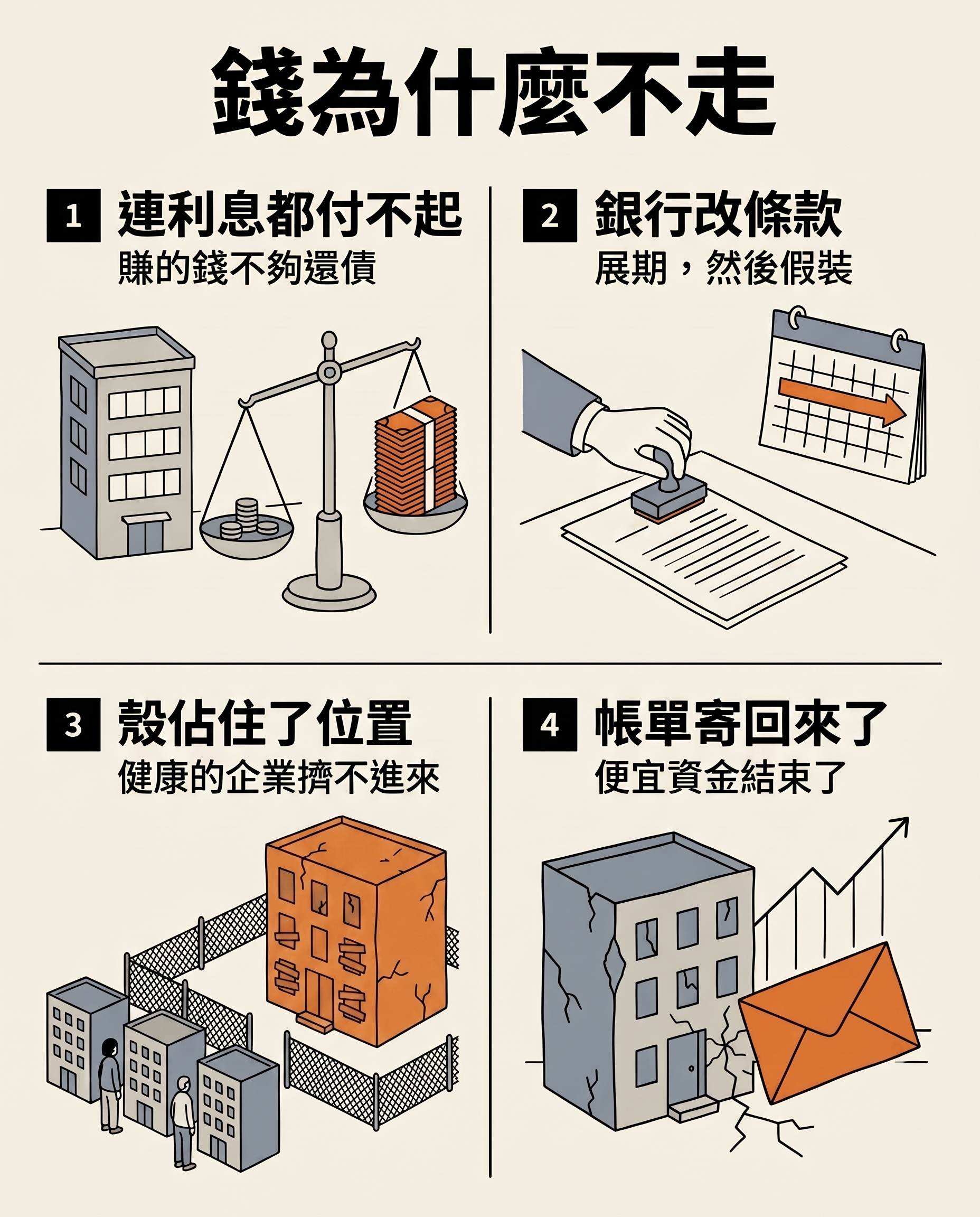
Loss-making enterprises surviving on renewed loans have a common name — zombie firms.
The most widely used definition: an interest coverage ratio below 1 for three consecutive years — meaning operating earnings cannot even cover interest payments, and the company breathes on new borrowing alone.
Why don't banks cut off credit? Because calling in a loan means recognizing losses immediately, while rolling it over requires only tweaking a few covenants and extending the maturity date. This practice has an English name: extend and pretend. Perfectly rational for any individual bank; chronic corrosion for the system as a whole.
Where does the cost fall? OECD systematic research provides the answer: the higher the capital share occupied by zombie firms in an industry, the lower the investment and employment growth of healthy firms. Low-productivity companies squatting on the edge of exit clog the market, slow resource reallocation, and the hardest-hit victims are precisely the most productive firms.
In other words, zombie firms are not merely inefficient themselves — they occupy the capital, market positions, and people that should be flowing to others.
On scale, Dallas Fed research shows that zombie asset share among Chinese non-financial enterprises rose from 5% in 2018 to 16% in 2024. Within that, real estate surged from 6% to 40%, and manufacturing climbed from 4% to 11%. ECB data shows that eurozone zombie firm prevalence before the pandemic remained higher than pre-financial-crisis levels, and that bank lending rates to these firms barely reflected their elevated default risk — even the risk-pricing layer had broken down.
4. Stop Here to Disarm a Trap
Before continuing, one thing must be made clear, or the entire essay can be toppled by a single sentence.
The definition "interest coverage ratio below 1" has interest expense as its denominator. Rate hikes mechanically push a batch of companies onto the zombie list, even if their operations haven't deteriorated by a single day.
So the recent record-high zombie firm counts across nations are partly an arithmetic consequence of interest rate normalization, not new rot. Quoting "all-time high" without this caveat is asking for trouble.
Different institutions also vary widely in definitional strictness. Some look only at interest coverage; others add firm age and market valuation. Counts under a broad definition can be several multiples of those under a strict one. Placing numbers from different sources side by side in the same paragraph makes the argument look impressive but fall apart on contact.
Yet once you think it through, this actually makes the issue more important, not less.
The real change is not that companies suddenly got worse — it is that the era of cheap money ended. Over the past two decades, many companies' survival condition was not "being able to earn money" but "being able to borrow cheap money." When interest rates returned to normal levels, the bill was mailed back — and those companies had never prepared to pay it.
Japan is currently the only major economy genuinely conducting liquidation, and its numbers repay close attention.
After the Bank of Japan ended negative interest rates, the policy rate reached 0.75% by December 2025. That same year, corporate bankruptcies hit 10,300 — the highest since 2013, up 2.9% year-on-year, and the fourth consecutive annual increase.
Meanwhile, as bankruptcies rose, the zombie firm ratio fell — Teikoku Databank figures show that for the fiscal year ending March 2024, Japan's zombie firm ratio dropped to 15.5%, the first decline in seven years.
One rising, one falling — that is what immune function restarting looks like. It is not collapse; it is thirty years of deferred exits finally beginning to happen.
Bloomberg's reporting adds the most critical piece: so far, bankruptcies have not spread to large enterprises, and displaced workers are generally finding new jobs — thanks to Japan's chronic labor shortage.
This single point determines everything.
Most other places are still extending and pretending.
5. Second Half: Why People Won't Leave
-f74bddfb4ea0a73600bee6bb71574c26.jpg)
Now switch to the other factor market.
In theory, human resource allocation should also have an exit mechanism: if there is no future here, you leave for somewhere with a future, and resources reallocate themselves.
In practice, this has nearly ground to a halt in recent years.
The English-speaking world recently coined a term for it: job hugging — staying not out of satisfaction but because the perceived risk of leaving feels too high. Multiple industry workforce surveys point in the same direction: the proportion of workers who self-identify as "hugging their current job" has been rising year over year, with reasons concentrating on economic uncertainty and fear of layoffs. (Most such surveys are published by recruiting platforms themselves; their methodology is less rigorous than official statistics. Read them for trends, not precise figures.)
What truly matters is not the percentages but the mechanism. Three conditions must hold simultaneously for people not to dare leave, and right now all three hold:
First, there are no openings outside. This is directly caused by the first half — healthy firms are squeezed by zombie competitors, dragging down both investment and employment growth, so hiring slows. The company you want to jump to is being starved of capital by the same zombies.
Second, entry-level positions are shrinking. The displacement AI is currently causing is primarily not firing incumbent workers but slowing recruitment for junior roles. For young people, this means the entrance narrows; for incumbent workers, it means that once you leave, re-entry is harder than when you left.
Third, social narratives equate leaving with failure. Staying is called stability; leaving is called restlessness. In cultures where seniority systems and face carry greater weight, this layer is especially thick.
The result is an acutely uncomfortable state: a group of people who don't want to stay, staying put, while the books read "stable headcount."
6. The Most Ironic Link: Who Stays Behind
Here is a phenomenon anyone who has worked in a company will recognize.
The least productive people are usually the last to leave. They cannot trade up in the market, so they place the highest personal value on their current role.
The most capable people leave earliest. They have options; the opportunity cost of leaving is lowest; and they have the fewest reasons to endure.
So when a company begins to rot, it does not bleed evenly — it bleeds selectively. The first to leave are always those you least want to lose. The remaining talent ratio slides down year after year; with each capable person who departs, the burden on those left behind grows heavier, accelerating the next capable person's departure.
This is adverse selection: not the good being chosen, but the good exiting first.
Job hugging makes this uglier still. When the overall labor market freezes, even the most capable face higher exit costs — yet they remain the first to leave, because however few their options, they still have some. The company thus loses two things at once: capable people continue to drain out, while incapable people lose even the possibility of attrition.
Inside the organization, this is usually described as "we can't retain talent." The accurate formulation is: Those who can be retained are precisely those least worth retaining.
7. My Hypothesis: Both Sides Lock Each Other In
-1c1119892d89500167810eeae5da5e61.jpg)
This section is my inference, not an empirical finding. I label it explicitly as a hypothesis because the evidential strength of its two halves is vastly different.
The half with empirical support: Zombie firms crowd out healthy firms. OECD research addresses exactly this — the higher the capital share held by zombies, the lower the investment and employment growth of healthy firms. Capital is locked up, causing vacancies to shrink.
The half without empirical support — which I am adding: The reverse direction. People being afraid to leave, in turn, extends the lifespan of zombie firms.
My reasoning: a chronically unprofitable company needs people to keep showing up, keep delivering, keep giving clients and banks the visual of a functioning operation. If the people inside could freely leave, the shell would collapse from within before banks could roll over another loan. So people not leaving may not merely be a consequence of zombie firms, but one of the conditions for their survival.
If both halves hold, this is a closed loop:
- Capital is locked where it shouldn't be → Healthy firms can neither hire nor expand → No openings exist outside
- No openings exist outside → People dare not leave → The shell retains staff to maintain appearances → Capital stays locked in place
Each side is the precondition for the other's existence.
To test this, one could examine several things (I do not have this data, but it is obtainable):
- In industries with high zombie firm ratios, is the voluntary turnover rate significantly lower than in healthy industries in the same period and location?
- In places where liquidation has begun accelerating (e.g., present-day Japan), does zombie firm survival duration shorten as the labor market tightens?
- Is the elapsed time between "onset of losses" and "actual exit" correlated with local labor market tightness?
If all these point in the opposite direction, then my half of the hypothesis fails and only the OECD half remains — which is fine, because that half alone is already severe enough.
But if it holds, the most pernicious aspect is that from the outside it looks remarkably like stability: unemployment isn't spiking, companies aren't failing en masse, and the numbers look placid.
That is not stability. That is nobody being able to move.
And a system that cannot move accumulates two things: one is losses on the books, the other is wear on human beings. The former can be rolled over; the latter cannot. A person placed in a position they know has no future for five years does not get those five years back.
8. What to Watch For
First, a fair point: Exit carries real costs. Bankruptcy is not merely a balance-sheet event — it means people losing jobs, suppliers eating bad debts, and local governments facing tax revenue gaps. Anyone who argues "let them fail" without simultaneously addressing those costs is merely making pain sound light.
Japan's approach is worth studying precisely because it meets two conditions simultaneously: pushing liquidation on one side, while a severe labor shortage catches the displaced workers on the other. The feasibility of liquidation depends on how many people can be caught. Without the second condition, the first is empty talk.
And Japan's conditions carry a layer of dark humor: the same labor shortage that catches workers released by liquidation is also pushing companies into bankruptcy — in 2025, cases of firms collapsing because they could not find staff reached a record 397. Worker scarcity is both the cure and the cause.
This illustrates precisely that exit mechanisms are not a moral question but a conditions question. The same event is a catastrophe where labor is abundant and metabolism where labor is scarce.
So what truly deserves watching is not "which company will fail," but these:
- The direction of interest rates: Whether cheap money ends or not determines how long the shells can stand
- Bank rollover behavior: Whether non-performing loans are genuinely recognized or merely re-documented
- Hiring composition: The number of entry-level openings reflects a freeze earlier than the headline unemployment rate
- The composition of departures: Who is leaving. If those leaving are all the capable ones, that company's problems are far worse than what the financial statements show
The last item requires no statistical data whatsoever. You can see it in your own company.
9. Conclusion
A line worth placing here: Surplus is not abundance.
And its sister line: Stability is not health.
An economy where no one resigns, no company goes bankrupt, and the numbers sit flat sounds like good news. But if that is because capital is locked and people are locked, what it describes is not health — it is paralysis.
A truly healthy system has things dying constantly, then yielding their place.
And the problem we face now is: What should die hasn't died, what should leave hasn't left, and so what should arrive cannot come.
Notes: What This Essay Owes
Not mine:
- Creative destruction — Schumpeter
- Soft budget constraint, and why loss-making enterprises fail to exit — Kornai János
- Empirical evidence that zombie firms crowd out healthy firm investment and employment — OECD
- Scale of zombie assets in China — Dallas Fed; eurozone portion — ECB
- The term "job hugging" and related surveys — English-language HR media and recruiting platforms (see Section 5 for methodological caveat)
Mine:
- Reading zombie firms and job hugging as a single phenomenon: simultaneous failure of exit mechanisms in two factor markets
- The closed-loop hypothesis where each side is the other's survival condition (Section 7, explicitly labeled as hypothesis) — people not leaving may not merely be a consequence of zombie firms but a condition for their survival; plus three testable observations
- "Those who can be retained are precisely those least worth retaining" — the specific form of adverse selection inside organizations
- The feasibility of liquidation depends on how many displaced workers can be absorbed, therefore Japan's key condition is not policy resolve but labor shortage
This is Part 3 of a trilogy. Part 1, 〈Your Fixed Deposits Subsidized German Car Buyers〉, addresses how cheap goods were engineered; Part 2, 〈Four Places Where No One Captured the Cheapness〉, addresses where that cheapness ultimately flowed; Part 3 addresses why exit mechanisms failed. All three share one sentence: When price signals are suppressed, actors that should exit fail to do so. Series landing page: 《Exit Mechanism Trilogy: The Cost of Cheapness》.