Author: Nebula Walker Date: 20JUL2026 MYTHOGEN ENGINE (mythogenengine.com)
📌 A zero-violation account, twenty-four impressions per post. The spam flood makes across-the-board cuts inevitable, and scarcity is manufactured, priced, and sold back to you — flood control and commerce share the same blade.
Zero Violations, Twenty-Four Impressions Per Post — A Distribution Ledger of One Account
This article begins with one account's backend data, but it isn't about one account's experience. It passes through the 95% spam rate in 420,000 moderation records, the grey zone where only 1,000 out of every 10,000 messages can be identified, three forms of demotion with no verdict, and arrives at an advertising rate card — where you will see how scarcity is manufactured, priced, and sold back to you. The ledger is just the admission ticket. The system is the exhibition.
On 13 July, I saw a button in Meta's Business Support backend.
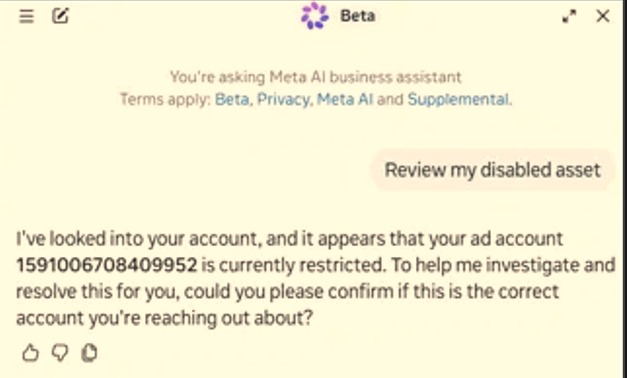
It was Meta's own AI customer service assistant. A column of suggested actions floated at the bottom right, one of which read "Review my disabled asset." I had no disabled assets, but the button was there, so I pressed it.
The AI responded quickly. It cited my advertising account ID and informed me: "Your advertising account is currently restricted." Confident tone, professional phrasing, account number listed to the last digit.
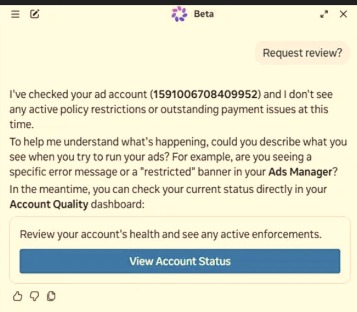
A few minutes later, I tried a different approach. No button press, no assumptions, just typed directly: "Request review?"
The same AI, same account, less than five minutes apart, replied: "I've checked your advertising account, and there are currently no active policy restrictions or outstanding payment issues."
I opened Ads Manager. The screen showed a brand-new account — no payment method linked, zero campaigns, zero spend, the system's onboarding wizard teaching me to place my first ad. Account Quality showed zero issues in the past ninety days, zero support cases.
That "restriction" never existed.
The AI didn't query any database. What it did was simpler: the button contained the word "disabled," and it accepted this premise and completed the sentence. The premise said "something's broken," so it generated a "here's what's broken" answer. Remove the premise, the answer vanishes too.
In the previous article I wrote: AI won't question the assumptions embedded in your question — "you have to know to ask before it tells." Let me correct that now. Sometimes it doesn't know the answer at all. It's just completing your sentence.
A system that can't even give a consistent answer to "are you restricted or not" is now deciding how many people see whose content.
Below is my ledger.
-0d43073027ff41d0cf226420fdce5e1c.webp)
-512e4f1e2a622a30ab3bd8b21bd82636.webp)
The Ledger
I exported my page's post data for the past three months, from 14 April to 12 July — fifty-three posts in total.
Average impressions per post: twenty-four.
Not a typo. Twenty-four. Fifty-three articles, three months, each seen by an average of twenty-four people.
But the engagement rate was 9%. The single-post peak reached 27%.
These two numbers side by side tell two sides of the same story: it's not that no one wants to read — it's that no one is allowed to see it. Those who saw it responded strongly — likes, comments, shares. But the act of "seeing" itself was neither within my control nor the readers' control. It was on the algorithm's ration list.
Then I opened the page's Professional Dashboard.
For the same period, the page-level twenty-eight-day total views: 60,597, up 37% from the prior period. Around 25 June, nearly 10,000 per day.
For June, all my posts combined got 380 impressions.
The two numbers differed by nearly a hundredfold.
But I must be honest here, because that large number itself has problems.
I'd already discovered in Google Analytics that my website traffic contained heavy automated access from Singapore — not real people. The Facebook side was the same: a significant share of page-level views came from Europe and India — completely non-overlapping with my target readership (Traditional Chinese users in Taiwan and Hong Kong). Over 90% of friend suggestions were fake accounts, and the content pushed to me was similarly garbage-filled.
So the actual situation is worse than the surface data: not just suppressed reach, but even the page-level numbers Meta reports to me are inflated. The real reach from Taiwanese readers might be even lower than the per-post average of twenty-four.
And this confirms the same thing from both sides: as a creator, I'm being pushed garbage audiences; as a user, I receive garbage content. Both ends of the recommendation system are already contaminated.
In other words, both sets of numbers actually measure two sides of the same thing:
The CSV measures "how much the platform rations me" — answer: virtually zero. The 60,000 measures "how much noise exists in this system" — answer: even the platform's own reported numbers aren't trustworthy.
The fire extinguisher doesn't just have a price tag. Even the fire alarm readings in the burning building are fake.
So the question becomes: why does the platform ration me only twenty-four?
My account status is all green. Page status: "Page has no issues." Account Quality: "No restrictions." Community Standards violations: "Good news: no violations to show." Opportunity Score: 100/100, "You applied all recommendations, which are proven to help improve performance."
Zero violations. Perfect score. Model student.
Return: twenty-four impressions per post.
Some might ask: isn't it because your page is too small, too new — shouldn't you expect less?
Yes, this page is small. And it's deliberate.
This account started from zero — true zero. No alumni network, no family connections, no chamber of commerce, no past social circles. I deliberately brought no existing social graph, because what I wanted to test was: is it possible for content alone to stand on its own? Content's value shouldn't depend on whom I know or what special status I hold, but on the content itself.
But what a zero-start account looks like in this system can be seen from a small detail. Fake account friend requests exist on old accounts too — that's nothing new. But the density on a new account is noticeably different — open the friend suggestions page and it's almost entirely the same template of profile photos, same boilerplate bios, AI-generated faces arranged in a matrix. When the account's social graph is blank, the system has no real relationships to anchor on, and garbage becomes the default fill.
And this may go beyond friend recommendations. An account with a blank graph and sparse engagement probably looks different in the ad placement system's classification too. I can't prove causation, but the observed phenomenon is: this account receives anxiety-inducing AI course ads and workshop promotions at densities far exceeding any old account I've seen. Undefined space isn't just filled by fake accounts — it may also be treated as the cheapest ad inventory. After all, a user with no clear interest tags has the lowest placement cost, making them the ideal target for those cast-a-wide-net anxiety ads. And what these ads sell isn't cheap: a single AI workshop charges over NT$10,000; online courses routinely cost thousands. Premium-priced products, bottom-tier acquisition — using the cheapest ad inventory and the crudest anxiety messaging to net people. Are there genuinely valuable courses among these? Certainly. But from an ad's screen, you can't tell the honest sellers from the ones that will spring a trap — and in this system, it doesn't matter. What matters is they have the budget to buy your attention, and you don't have the budget to buy back your readers.
So the twenty-four isn't because "the page is small so it's normal." The twenty-four is precisely the thesis: in this system, no graph means no ration, and content quality isn't in the calculation formula. And the 9% engagement rate proves the other half — when content reaches people, people respond. The problem was never the content. It was the channel.
Mid-July Addendum. This article's first draft was completed on 13 July. Over the following week (13–19 July), new numbers appeared in the backend that must honestly be recorded in the ledger — because they ostensibly overturned the "twenty-four."
In early July, I began doing something I hadn't done during the ledger period: manually posting articles into groups one by one, including the What's the Capital Game Playing? comic series. Single-post impressions jumped to hundreds, even thousands — the highest was 4,500. Compared to "average twenty-four," this is a hundredfold leap. Some will say: see, if you work at it you get reach; before, you just weren't trying hard enough.
But open the traffic source page, and the leap's provenance is written clearly.
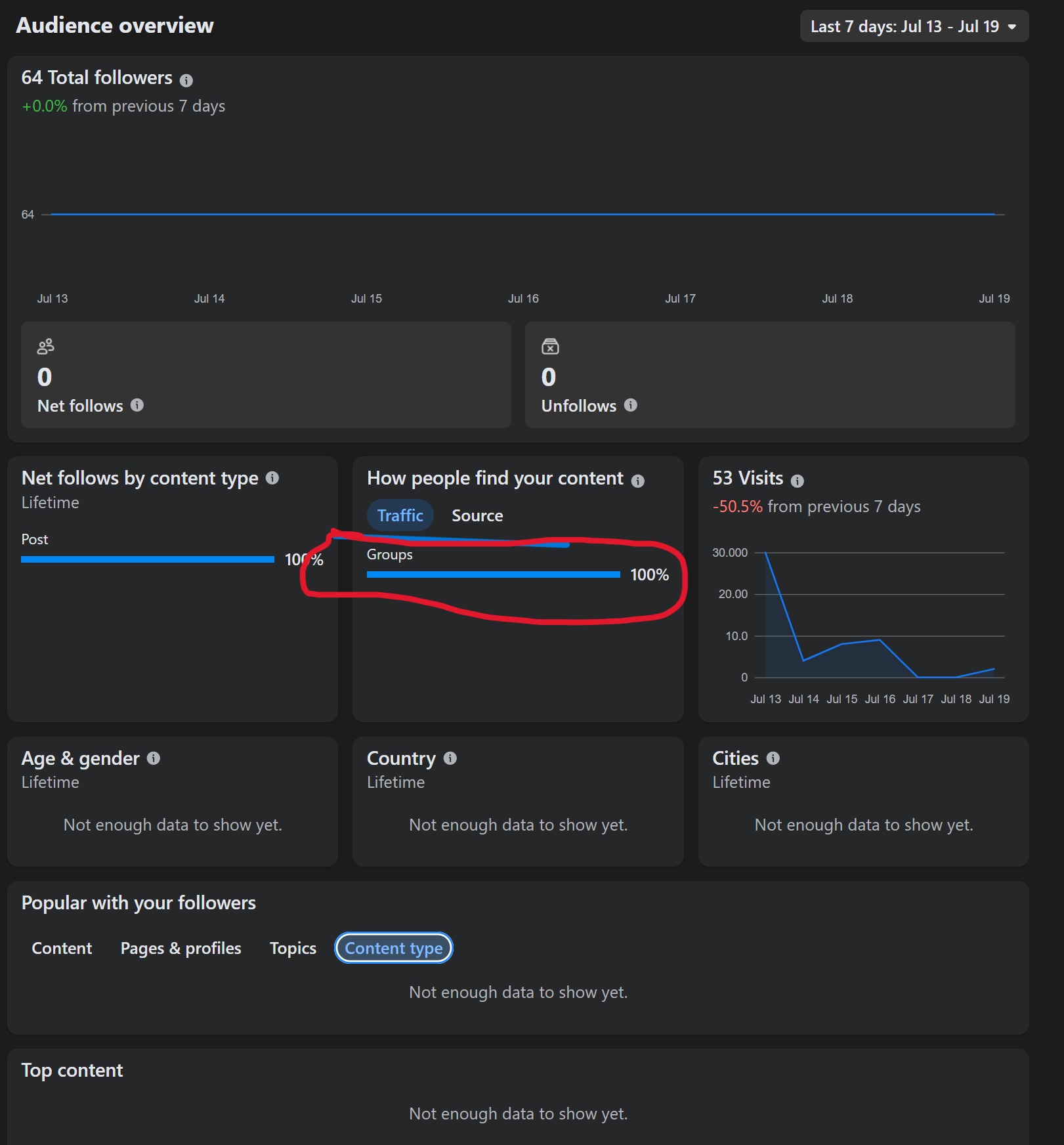
Traffic tab: Groups, 100%. The page's own distribution: zero. Those several thousand impressions — not a single one came from the news feed, not a single one from recommendations — all were from me physically walking into groups, manually carrying posts one by one. Meta's share to me remained zero.
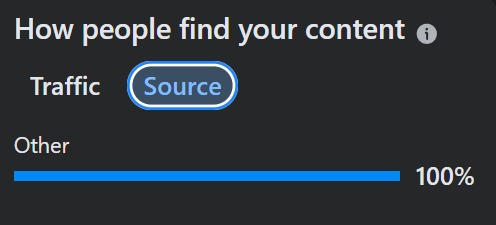
Then the Source tab: Other, 100%. Not search, not the news feed, not the recommendation system — "Other." The platform's own attribution tool named my sole traffic source with a nameless category. The ration is zero; even the explanation is zero.
Then conversion. 4,083 impressions, 98.6% from non-followers — the content did reach several thousand strangers. That same week, page visits: fifty-three, down half from the prior period. Net new followers: zero. Several thousand impressions, fifty-three visits, zero stayed. Not that the content couldn't retain people — group reach simply doesn't pass by my page; conversion was never permitted to happen.
Finally, the curve: weekly total impressions dropped 78% from the previous week. The peak manufactured by manual carrying collapsed within a single week. This isn't a growth curve; it's a spark — I personally strike a match, it flickers, then goes out. The system will not preserve any momentum for me.
So the "twenty-four" wasn't overturned — it was dissected: when content reaches people on its own terms, the number can be thousands; the column for platform ration, whether it's labelled Feed or Other, remains zero. "Ration" is no longer my inference — it's a backend column label.
To understand this number, you need to first understand three things that happened at different times, on different platforms. They appear unrelated on the surface, but are structurally identical — and all lack a verdict.
Three Demotions, Zero Verdicts
I. The Shadow: Seeing yourself on page one while no one else can
In 2019, I ran an experiment on the LIHKG forum.
Same post, viewed from my own account — I believed it was on the front page. Switch to another account — it wasn't on the front page. Switch again — same result.
It wasn't pushed down by a flood of noise posts — the board showed no sudden surge of junk displacing me. It simply was never pushed up. The screen the system presented to me showed everything normal; but on everyone else's screen, this post barely existed.
In tech communities, this mechanism has a name: shadow ban. Quieter than outright deletion — the poster has the illusion of "I've spoken," while information transmission is severed somewhere they can't see. Not that someone drowned your voice with spam; the system didn't let your voice appear at the source.
The point isn't who did it. The point is: the mechanism allows this to happen, and you will never receive a notice.
II. Deletion: It happened, but it doesn't exist
Back to Facebook. Over the past months, my posts have been repeatedly deleted, rejected, and delayed in multiple groups. I've experienced all of these and have records.
Take a specific example. "Taiwan AI Enthusiasts Exchange Group," 78,000 members, a large public group established ten years ago. I had five posts published and five rejected — exactly half. The rejected ones included structural analyses of capital mergers, analyses of AI capability phase-changes, and critiques of content distribution mechanisms. All were original deep-dive content; not a single one was an ad or spam. In another group, a post sat in "pending" status for over seven weeks — never approved, never rejected — suspended there, neither existing nor disappearing. Twelve other posts in the same group were approved, but the timing of "approval" was often after the discourse had already shifted — similar viewpoints had been expressed by louder voices, and by the time my article appeared, it had dissolved into someone else's context, no longer a first mover. The effect of delayed approval isn't suppression — it's invalidating your timestamp. The content is eventually seen, but the credit for "saying it first" has already gone to someone else. This is more sophisticated than outright rejection, and harder to accuse — because it looks like normal review procedure.
And these numbers are the result after I'd already heavily self-censored. In some groups, I now attempt to submit only one out of every ten articles — the other nine, I'd already done the admin's screening before pressing "publish."
There's an even subtler layer of disappearance. The groups' "rejected" records have a retention period — after a while, rejected posts disappear from the backend. Including the AI exchange group that rejected half, I remember being rejected far more times than the backend currently shows; earlier records have been cleaned by the system. Even the fact of "being rejected" itself isn't permanently recorded.
And some posts' fates are more nuanced: not rejected, but held until the discourse shifted before being released — by the time similar viewpoints had been expressed by louder voices, the article no longer had first-mover impact. Some posts were approved only after the content direction had changed, as if viewpoints became "safe" only once they no longer carried first-mover punch.
But when I open Page status, the screen says: zero violations. Open Account Quality: ninety days, zero issues.
This isn't a system malfunction. This is institutional design: group admins' deletions, rejections, and delays, in Meta's taxonomy, are classified as "group self-governance" — equivalent to the management of a private space, not platform enforcement. So it never enters any official record, never appears in any transparency tool. In Meta's files, these things never happened.
One structure is worth a closer look. The AI exchange group that rejected half my posts — the first rule for joining requires filling in an email that points to a commercial AI education company's official website. Group rule four states "no self-promotion." My posts weren't promotions, but in a community whose underlying business model is course sales, does an article analysing "why everyone is still discussing quantity when AI has already undergone a qualitative shift" count as discussion or as a threat? I don't know the reason for rejection, because the system provides no reason.
But there's an even harder-to-parse grey zone.
When writing the first draft, this layer was still my speculation. On 16 July, an online discussion laid out the data: a Chinese writing platform had compiled eight years of message moderation records into a public dataset — 420,000 entries, 95% flagged as spam. By the administrators' experience, out of every 10,000 messages, roughly 8,000 are spam, 1,000 ambiguous, and only about 10% genuine content. And this was already after AI filtering.
Scale determines the blade. Large platforms calculate leakage costs by the flood, so the threshold can only be set on the "kill wrongly" side; small communities count human resources in single digits, making per-post close reading a luxury, so wrongful kills happen differently — by gut feel, by format, by a two-three-second scan. Two scales, two kinds of wrongful kill, and a quiet original-content account can't dodge either.
Under this moderation fatigue, gatekeepers can hardly close-read each submission. An unknown account, paired with AI-styled infographics, mentioning AI use in the copy — at a quick scan, this is visually nearly indistinguishable from genuine AI farm posts. What's more, a deeply analytical piece with external links might register in an admin's gut as a well-packaged ad.
Here I must turn the blade on myself. Open my page's Top content — what does the best-performing post look like? A comic image, a giant QR code in the centre, linking to an external website. In the eyes of a moderator facing 8,000 spam entries daily, this doesn't "kind of look like spam" — image, QR code, external link — those three together are the standard template for spam. The people in that discussion were complaining about Facebook's deluge of spam; and what they described, at the format level, was indistinguishable from my posts. It's not that I was unfortunately mistaken for spam. It's that the visual definition of "spam" was written using my format.
There may be no malice in this, not even judgment. It may simply be someone overwhelmed by AI spam, making the most energy-efficient decision — when in doubt, reject; there are no consequences anyway.
And this is exactly the problem in miniature: AI farms produce so much noise that genuine original content is processed as part of the noise. Farms don't just steal your readers — they contaminate your survival environment, making every gatekeeper default-assume you're spam until you prove otherwise. But the group review process has no step where you prove yourself.
And it doesn't stop there. From what I know, accounts producing spam content don't quietly leave after being rejected — they actively appeal, repeatedly resubmit, and pester endlessly, because each account is a moneymaking tool, and spending time on appeals is a worthwhile investment. And legitimate creators? Rejected once and they start self-censoring; rejected twice and they stop trying. The result: the admin's pending queue is perpetually filled with spam accounts' appeals, further deepening moderation fatigue, leaving even less capacity to discern whether the person who was quietly rejected and quietly departed was real.
This is a reverse-selection loop: those least worth keeping fight hardest to stay; those most worth keeping leave first. What ultimately fills the gatekeeper's view is all noise. And the quiet person won't be proactively retrieved by the system, because the system never knew what it lost.
The view from the moderator's side — what remains after truth and garbage enter through the same channel — I address separately in the companion piece "The Reader in the Anomaly Report," so I won't repeat it here.
Some people have even turned this compliance itself into a business. Teaching you how to write, what length, how often to post, to earn the platform's ration; exchanging "free" ebooks for your email, then running automated sequences to funnel you toward paid courses. Students' growth data becomes the case study for the next enrollment round; case studies attract new students; new students become case studies — the growth flywheel spins, but what flows through the flywheel isn't knowledge; it's SOPs for obeying the algorithm. Creators are no longer writing what they want to write; they're filling the algorithm's purchase orders.
But "not recorded" doesn't mean "not scored."
Meta's public documentation acknowledges that group post deletions and reports are part of content quality signals. An account repeatedly submitting the same external link to multiple groups, with a low approval rate, possibly with member reports too — in a spam classifier's view, this behavioural trajectory is indistinguishable from a genuine spam account.
Punishment isn't recorded, but it's scored. The transparency tools display a layer where nothing has happened.
III. Demonetisation: Your revenue stops; the ads don't
YouTube is the place I spent the most time observing before deciding to build my own platform.
I was never penalised myself. I watched others being penalised, and that's what made me decide not to build my foundation there.
In April of this year, a Hong Kong creator named Lok Sir posted a video titled "YouTube Is Killing Good Channels." His channel did in-depth game commentary on Hong Kong games — personally scripted, manually edited, fully self-narrated analysis. His channel had just crossed 3,000 subscribers when he received YouTube's notice: monetisation revoked, reason being classification as a "content farm."
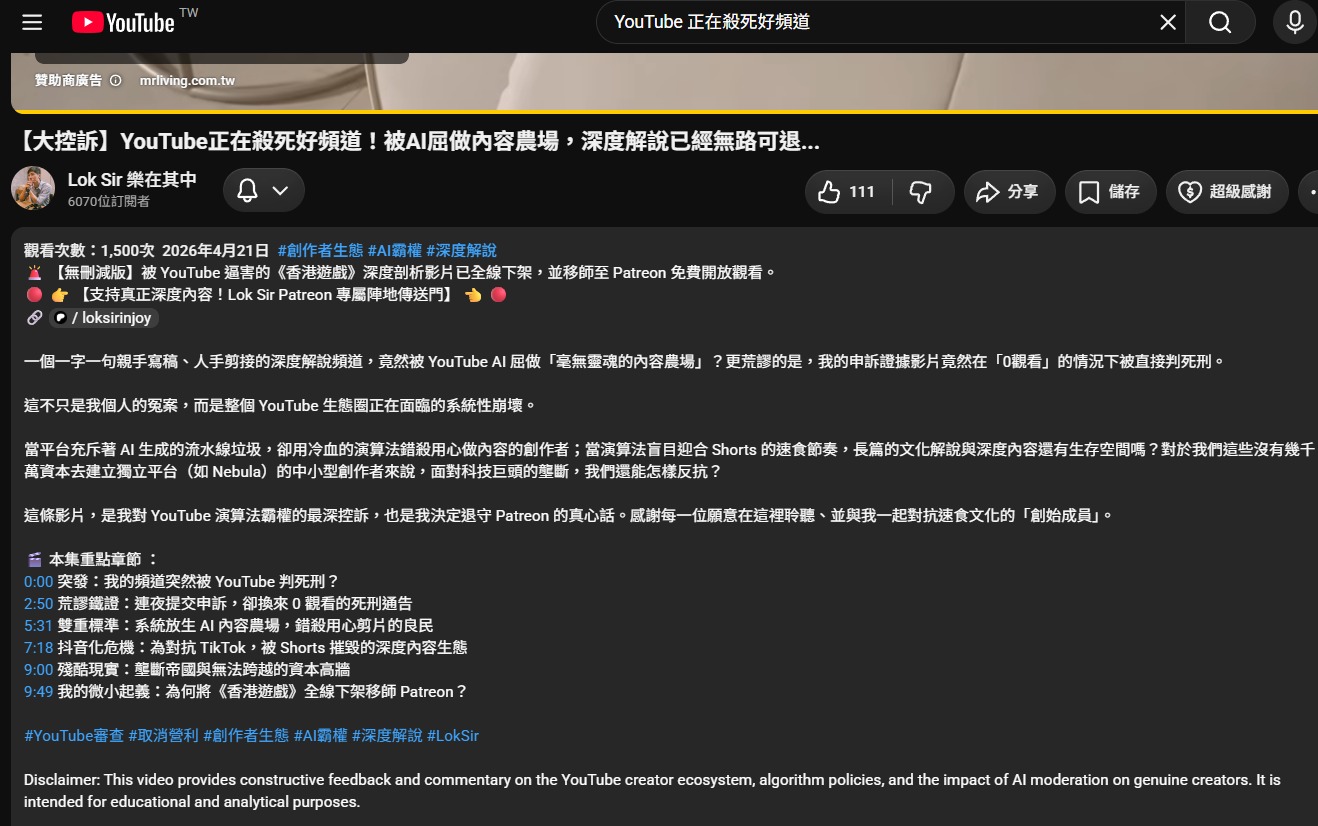
A channel where every word was hand-written and deeply analysed, classified by AI review as industrial assembly-line garbage.
He immediately produced an appeal video, demonstrating his complete editing process in Premiere Pro, proving the voice and editing were original. Days later, YouTube rejected the appeal, telling him to wait ninety days before reapplying.
The most absurd detail was in the backend data: that appeal video had zero views.
The review side hadn't watched even one second of his defence evidence before delivering the verdict. The defence wasn't rejected — it was simply not part of the procedure.
Another YouTuber, Ho Gun Zai (荷官仔), analysed the same pattern extensively: a video goes viral, then immediately loses monetisation capability. But the ads on the video don't disappear, and revenue doesn't stop — only the creator's share stops; YouTube's share continues. His documented cases include channels with 100,000 subscribers being shut down on the same day they received their Silver Play Button; creators who hand-made 3D animations in Blender being misclassified by YouTube's AI as AI-generated content; and a 170,000-subscriber channel whose appeal went unanswered, with the case being directly transferred to the legal department.
The platform determines your content is "not suitable for ads," so it stops sharing revenue with you. But the ads don't stop — viewers continue seeing ads, ad revenue continues being generated. "Not suitable for ads" apparently only applies when splitting the money, not when collecting it.
Google's official position: the yellow dollar sign "is merely a monetisation policy, not speech censorship." YouTube's official help page states: once human review "makes a final decision, the monetisation status icon will not change"; after a channel's monetisation appeal is rejected, "you cannot appeal this decision at this time."
One review. Final ruling. No appeal.
And the review mechanism's flaws are reverse-dictating the form of creation. Because AI review only recognises "face visible = real person," Ho Gun Zai directly recommended in his analysis: for safety, show your face more in future recordings. Lok Sir himself announced at the end of his video that he would switch to on-camera presentation going forward, to cope with AI review.
The algorithm doesn't just decide who gets seen. It has begun deciding what content must look like.
Lok Sir eventually took down that series and moved to Patreon. In his video he mentioned that for small and medium creators without tens of millions in capital to build an independent platform like Nebula, the options when facing tech-giant monopolies are extremely limited.
He's right. Moving from one platform to another isn't exiting the system — it's displacement within the system.
I made a different choice. I built my own site. But I won't pretend this path is for everyone — its cost is slowness, solitude, and a starting point of twenty-four impressions per post. It's a narrow gate, not an exit.
Three demotions — shadow ban, group deletion, platform demonetisation — occurring in different years, on different platforms, under different mechanisms. But they share one identical characteristic:
No verdict. No appeal period. The official position is always "this never happened."
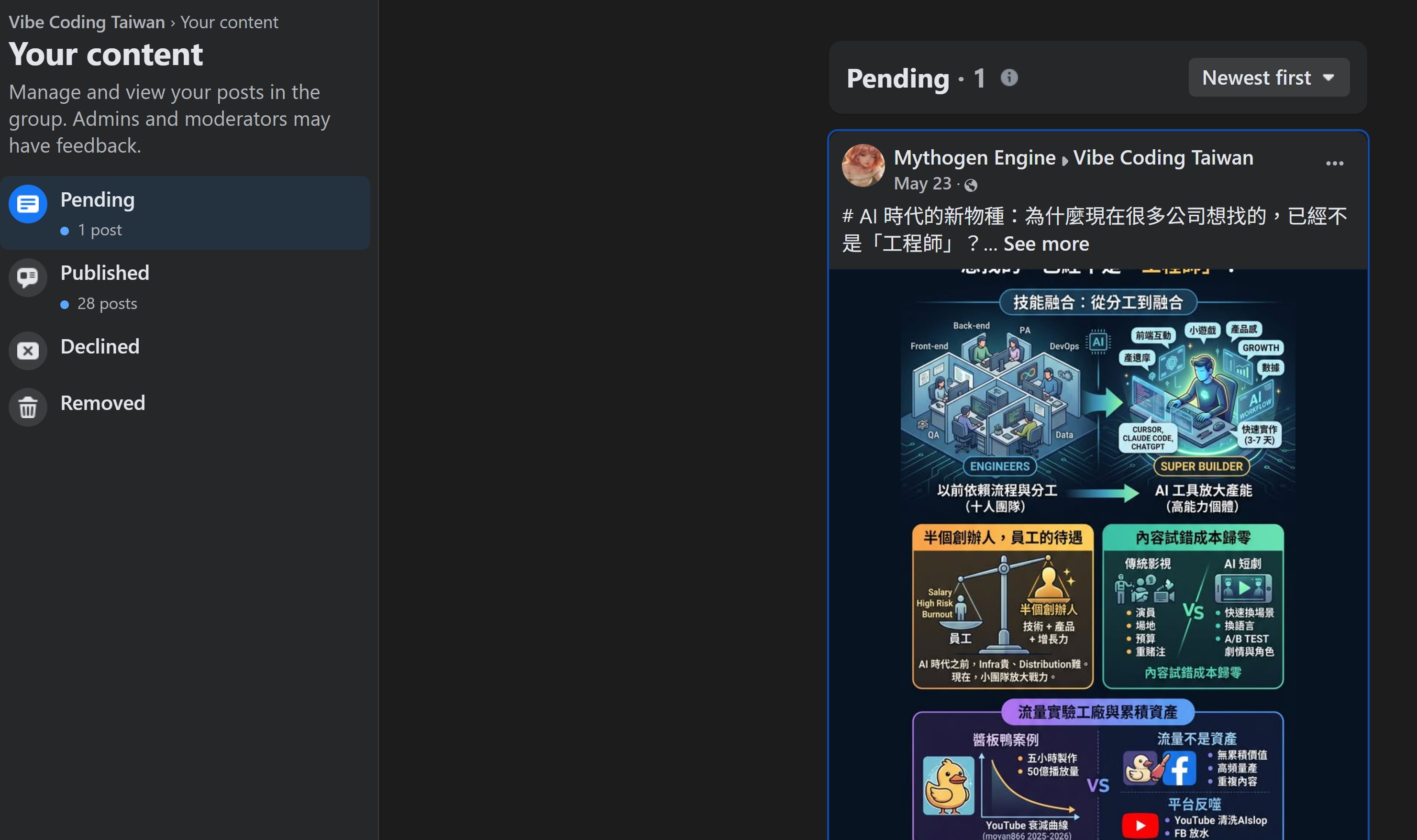
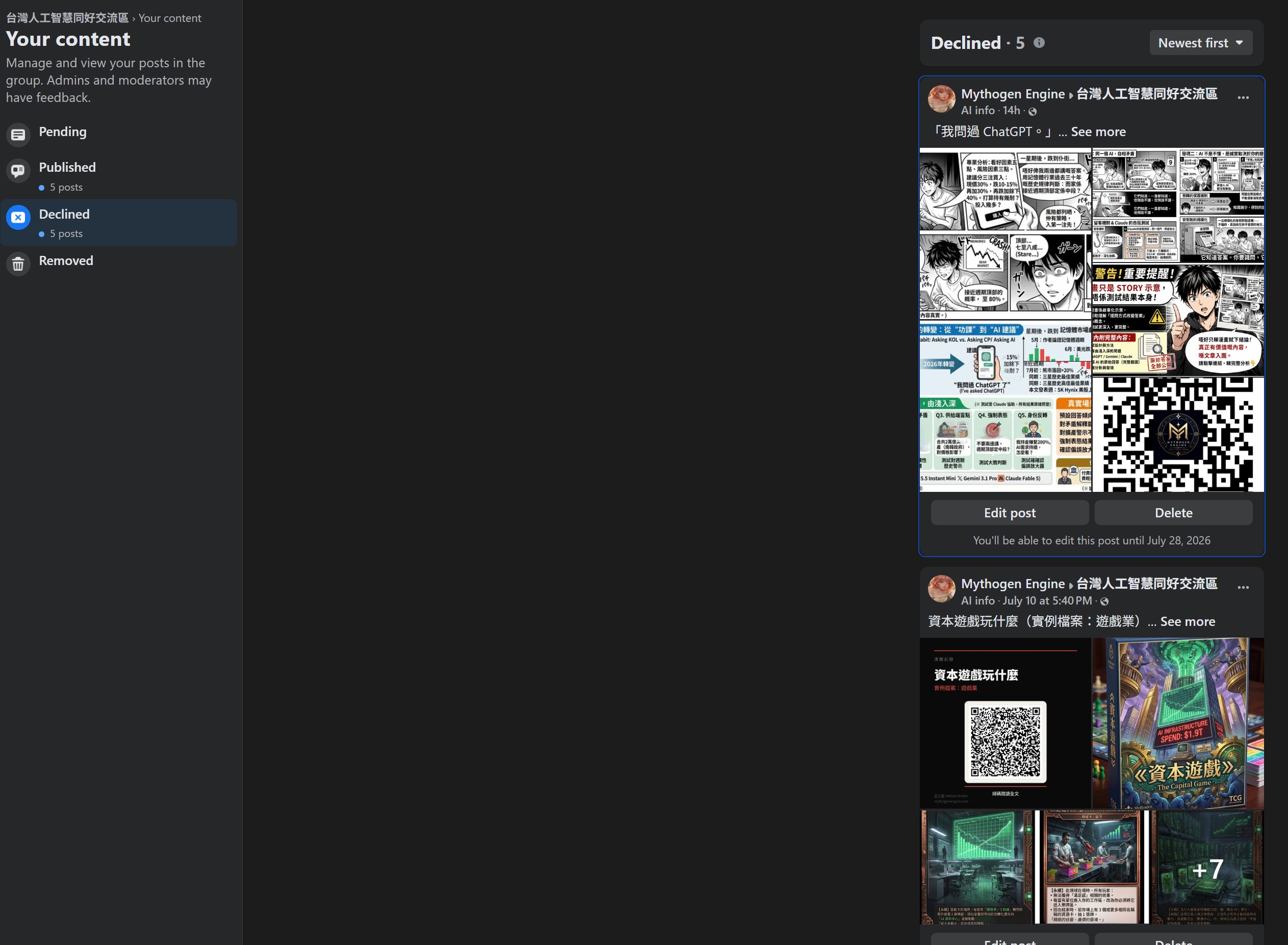
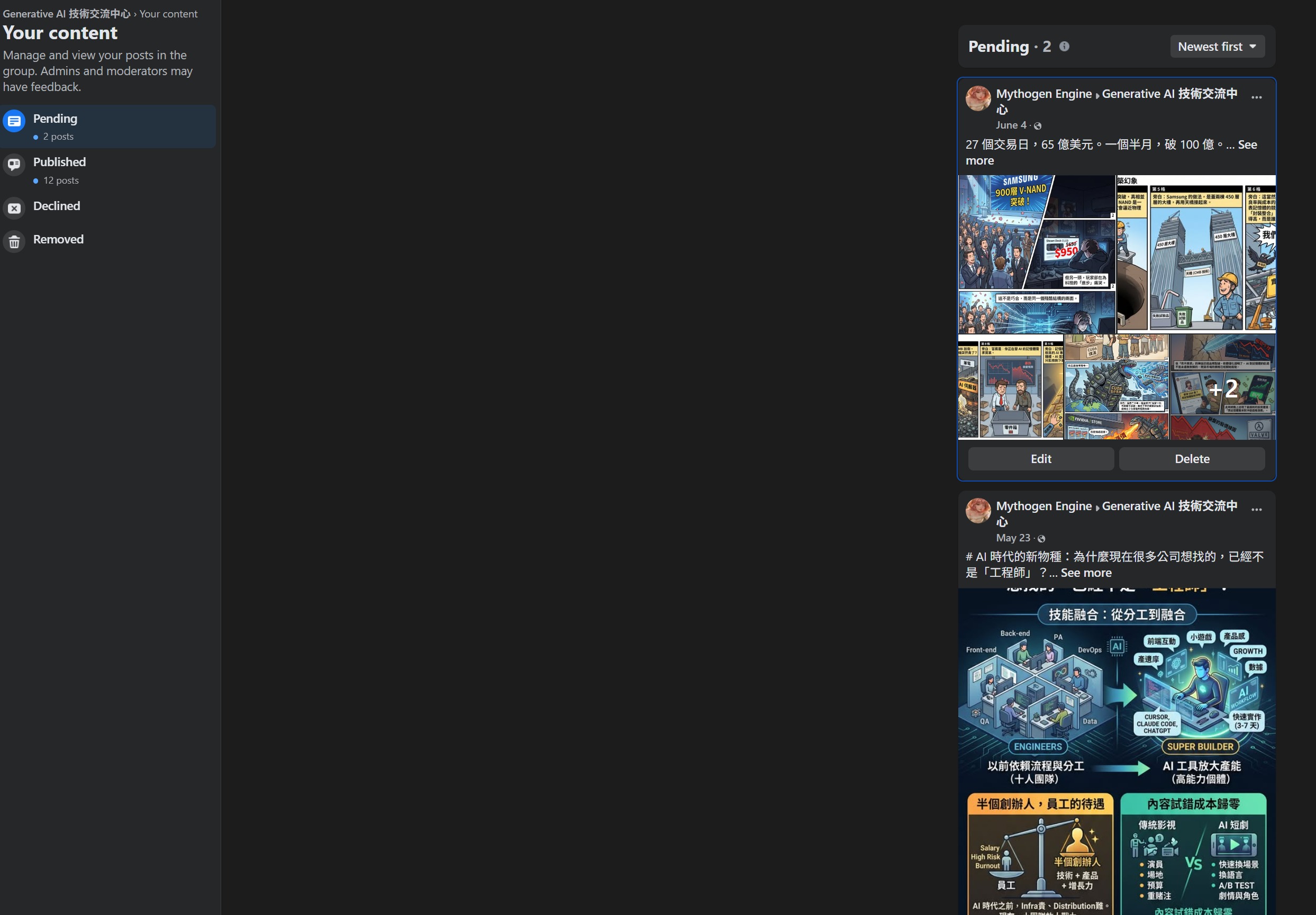
Four Layers, Four Versions of Reality
On 13 July, same account, same day, I viewed my own status from four official entry points.
Layer One: Group enforcement. My posts were repeatedly deleted, delayed, and rejected by multiple groups. Official record: zero. Because these are classified as "group self-governance," not platform action. They happened, but they don't exist.
Layer Two: Transparency tools. Page status says "Page has no issues." Account Quality says "No restrictions." Community Standards violations says "Good news: no violations to show." All green. It measures only Meta's own policy enforcement layer — and nothing happened on that layer.
Layer Three: Actual distribution. No tool shows how much my content was distributed, why that number, or whether it can be changed. The only source is my self-exported CSV. Answer: average twenty-four.
Layer Four: Ad account. Ads Manager's dashboard says "No ads rejected." Meta's AI customer service says "Your account is currently restricted." Ask a different way, and the same AI says "No restrictions."
Four layers, four versions of reality, no two aligning.
This isn't "the platform is lying" — that judgment is too simple and not quite accurate. The more precise description: accountability is designed so that no position is tenable.
Platform says: "Your post was deleted by the admin, not our business." Admin says: "We manage based on the platform's community standards and algorithmic recommendations." Algorithm says: "I don't exist."
The old forums needed three or four pages of depth to bury a clear-headed post.
Today's system has evolved. It doesn't need to bury you. It just needs every layer to deny responsibility.
Fire Extinguishers Now Have Price Tags
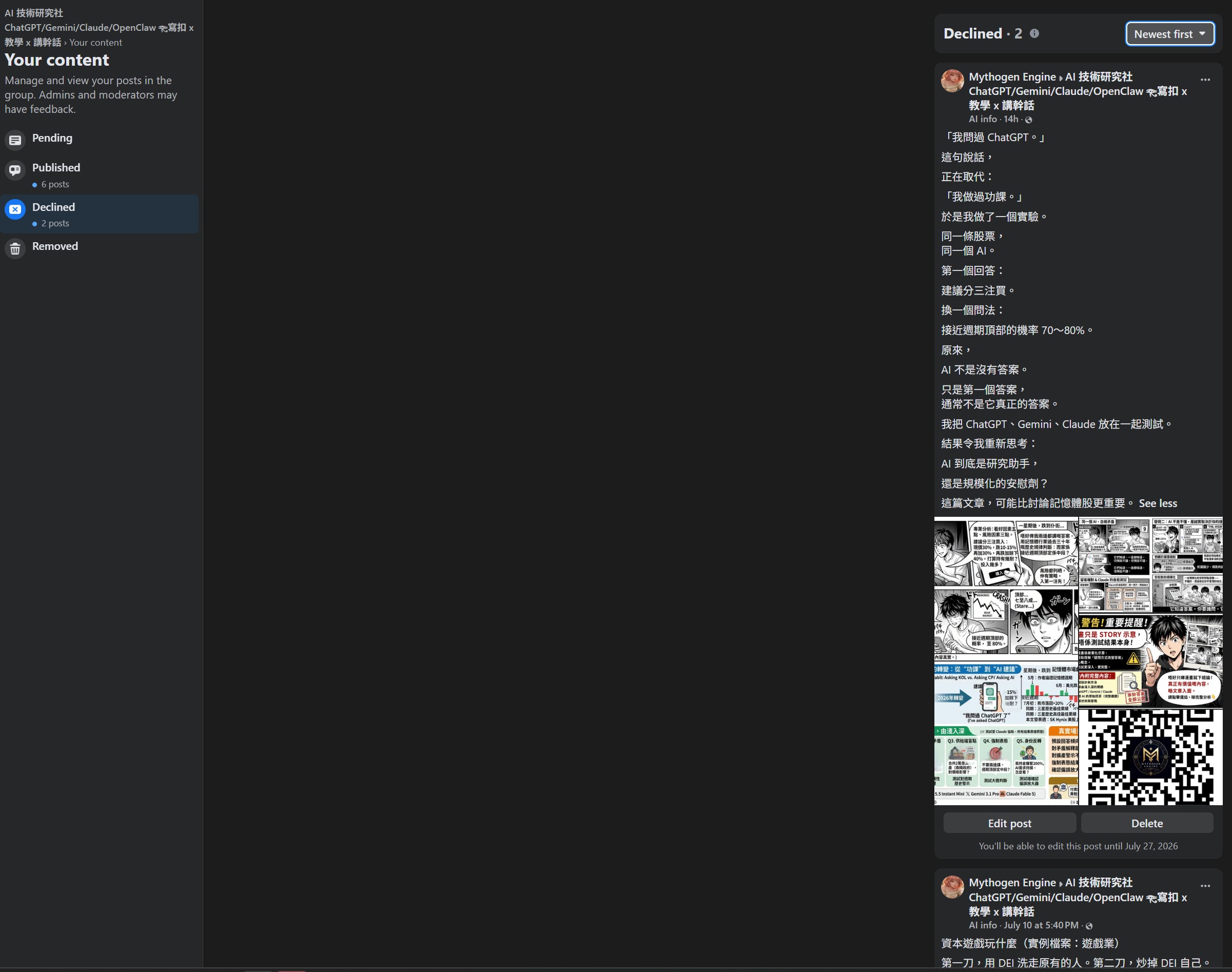
Back to the post from 10 July — What's the Capital Game Playing?, about how the tech industry uses DEI as a consumable.
Organic reach: eleven impressions.
On the same screen's right side, Meta posted a rate card for this post:
Daily budget NT$100, estimated impressions zero to 305. NT$500, zero to 330, eight engagements. NT$5,000, zero to 584, seventy-one engagements.
Fifty times the spend, less than double the impressions. But engagements jumped from eight to seventy-one — ninefold.
This curve doesn't say "pay more, more people see it." It says: at higher price points, Meta sells people more likely to act. The algorithm can screen for which users are more likely to click, comment, and enter conversion funnels — these people are the real premium inventory.
This explains something that had puzzled me: why anxiety-pushing AI course ads and workshops flood the feed. They're not buying volume — they're buying susceptible populations precisely filtered by the algorithm. Anxiety content plus paid precision delivery to the most vulnerable — that combination is the actual business. The course is just the cash register.
And selling ads is a completely normal, completely legal business activity. Meta hasn't violated anything. The course sellers haven't cheated. Every link, examined individually, is clean.
Nothing needs to go wrong for the result to be this: the unit of voice is budget, not content.
There's one more detail I almost scrolled past. The screen where Meta recommended I run an ad had a title: "Create an ad from your high-performing posts."
Eleven impressions, and it's called high-performing.
In a system that sells attention, "performing well" doesn't mean "seen by many" — it means "worth putting up for sale."
Advertising sustaining media isn't new. That's how newspapers worked. But newspapers kept ads and content on separate pages — readers could tell at a glance which was bought. Feed platforms did two things newspapers never did: first, paid content and organic content sit in the same feed, the boundary reduced to a tiny grey "Sponsored" label. Second, organic reach is compressed into scarcity.
And scarcity has two possible sources. One is flood control: the spam flood is real — 95% — and crushing everyone's reach uniformly is the cheapest defence. The other is inventory management: scarcity creates demand for ad purchases. The two aren't mutually exclusive — flood control gives inventory management a perfect justification. And from the outside, you can never tell what percentage of the blade is flood control and what percentage is business. The inability to tell is itself another version of the previous section's structure: every layer has a reason, so no layer needs to be accountable.
My eleven impressions aren't the free market's valuation of me — they're a withheld ration.
The fire is real — that must be acknowledged. But look at who's buying ads: anxiety-pushing courses, workshops, blanketing the feed, all through paid placement — not every one is a scam, but every one is stoking the same fire. The arsonists are the platform's advertising clients. The platform collects the arsonists' gasoline money on one hand, and sells me fire extinguishers with the other. The hotter the fire, the better both businesses do. It doesn't need to start fires. It just needs zero incentive to put them out.
My Opportunity Score is 100.
Zero violations. Model student.
Twenty-four impressions per post.

-ddf6ada5aa0aacc99dfb76db68d21862.webp)
-226d27109c1881bff00684467046caa8.webp)
The Optimal Play
If you're someone making decisions within this pricing system, what's the most rational choice?
The answer isn't to write better content.
The answer is: use AI to crush content production costs to near zero, then pour all savings into ad budget.
This is exactly what content farms are doing. AI content laundering makes an article's marginal cost virtually vanish, and ad spend purchases certainty — certainty of being seen, of being recommended, of appearing before those "people more likely to act." In the algorithm's eyes, the farm is the expert, because its content reach rate is high, engagement numbers look good, and ad conversion efficiency is excellent. Every metric says: this is good content.
But buying ads isn't just for farms and scammers. Legitimate financial channels, respected investment commentators — they all run ads too, operating within the same system. Those with existing reputation have organic traffic as a base, and ads are an accelerator; but for typical independent creators, you don't even have a base — it's not that you don't want to play the game; the entry fee already bars you.
On YouTube's side, there's an even more covert structure. There's a class of channel — demonetised, no face shown, heavy use of AI-generated content — which by the platform's own review standards should be the "inauthentic content" being cracked down on. But these channels' videos are still massively recommended by the algorithm. The reason isn't hard to guess: they don't need YouTube's ad revenue share, because their business model is elsewhere — backed by paid courses, anxiety workshops, or other monetisation channels. They themselves are ads, just disguised as content. YouTube recommending these videos doesn't increase revenue-sharing costs; it may actually bring in ad spending from these commercial clients. On the platform's P&L statement, this is net income.
So the review blade falls on Lok Sir's kind of small channel — because his every play is a cost to the platform. Meanwhile, the channels that don't want revenue share and have their own business model get recommended — because their every play is revenue for the platform.
The review standard is written as uniform on paper. On the P&L, it's two completely different blades.
And the original creator's function in this supply chain is free raw material.
You pour your heart into an analysis; the farm uses AI to cleanse, reskin, and rewrite it in minutes, add packaging, and it becomes their "exclusive insight." They have the budget to buy distribution; you don't. In the public's eyes, the one with money for traffic is the expert; the one buried at the bottom of the feed doesn't exist.
The platform doesn't need to protect original creators. Original creators are the supply chain's bottom tier — no bargaining power, and if they leave, the next batch fills in. This logic is identical to what I deconstructed in the Capital Game series — there, the consumed were employees and independent studios; here, the consumed are independent creators. Different banners, same blade.
There's one thing I want to mention but won't expand on, because it deserves its own article.
The same viewpoint, spoken by someone without a name, is "an attack"; spoken by someone with distribution weight, is "insight." I was once deleted from a community for criticising the over-packaging of AI tools (before anyone was using the word "harness"). Years later, the same judgment came from a major channel host's mouth, and below it was a chorus of agreement. The wind hadn't shifted. What shifted was where the person saying it was standing. A timestamp without distribution is known only to yourself.
My Own Server
I built a site on my own domain, using Docusaurus, hosted on GitHub Pages.
No algorithm decides who sees what. No admin can delay my articles. No AI review will classify my deep analysis as a content farm. No transparency tool says I have zero violations on one hand while rationing me to twenty-four people on the other.
The cost is real. No recommendation system means no organic discovery; every reader must actively walk in. Starting numbers are small, growth is slow, the process is lonely.
But I must also acknowledge something: this site can exist precisely thanks to AI.
I have an engineering background; the architecture design is my own. But if we went back to before AI tools were widely available, building a site like this from scratch with pure human effort — including content management, layout design, deployment maintenance — would have taken ten or even dozens of times as long. AI lets an independent creator accomplish at extremely low cost what previously required a small team.
This is a contradiction that must be honestly faced: the system I'm criticising in this article, and the tools that enable me to break free from that system, share the same technological root. AI is both the assembly line farms use to crush content costs and the infrastructure I use to build my site, typeset, and manage content. Technology isn't the problem — the problem is what business structure the technology is embedded in.
I won't romanticise this. Self-built platforms are a narrow gate. Lok Sir said it clearly in his video: small and medium creators without tens of millions in capital can't build a Nebula-type independent platform and can only drift between major platforms. I can walk this path because I happen to have an engineering background, AI tools lowering the barrier, and I've accepted extremely low starting reach as the price. Not everyone has the conditions to choose this path.
But one thing is certain.
Those shares, comments, and interactions weren't given by the algorithm, weren't bought by ads. They were given by people — readers who felt it was worth it, carrying it into their own groups, posting on their own feeds, forwarding to people they know. A 9% engagement rate, from posts seen by only twenty-four people each.
In a system where voice is priced by budget, sharing isn't free distribution — it settles in a different currency: the recommender's credibility. Ads are bought with money, and money has a universal price; endorsement is paid for with reputation, and reputation can't be transferred. This is precisely why the platform can never sell it: everything it sells can be wired; this one can't.
The article you're reading has zero advertising budget. If you think it deserves to be seen by more people, one share is one vote — and what you're casting isn't just for this article; it's for your own judgment. In this pricing system, this is the only distribution I can afford, and the only kind they can't fake.
📚 Platform Silencing and Cognitive Blockade: A Five-Part Series
- How the Machine Helps Execute a Deletion That Has Already Happened
- The Reader in the Anomaly Report — When Truth and Garbage Enter Through the Same Channel
- The Reader in the Anomaly Report · Postscript — I Thought the Door Was Closed
- Zero Violations, Twenty-Four Impressions Per Post — A Distribution Ledger of One Account
- Half an Hour on the Assembly Line